


Can a psychic drawing really reveal my soulmate's appearance?
A psychic drawing may provide an intuitive impression of a soulmate’s appearance, such as notable features, colouring or personal style, but it cannot reliably establish an exact likeness or guarantee who you will meet. Treat the sketch as a symbolic aid for reflection rather than verifiable evidence about a future partner.
A psychic drawing is best understood as an interpretive visualisation produced from a reader’s impressions, rather than as a forensic-style portrait. It may translate perceived qualities into facial structure, hair, clothing, age range or overall presence, but its value lies in the themes it prompts you to consider, not in matching a particular person line by line.
The process can vary between practitioners. A reader may work from your question, intuitive impressions, clairvoyant imagery, symbolic associations or information that arises during a broader love reading. Some may describe features first and then create an image; others may sketch while discussing the impressions they receive. The resulting picture reflects both the reader’s method and the limits of converting non-visual impressions into a physical drawing.
Appearance is also more complex than a list of measurable features. A reading might focus on a distinctive manner, clothing preference, expression, posture or the way someone presents themselves socially. These details can feel meaningful because they describe recognition cues, but they are not necessarily fixed identifiers. Hair, clothing, weight and personal style can change, while an impression such as a calm presence or expressive eyes remains open to interpretation.
Timing creates another difficulty. A drawing may be interpreted in relation to a future relationship, a person you have not yet recognised or someone already in your wider social circle. Without a clear, independently verifiable way to date or test the image, it is difficult to determine which person it refers to. A resemblance discovered later may be interesting, but it does not by itself prove that the drawing predicted that individual.
If you commission or discuss a drawing, ask the practitioner to distinguish between:
- features they regard as relatively clear;
- details that are symbolic or uncertain;
- information based on your own descriptions; and
- interpretations added after the sketch has been completed.
This separation helps prevent confirmation bias, where a person notices matching details while overlooking differences. It is also useful to record the original description and drawing before meeting anyone who seems to fit it. Reviewing the material later can give you a more balanced view than adapting the interpretation after the event.
A responsible reading should not encourage you to identify a stranger solely by appearance, overlook behaviour or disregard consent. Physical resemblance cannot establish character, compatibility or the quality of a relationship. If a drawing appears to match someone, assess the connection through ordinary evidence, including how they communicate, whether they respect boundaries and whether your values are compatible.
For that reason, a psychic drawing is generally more useful as one element within a wider soulmate reading than as a standalone identification tool. Tarot, astrology, clairvoyance or mediumship may explore different questions, such as relationship patterns, personal expectations or the emotional qualities you associate with a partner. None should replace your judgement when deciding whether a relationship is healthy or suitable.
When considering a phone or email psychic reading about a soulmate, provide a focused question and avoid supplying unnecessary assumptions about the person you hope to meet. Ask how the reader treats uncertainty, whether revisions are offered as interpretation rather than fact, and how the image should be understood. This approach allows the drawing to support self-reflection without turning an impression into a fixed prediction.
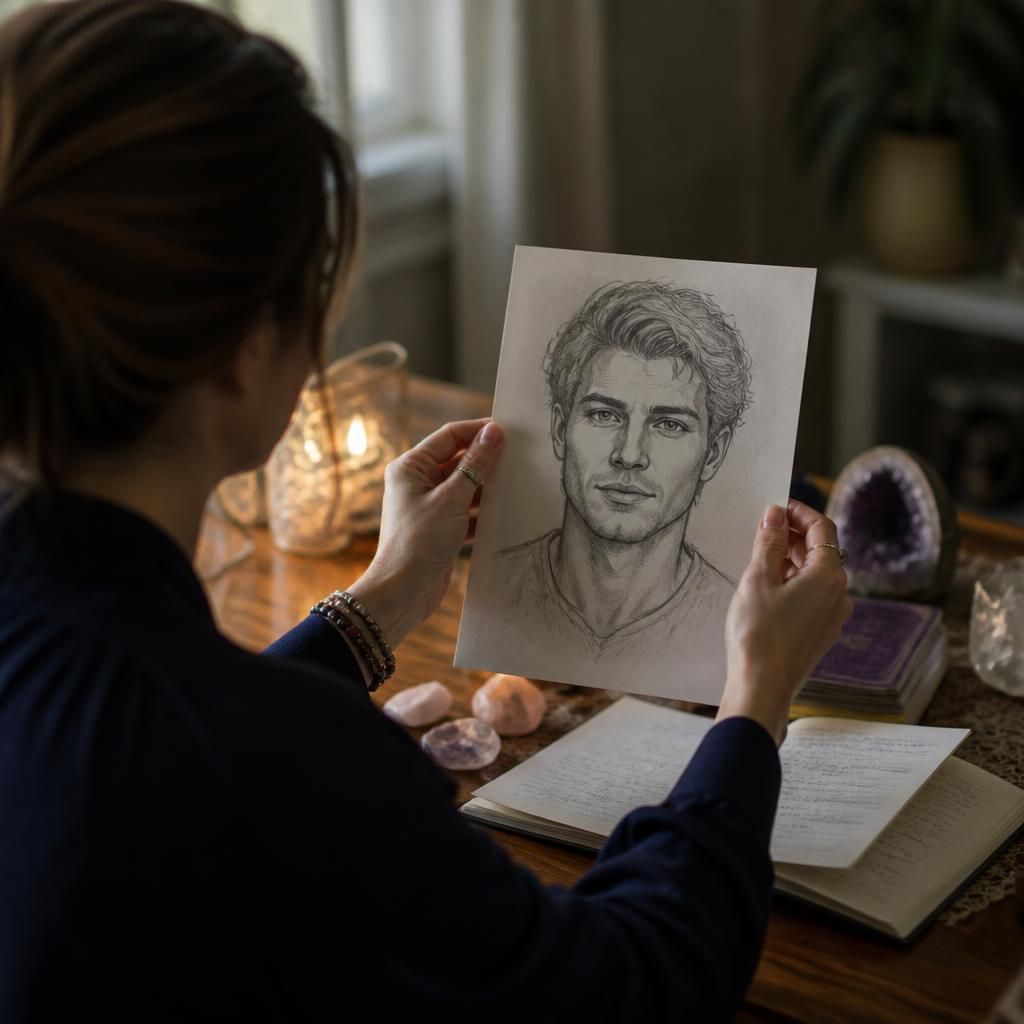
A psychic drawing can be influenced by the way a reader translates impressions into visual form. Artistic ability, drawing style and familiar cultural ideas about attractiveness may affect details such as facial proportions, hairstyle or clothing. Consequently, the image may reflect the reader’s interpretation of an impression rather than provide a neutral representation of your future partner’s face.
When assessing a sketch, focus on the level of detail the reader can reasonably support. Broad features or a general style may offer a useful prompt for discussion, while highly specific claims should be treated more cautiously. The drawing is therefore better used to explore the qualities you associate with a soulmate than to make a definite visual identification.