




What methods do psychics use to predict if someone has met their soulmate?
Psychics may combine tarot, astrology, clairvoyance and mediumship to interpret relationship patterns, emotional compatibility and signs associated with a soulmate connection. These methods offer a spiritual perspective on whether a significant bond has already formed, rather than a verifiable prediction or guarantee.
Psychics typically assess whether you have met a soulmate by interpreting several types of information about the relationship, rather than relying on one definitive sign. A reading may examine emotional patterns, timing, mutual behaviour, intuitive impressions and the relationship’s likely direction. These interpretations are spiritual perspectives, not scientifically verifiable tests, so they should be used for reflection rather than as proof or a guarantee.
Tarot can explore the relationship’s current pattern. A psychic may use a spread designed to examine your feelings, the other person’s apparent position, the foundation of the connection and its potential development. Certain cards can be read as indicating emotional openness, partnership, conflict, personal lessons or a need for clearer boundaries. The important point is the relationship between the cards and their positions. One card is rarely treated as conclusive evidence that someone is a soulmate.
For example, a reading might distinguish between a connection that feels intense because it is prompting personal change and one that appears to have a more stable, mutually supportive foundation. Tarot can also highlight whether attraction is being confused with familiarity, idealisation or unresolved emotional history. This makes it useful for examining what the relationship is showing you now, rather than simply labelling the other person.
Astrology provides a framework for compatibility and timing. Where sufficient birth information is available, a psychic or astrologer may compare two birth charts, a process often called synastry. This can involve the positions and relationships of the Sun, Moon, Venus and Mars, as well as the chart angles and other significant points. These comparisons are used to discuss emotional needs, communication styles, attraction, shared values and areas where the pair may misunderstand one another.
Astrology may also consider the timing of a meeting or a significant change in the relationship. Transits and other forecasting techniques can be interpreted as periods of commitment, reassessment, growth or pressure. They do not establish that two people must remain together. Instead, they can provide a symbolic way to consider why a connection has become important at a particular stage of life and what choices may require attention.
Clairvoyant impressions focus on perceived images, feelings or symbols. During a reading, a clairvoyant may describe an image, colour, location, personality characteristic or recurring symbol that seems associated with the relationship. They may also report impressions about the emotional atmosphere between the two people or the circumstances surrounding their meeting. These impressions are then discussed with the client to determine whether they correspond with known details.
Clairvoyance is not the same as identifying a person through objective evidence. Impressions can be symbolic, incomplete or open to more than one interpretation. A responsible reading should therefore distinguish between what was directly perceived, what is an interpretation and what remains uncertain. The client can decide whether an impression is relevant without treating it as an instruction to pursue, remain with or leave someone.
Mediumship may be relevant when the relationship is connected with someone who has died. In this context, the focus is not normally on proving that a living person is a soulmate. Instead, a medium may interpret communication or symbolic information believed to come from a deceased loved one who has a connection to the client’s romantic life. This may help the client reflect on grief, emotional continuity or guidance associated with a significant relationship.
Mediumship should not be confused with relationship compatibility analysis. It addresses perceived links with the spirit world, whereas tarot and astrology are more commonly used to examine patterns between living people. If a reading includes mediumship, the client should be clear about whether they are seeking insight into the relationship itself, support relating to bereavement, or both.
Psychics often look for several practical indicators alongside the spiritual method. These may include:
- whether the connection encourages honesty, respect and emotional safety;
- whether effort and communication are mutual rather than one-sided;
- whether the relationship supports personal development without requiring a loss of identity;
- whether recurring difficulties are being addressed or simply repeated;
- whether the apparent bond is supported by consistent behaviour, not only strong feelings; and
- whether both people are free and willing to make similar choices about the relationship.
These points matter because spiritual language can make an unhealthy attachment sound significant. A powerful sense of recognition, repeated coincidences or immediate attraction may feel meaningful, but none of these automatically demonstrates compatibility. A psychic interpretation is more useful when it is considered alongside observable conduct, informed consent and the facts of the relationship.
The reading process usually depends on the question asked. “Is this my soulmate?” invites a broad and potentially fixed answer. More focused questions can produce more useful reflection, such as “What pattern is shaping this connection?”, “What should I understand about our compatibility?” or “What do I need to address before deciding how to proceed?” The reader may also ask for relevant context, although clients can choose how much personal information to share.
Methods may be used separately or compared. Tarot can examine the present dynamics, astrology can offer a longer-term symbolic framework, clairvoyance can add intuitive impressions and mediumship can address perceived spiritual links involving someone deceased. Agreement between methods may feel significant to the client, but it still does not turn an interpretation into certainty. Differences between methods can be equally useful because they may reveal areas requiring further thought.
When evaluating a soulmate reading, look for clear explanations of the method, acknowledgement of uncertainty and respect for your ability to make decisions. Be cautious of any interpretation that presents a stranger as unquestionably destined for you, demands immediate action, discourages practical judgement or treats every difficulty as evidence of a deeper bond. The most balanced approach uses psychic insight as one perspective on a relationship while giving equal weight to communication, boundaries, safety and the choices made by both people.
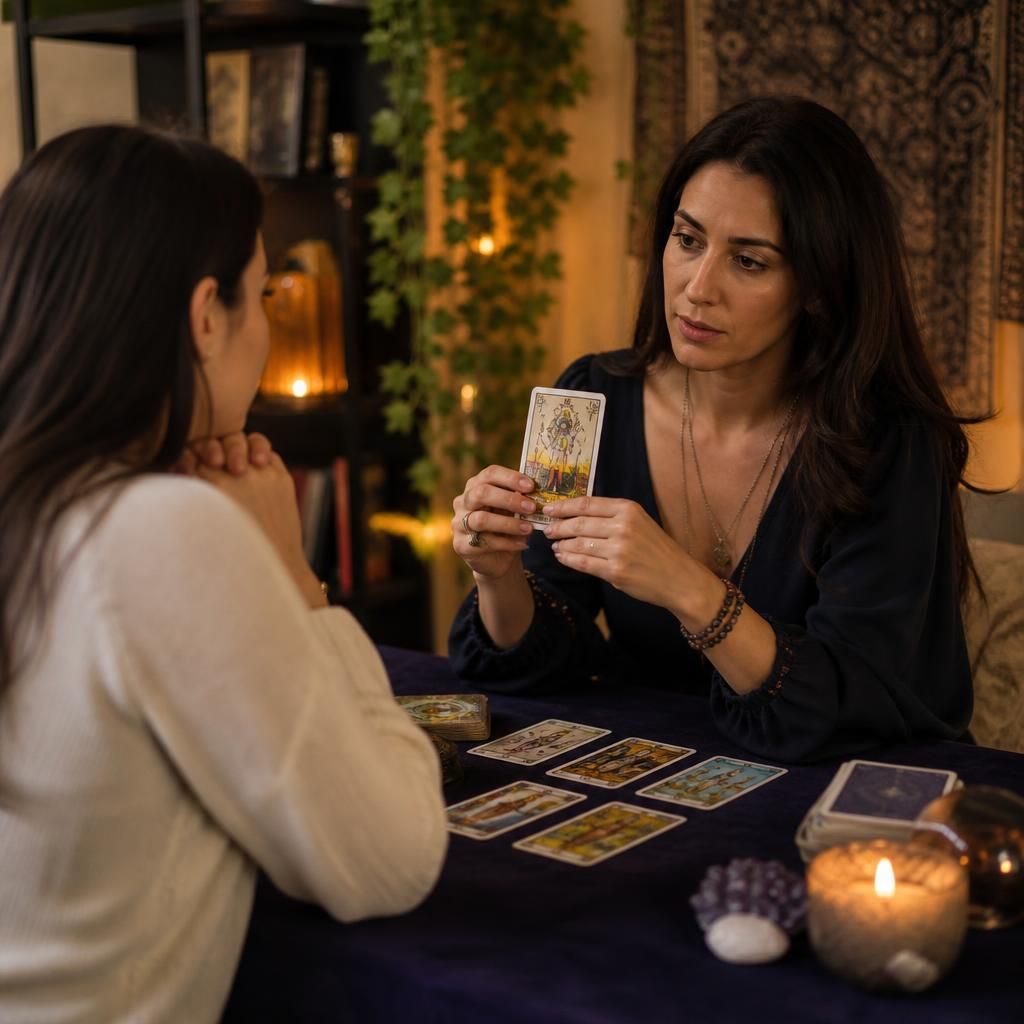
The meaning assigned to “soulmate” can affect how a psychic interprets a reading. Some people use the term to mean a likely lifelong partner, while others mean a person who brings significant personal change, emotional recognition or a lasting spiritual connection. These are different concepts, so the same tarot card, astrological pattern or intuitive impression may be understood differently depending on the definition being used.
Before a reading, clarify what you want the term to describe. You might ask whether the relationship has the qualities of a committed partnership, whether it is an important learning connection, or whether it is likely to remain significant over time. A precise definition gives the reading a clearer basis and makes it easier to distinguish a soulmate interpretation from a general statement that the relationship feels meaningful.