





What specific methods and abilities do the psychics employ in their spiritual guidance sessions to provide tailored insights?
Elizabeth Rose Psychics’ spiritual guidance sessions draw on clairvoyance, mediumship, tarot and astrology to explore a client’s questions and circumstances. Psychics use these methods individually or in combination to shape personalised insights around relationships, career and personal growth by phone or email.
Psychics tailor spiritual guidance by combining intuitive perception with structured interpretive systems and attentive consultation. The methods used do not produce a single fixed type of answer: each practitioner considers the client’s question, the information shared, the symbols or impressions that arise, and the themes that appear consistently before forming an interpretation.
Clairvoyance refers to receiving intuitive impressions, which may be experienced as mental images, scenes, colours, symbols or a sense of knowing. A practitioner may examine the meaning of these impressions in relation to the client’s circumstances rather than treating every image as a literal prediction. Context, sequence and recurring themes help distinguish a potentially relevant impression from a general association.
Mediumship is centred on perceived communication with people who have died or with spiritual presences. A medium may describe impressions relating to personality, memories, emotions or recognisable details, allowing the client to consider whether the information has personal meaning. Responsible mediumship should be presented as an interpretive spiritual practice, not as a substitute for evidence, legal guidance or professional support.
Tarot provides a visual framework for examining a situation. Each card has established symbolic associations, while its position in a spread and relationship to surrounding cards influence the interpretation. Practitioners may use the cards to explore motivations, obstacles, possible developments and choices. The value of a reading lies in the reflective interpretation of the spread, rather than assuming that a card guarantees a particular outcome.
Astrology interprets planetary positions and their relationships within a birth chart or another chart selected for the enquiry. This can provide a symbolic way to consider behavioural tendencies, recurring themes and periods that may feel significant. A careful reading distinguishes between broad chart symbolism and the individual’s lived experience, avoiding overly definite conclusions from one placement alone.
Several abilities support the use of these methods:
- Intuitive synthesis: bringing separate impressions, symbols or chart factors together into a coherent interpretation.
- Discernment: considering which details are central to the enquiry and which may be ambiguous, symbolic or open to more than one meaning.
- Empathic listening: recognising the emotional and practical context behind a question without imposing assumptions on the client.
- Clarifying enquiry: using relevant follow-up questions to understand the focus of the session and keep the interpretation aligned with what the client wants to explore.
- Communication: explaining spiritual concepts in direct language, including where an impression is uncertain or has more than one possible interpretation.
Tailoring begins with the client’s specific area of concern. A question about a relationship may lead to a discussion of communication, expectations and recurring dynamics; a question about work may focus on decision-making, direction and perceived obstacles. The practitioner then selects the most suitable tool, or combines tools when that gives a clearer framework. For example, tarot may be used to examine the structure of a current decision, while astrology may add a longer-term symbolic perspective.
The client’s own responses remain important to the interpretation. Spiritual guidance is not a replacement for personal judgement, medical care, financial advice or other qualified professional services. The most useful reading therefore treats psychic impressions as material for reflection and discussion, presents possibilities rather than certainties, and leaves the client able to assess the guidance against their own knowledge and circumstances.
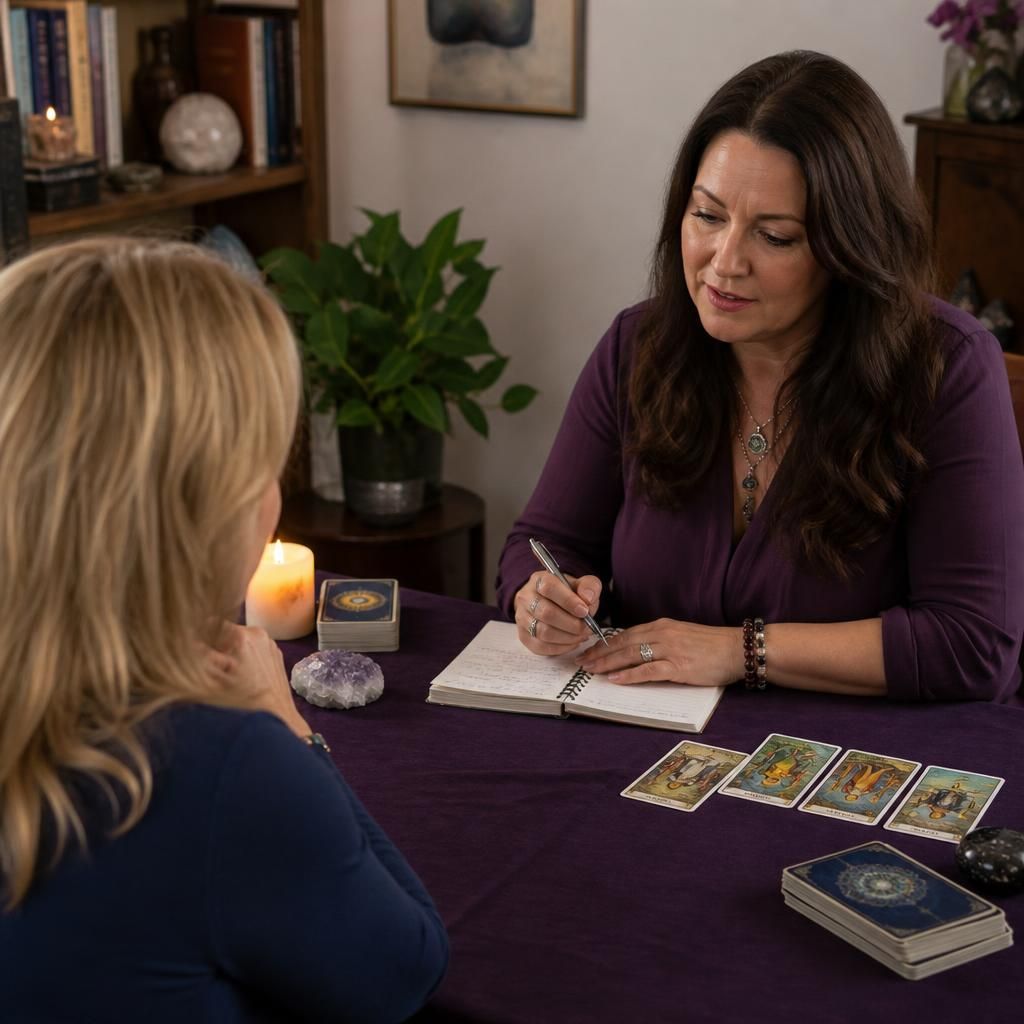
A key part of tailored spiritual guidance is setting the scope of the session before interpreting any impressions or symbols. The client can identify the central question, explain the context they consider relevant and state any areas they do not want explored. This helps the practitioner keep the reading focused rather than applying a broad interpretation to unrelated parts of the client’s life.
Skilled guidance also adapts the way information is presented to the client’s needs. A reader may distinguish between:
- Observations: the image, card, chart feature or impression that arises.
- Interpretations: the possible meaning in relation to the client’s question.
- Practical reflections: questions or considerations the client can use when making their own assessment.
This structure makes it easier to separate the psychic method from the conclusion drawn from it. It also gives the client room to identify which parts are relevant, ask for clarification and decide how the guidance fits their circumstances.