

What should I expect during a tarot reading session with a psychic?
During a tarot reading session with a psychic, you typically discuss the area you want to explore, then the psychic draws and interprets cards in relation to your question or circumstances. The session may include explanations of the cards, follow-up questions and practical reflection, while the reading is offered as guidance rather than a guaranteed prediction.
A tarot reading with a psychic is a structured conversation in which a spread of cards is used to examine a situation, its influences and possible directions. The psychic combines the traditional symbolism of the cards with intuitive interpretation, explaining how the cards relate to one another rather than treating each card as an isolated prediction.
At the beginning of the session, the psychic will usually establish the focus and explain how the reading will be approached. You may choose to explore one subject, such as a relationship or career decision, or ask for a broader overview. A clear focus helps the reader select a suitable spread and keeps the interpretation relevant. You do not need to provide a detailed personal history; share only the context you are comfortable discussing.
The psychic may invite you to concentrate on your question while the cards are shuffled. Depending on the reader’s method, either you or the psychic may shuffle, cut or select the cards. These actions are part of the reading’s process rather than a test of your ability to perform a ritual. There is no special knowledge you need to have before the session begins.
The spread determines how the cards are organised. Each position has a particular purpose. For example, positions might represent the present circumstances, an underlying influence, an obstacle, available support and a possible direction. A smaller spread may provide a direct examination of one issue, while a larger spread can show several connected factors. The psychic should explain the structure sufficiently for you to understand why each card is being considered.
Interpretation normally involves several layers. The reader may consider the card’s imagery, traditional meaning, suit, number, position in the spread and relationship to neighbouring cards. Major Arcana cards are often read as significant themes or turning points, whereas Minor Arcana cards can describe day-to-day conditions, actions and interactions. Some psychics use reversed cards, meaning a card appears upside down; others read every card upright. Neither approach needs to be treated as automatically more accurate, but the method should be applied consistently.
A psychic may also bring intuitive impressions to the traditional tarot meanings. This can add emphasis or suggest a connection that is not obvious from one card alone. It is reasonable to ask whether an interpretation comes from the card’s established symbolism, the reader’s intuition or both. You can also provide clarification if a detail does not fit your circumstances. A useful session allows a dialogue rather than requiring you to accept every interpretation without question.
The wording of your questions affects the usefulness of the discussion. Questions that explore choices, influences or practical considerations usually allow more context than questions seeking a fixed yes-or-no answer. Examples include:
- What should I understand about the current direction of this relationship?
- Which factors may be affecting my career decision?
- What can I consider before taking this next step?
- What pattern in this situation may need closer attention?
Tarot does not establish a guaranteed timetable or remove personal choice. A reading may identify tendencies, tensions and possible outcomes based on the circumstances being examined, but decisions remain yours. Circumstances can change, and your actions can affect how a situation develops. A responsible psychic should avoid presenting the cards as an unavoidable verdict or using fear to influence your choices.
You can set boundaries before or during the session. This may include declining a particular topic, asking for a pause or requesting that the psychic explain a statement in more neutral language. If a reading raises a sensitive issue, take time to reflect rather than feeling pressured to make an immediate decision. Tarot guidance should not replace qualified medical, legal or financial advice, particularly where a decision could have serious consequences.
Near the end, the psychic will generally summarise the main themes and distinguish them from less central details. You may wish to note the cards, the spread positions and any practical questions that emerged. Reviewing the reading afterwards can help you separate useful reflection from an initial emotional reaction. Elizabeth Rose Psychics provides tarot guidance through phone and email, so the same basic structure can be adapted to a remote consultation without requiring an in-person setting.
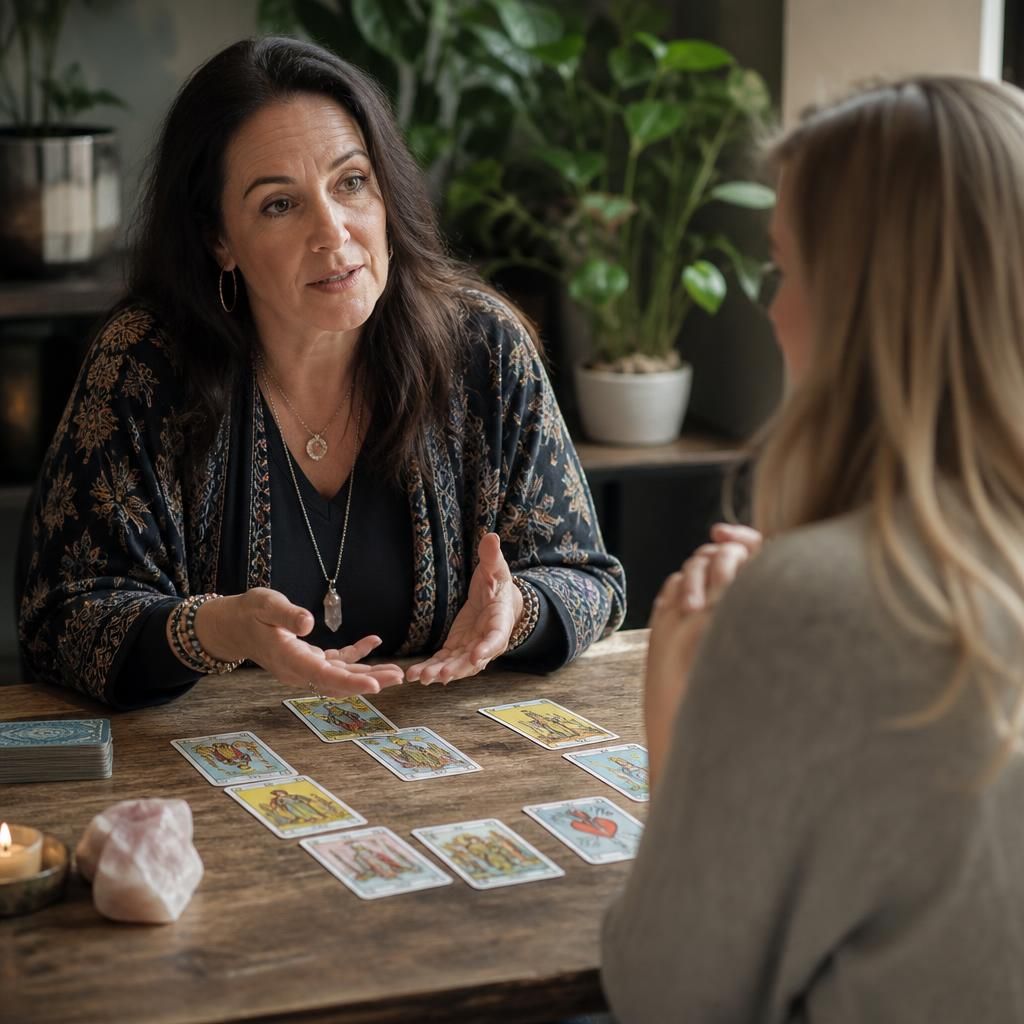
Conflicting cards do not necessarily make a tarot reading unusable. A psychic may examine whether the cards represent different stages of the situation, opposing influences or a choice between possible responses. Rather than treating one card as cancelling out another, the reader should explain how the positions and surrounding cards affect the interpretation.
You can ask the psychic to clarify an apparent contradiction, identify which theme is most significant or explain what information would help distinguish between possible interpretations. This part of the session is often useful because it shows how the reading is being reasoned through, rather than reducing it to isolated card meanings.