






How can a psychic discern relationship patterns through astrology and tarot?
A psychic may use astrology to interpret recurring relationship themes through birth charts, planetary placements and compatibility indicators, then use tarot to explore current dynamics, emotional responses and likely influences. Read together, these tools can provide a symbolic framework for examining repeated cycles, communication habits and areas of compatibility without treating the interpretation as a guaranteed prediction.
Astrology and tarot can help a psychic discern relationship patterns by comparing longer-term tendencies with the circumstances surrounding a particular relationship. Astrology supplies a structured map of timing, temperament and relational needs, while tarot offers a focused way to examine the choices, perceptions and tensions present at the time of a reading. The purpose is not to prove that a relationship must follow a fixed path, but to identify themes that may be influencing how people connect.
Astrology provides the underlying framework. A reader may begin with each person’s birth details and consider features such as the Moon, Venus, Mars, the seventh house and significant aspects between planets. These are traditionally associated with emotional security, attraction, desire, partnership preferences and the way a person approaches commitment. The interpretation becomes more useful when these factors are considered together rather than treated as isolated signs.
For example, a chart may suggest that one person seeks reassurance before expressing vulnerability, while the other values independence and needs space to process emotions. That combination does not automatically indicate incompatibility. It may instead point to a recurring negotiation between closeness and autonomy. A psychic can use that distinction to explore whether the same tension appears in several relationships, how it is expressed and what responses tend to intensify or reduce it.
Chart comparison can reveal interaction patterns. In relationship astrology, the reader may compare the two charts to examine how one person’s planets relate to the other person’s. Supportive connections can be interpreted as areas of ease or mutual recognition, whereas more challenging contacts may highlight differences in communication, emotional regulation or expectations. The important question is not whether an aspect is labelled “good” or “bad”, but how both people experience it in practice.
Astrology can also be used to place a pattern in context over time. Current planetary movements may be considered alongside the birth charts to explore periods associated with reassessment, commitment, change or emotional pressure. This is best treated as a way of identifying themes and questions for reflection, rather than as a timetable that guarantees a particular event. A responsible reading distinguishes between a potential period of focus and a definite prediction.
Tarot adds a situational and reflective layer. A spread may be arranged around specific positions, such as each person’s perspective, the central dynamic, an unresolved influence, a repeating behaviour and a constructive next step. The cards are then interpreted in relation to the question and to one another. A single card is rarely enough to establish a relationship pattern; its position, surrounding cards and relevance to the client’s circumstances all affect its meaning.
Tarot can be particularly useful when a person recognises a repeated outcome but is uncertain about the behaviour leading to it. For instance, a spread might draw attention to avoidance, idealisation, guarded communication or difficulty setting boundaries. It may also show where assumptions have replaced direct conversation. These observations can help separate a recurring personal response from circumstances that are specific to the current relationship.
The two systems are often read as complementary rather than interchangeable. Astrology may indicate a relatively stable preference or sensitivity, while tarot can explore how that tendency is being handled now. If both point towards the same issue, the psychic may investigate it more closely. If they appear to differ, that difference can be informative: a person may have one underlying need but be responding to current circumstances in an unfamiliar way.
A careful reading usually follows a process such as:
- Clarifying the relationship question and separating observable facts from assumptions.
- Identifying repeated themes in the person’s relationship history, including how conflict, distance or commitment tends to develop.
- Using astrological indicators to examine relational preferences, sensitivities and periods of change.
- Using a focused tarot spread to explore present perceptions, behaviour and possible choices.
- Comparing the symbolic information with what the client recognises from lived experience.
- Turning the interpretation into practical questions about communication, boundaries and personal responsibility.
The quality of discernment depends heavily on the question being asked. “Will this person come back?” encourages a narrow prediction, whereas “What keeps this connection in a repeated cycle, and what can I learn from it?” allows astrology and tarot to examine behaviour, expectations and options. Specific questions also reduce the risk of interpreting broad symbols as confirmation of a desired outcome.
Psychic interpretation should remain distinct from evidence about another person’s private thoughts or future actions. Astrology and tarot cannot establish consent, diagnose a mental health condition or replace direct communication. They can provide symbolic prompts for self-examination, but important relationship decisions should also take account of observable conduct, safety, mutual respect and honest discussion. Used in that way, a reading can clarify recurring themes without presenting them as fixed destiny.
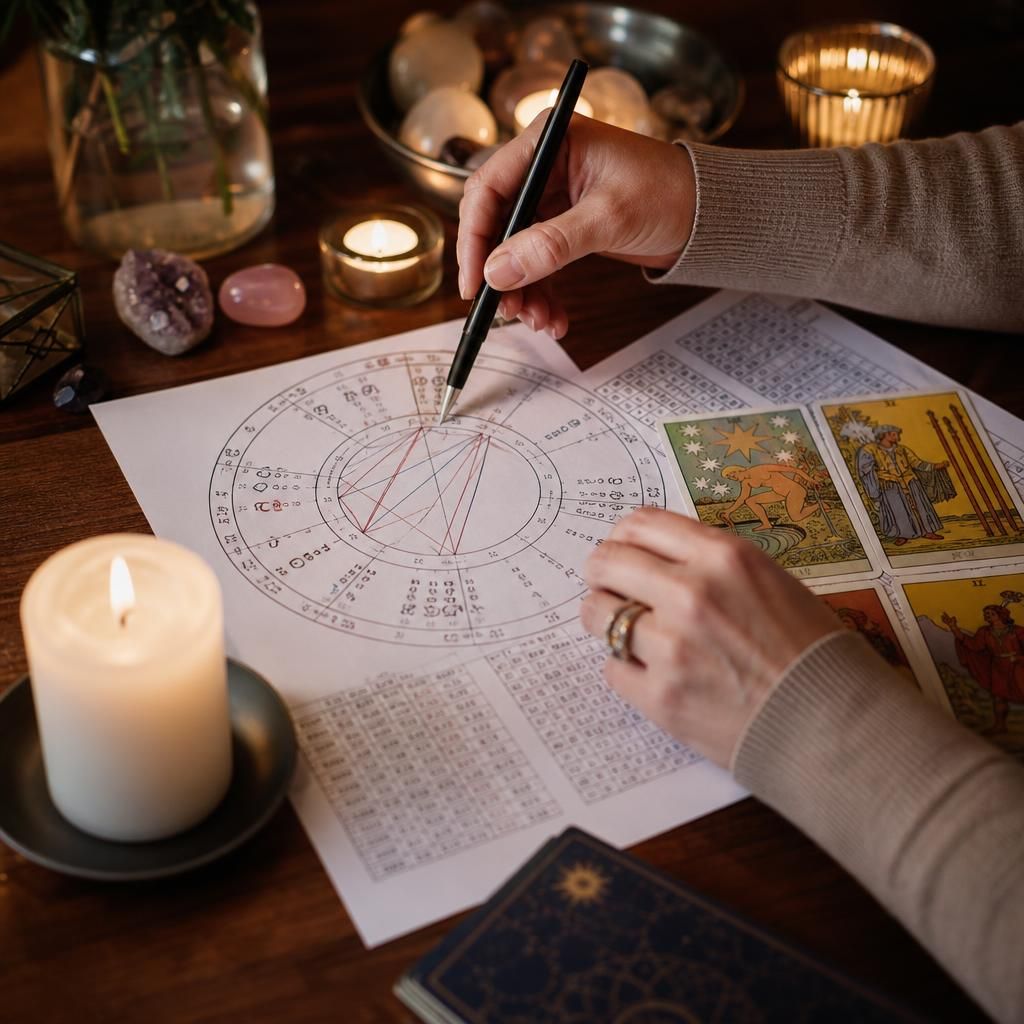
A useful way to discern relationship patterns is to distinguish between a personal pattern, a relational pattern and a situational pattern. This prevents astrology or tarot from treating every repeated difficulty as a permanent feature of someone’s personality.
- Personal patterns involve responses that appear across different relationships, such as withdrawing when intimacy increases or repeatedly overlooking unclear boundaries.
- Relational patterns arise from the interaction between two people, where each person’s behaviour reinforces the other’s response.
- Situational patterns are linked to particular circumstances, such as long-distance contact, family pressure or an uncertain stage of commitment.
A psychic may use the birth charts to consider whether a tendency is broadly familiar to the individual, then use tarot to examine how that tendency is operating in the specific situation. The distinction matters because a challenging dynamic with one person does not necessarily describe every future relationship. It can instead show that the circumstances, expectations or communication style of that connection are producing a particular cycle.
Explore Your Relationship Patterns Through Astrology and Tarot
If you want to examine recurring relationship themes through astrology and tarot, consider booking a personalised reading with Elizabeth Rose Psychics. Bring a specific question and relevant birth details where available to support a focused discussion.