




What role do planetary positions play in astrology compatibility readings?
Planetary positions show how each person’s drives, emotions, communication habits and relationship needs may interact in an astrology compatibility reading. Astrologers compare the planets’ signs, houses and aspects to identify areas of natural rapport, potential tension and longer-term relationship patterns.
In astrology compatibility readings, planetary positions provide the framework for comparing how two people may approach identity, emotions, communication, affection, desire, responsibility and personal development. A chart records where each planet was positioned at a person’s birth, and the comparison considers the specific relationships those positions form between both charts rather than judging compatibility from Sun signs alone.
Each planet represents a different relationship function:
- The Sun relates to identity, confidence, vitality and the need to express individuality.
- The Moon is associated with emotional responses, comfort, habits and instinctive needs.
- Mercury concerns thinking, conversation, listening and the way information is processed.
- Venus describes attraction, affection, values and preferences in partnership.
- Mars indicates initiative, assertiveness, desire and methods of handling conflict.
- Jupiter can point to enthusiasm, generosity, shared learning and areas where a relationship encourages growth.
- Saturn is examined in relation to duties, limits, perseverance and the structures that help a relationship endure.
The outer planets—Uranus, Neptune and Pluto—are also considered, particularly when they make close connections with a partner’s personal planets or chart angles. Because these planets move more slowly, they may describe broader generational attitudes when viewed in isolation. A close personal connection can make their themes more prominent, such as a need for freedom, idealisation, transformation or profound change.
The sign occupied by a planet describes its style of expression. For example, Venus in an earth sign may approach affection through reliability and practical support, whereas Venus in an air sign may place greater emphasis on conversation and intellectual rapport. This does not make one placement inherently better than another; it helps an astrologer compare what each person values and how those values may be expressed.
House position adds context by showing the area of life in which a planet’s themes are likely to be experienced. A partner’s planet falling in another person’s seventh house, for instance, may make partnership matters especially noticeable to the house person. A placement connected with the fourth house may draw attention to home, family or emotional security, while one linked with the tenth may bring career, public life or ambition into the relationship dynamic.
Aspects determine how planetary themes interact. A conjunction brings two influences together and can make their connection particularly direct. A trine or sextile is traditionally interpreted as offering ease or cooperation, while a square or opposition may highlight contrasting needs that require negotiation. These classifications do not predict success or failure. They describe the type of interaction an astrologer may explore, including whether the connection feels instinctive, demanding, motivating or difficult to integrate.
Degrees and the closeness of an aspect also matter. A very close contact is generally given more interpretive weight than a wide one, although the importance of an aspect depends on the planets involved and the wider pattern in both charts. An astrologer may also look for repetition: if several contacts point towards the same issue, such as independence versus closeness, that theme may deserve more attention than a single isolated placement.
Compatibility analysis usually distinguishes between personal planets and slower-moving planets. Contacts involving the Sun, Moon, Mercury, Venus and Mars often relate to everyday interaction and immediate attraction. Saturn contacts may raise questions about commitment, accountability and restrictions. Uranus, Neptune and Pluto can introduce themes of disruption, idealisation or major psychological change, especially when they connect closely with personal placements.
Planetary positions are interpreted as a complete pattern rather than as a list of fixed verdicts. A challenging contact may indicate an area requiring awareness and communication, while an apparently harmonious contact may still produce passivity or avoidance if it is not supported by the rest of the charts. The astrologer therefore weighs the planets, their signs, house contexts, aspect patterns and the life circumstances described by the people involved.
It is also useful to separate natal compatibility from timing. The natal comparison explores the underlying relationship pattern, while current planetary movements may be used to examine periods when existing themes become more noticeable. Timing techniques can provide context for reflection and planning, but they should not be treated as guarantees about another person’s behaviour or about a relationship’s outcome.
Astrology is an interpretive system rather than a scientific method for proving personality or predicting events. A careful compatibility reading should therefore present planetary symbolism as a way to examine tendencies, expectations and areas for discussion—not as a substitute for direct communication, informed judgement or professional advice where that is needed. A phone or email astrology reading can use these principles to explain the planetary patterns in two individual birth charts in a structured, personalised way.
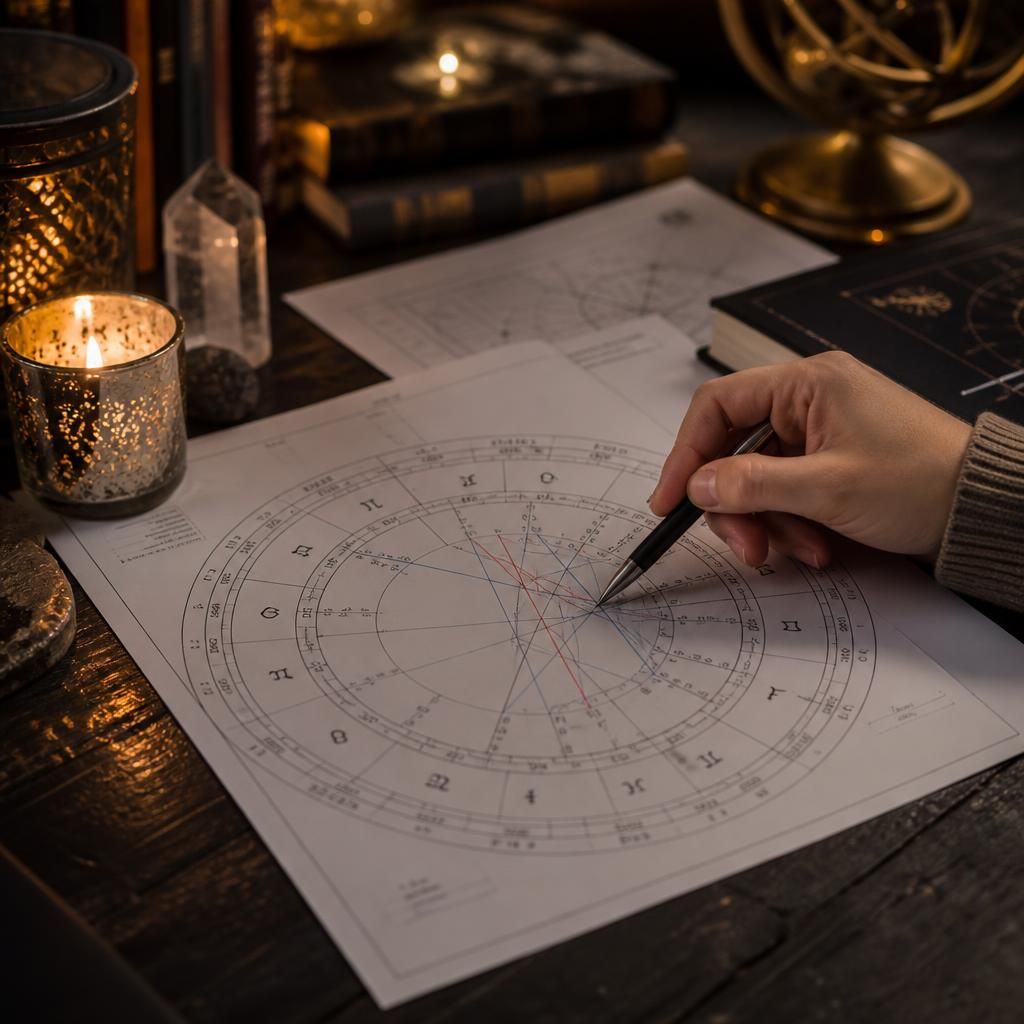
The accuracy of planetary positions depends on the birth information used to calculate each chart. The date establishes the broad planetary pattern, while the exact time and birthplace can affect the Moon’s position and the chart angles. This matters because even a small change in recorded time may alter the placements used to interpret how two people relate.
Before an astrology compatibility reading, it is therefore useful to check whether both birth times are documented or estimated. If one time is uncertain, an astrologer can distinguish between conclusions supported by stable planetary data and those that depend on more precise chart information. This helps keep the reading proportionate to the quality of the evidence rather than presenting every calculated position with equal certainty.