






What role do planetary aspects play in synastry readings, and how can different aspects such as conjunctions, oppositions, or trines impact relationship compatibility?
In synastry, planetary aspects show how two people’s birth-chart energies interact, helping an astrologer assess attraction, ease, tension and areas for development within a relationship. Conjunctions intensify and combine planetary influences, oppositions create polarity that may encourage both challenge and balance, while trines indicate natural compatibility and supportive flow; no single aspect determines the relationship, so its meaning depends on the planets, signs, houses and wider chart pattern involved.
Planetary aspects in synastry are the angular relationships between one person’s planets and the other person’s planets. Their role is to show how particular functions—such as communication, affection, desire, emotional security and responsibility—meet between two birth charts. A useful interpretation does not count favourable and difficult aspects mechanically; it examines the planets involved, the exactness of the aspect, the houses affected and whether the same theme is repeated elsewhere in the comparison.
Conjunctions: concentration and emphasis
A conjunction occurs when two planets occupy closely aligned degrees. The planets operate in the same area of the chart, so their meanings become closely intertwined. A Venus–Mars conjunction, for example, can link affection with physical attraction, while a Mercury–Moon conjunction may connect conversation with emotional responses. The effect can feel immediate because one person’s planetary expression directly activates the other person’s corresponding function.
Conjunctions are not automatically positive. The outcome depends on the planets involved. The Sun, Venus or Jupiter may bring warmth, encouragement or mutual appreciation, whereas Saturn, Mars or Pluto can add pressure, intensity or confrontation. Even more supportive conjunctions may become overwhelming if the energies are expressed too strongly or leave little room for difference. The sign, house placement and condition of each planet in its owner’s natal chart help determine whether the contact is constructive, demanding or both.
Oppositions: polarity and negotiation
An opposition places planets approximately 180 degrees apart. It creates a relationship of polarity, in which the two people may experience contrasting needs that nevertheless draw attention to each other. One person’s Sun opposing the other’s Saturn, for instance, may raise questions about authority, approval and responsibility. A Moon–Venus opposition could connect emotional security with affection while also exposing differences in how care is offered and received.
Oppositions often make a theme visible through the relationship. They can encourage complementarity when both people recognise the value of the other’s approach, but they may produce projection when an individual attributes an uncomfortable quality to the partner rather than acknowledging it within themselves. The houses on the two ends of the opposition indicate the life areas where this balancing process is most likely to occur.
Trines: ease and natural reinforcement
A trine is an aspect of approximately 120 degrees, usually linking planets in the same element. It can indicate that two people understand or support a particular function with relatively little effort. Mercury trine Mercury may assist mutual comprehension, while Moon trine Venus can make emotional expression and affection feel compatible. Jupiter trines may encourage generosity and confidence, and Saturn trines can support reliability and sustained effort.
The ease of a trine is useful, but it does not guarantee action or lasting commitment. Because the interaction may feel natural, the people involved can take it for granted. A trine may also reinforce an existing habit, whether that habit is helpful or unhelpful. Its practical value is best assessed alongside aspects that show motivation, resilience and willingness to address difficult subjects.
Squares and sextiles: friction and cooperation
A square is formed at approximately 90 degrees. It creates friction between planetary functions and can reveal incompatible timing, priorities or methods. For example, Mars square Saturn may describe frustration between initiative and restraint, while Mercury square Neptune can require care around assumptions, clarity and interpretation. Squares are not evidence of failure: they can generate effort, problem-solving and development when the people involved respond consciously rather than defensively.
A sextile, at approximately 60 degrees, tends to show an available opportunity for cooperation. It may support practical communication, shared interests or the development of a skill within the relationship. Unlike a trine, a sextile often needs deliberate engagement before its benefits become obvious. A Mercury–Jupiter sextile, for example, may be valuable when both people actively exchange ideas and make space for different viewpoints.
Quincunxes and minor aspects
A quincunx, or inconjunct, is approximately 150 degrees and often indicates that two planetary functions do not fit together automatically. The people may need to adjust expectations, routines or forms of expression without receiving the immediate feedback associated with a square or opposition. A quincunx involving the Moon, for example, may require ongoing adjustment between emotional habits and the partner’s way of responding.
Some astrologers also examine minor aspects, such as semi-sextiles or quintiles. These can add detail, but they should not outweigh close contacts involving the Sun, Moon, personal planets, chart angles or significant rulers. The usefulness of a minor aspect depends on a consistent interpretive method and a chart pattern that supports its relevance.
Why the planets matter
The aspect describes the type of interaction, while the planets describe what is interacting. The Sun relates to identity and vitality; the Moon to emotional regulation and familiarity; Mercury to thought and communication; Venus to affection, attraction and values; and Mars to desire, assertion and conflict. Jupiter can broaden faith and enthusiasm, Saturn can introduce commitment, limits or judgement, and the outer planets may intensify psychological, transformative or idealistic themes.
Contacts to the Ascendant, Descendant, Midheaven or Imum Coeli can make an aspect especially noticeable because they connect the interaction with identity, partnership style, public direction or private foundations. A close contact to an angle may be experienced as highly personal even when the planets themselves are not traditionally considered romantic indicators.
Orbs, direction and chart context
Aspect strength is usually judged partly by the orb, meaning the distance from the exact angle. A closer aspect generally receives greater weight, while a wider aspect may operate more subtly. There is no single universal orb system: astrologers may use tighter allowances for minor aspects and broader ones for major contacts or luminaries. Consistency matters more than presenting an isolated aspect as decisive.
Some practitioners distinguish applying aspects, which are moving towards exactness in the relevant chart framework, from separating aspects, which have already passed exactness. This distinction may be used as an additional layer of interpretation, but it should not replace the central assessment of the planets, signs, houses and natal condition. The aspect’s repetition elsewhere is often more informative than technical emphasis on direction alone.
Interpretation should also consider mutual contacts. If one person’s Venus aspects the other person’s Mars, that is different from a reciprocal Venus–Mars connection in which both charts activate the same theme. Repeated links between the same planets, signs or houses can create a stronger pattern, sometimes called reinforcement or a double-whammy. Conversely, a challenging aspect may be moderated when supportive contacts connect the same planets or when one person’s chart shows familiarity with that type of energy.
Assessing compatibility without reducing it to a score
Compatibility is better understood as a set of relationship capacities than as a total of easy and difficult aspects. An astrologer may assess whether the charts support:
- clear communication and the ability to repair misunderstandings;
- emotional recognition and compatible ways of seeking reassurance;
- affection, attraction and shared values;
- respect for independence, boundaries and responsibility;
- constructive handling of anger, fear, jealousy or disagreement; and
- the capacity to sustain practical commitments over time.
For example, strong Venus–Mars contacts may describe attraction, but they do not by themselves establish trust or dependable communication. Saturn contacts may feel demanding, yet they can correspond with loyalty and perseverance when handled respectfully. Neptune contacts may support imagination and spiritual connection, while also requiring explicit communication about expectations. Pluto contacts can bring depth and transformation, but they call for careful attention to control, compulsion and personal boundaries.
A complete synastry reading therefore weighs several layers together: major aspects, contacts to angles, house placements, sign compatibility, the natal condition of the planets and recurring themes across both charts. Astrology describes potential patterns and areas for attention; it cannot determine a person’s choices or guarantee the outcome of a relationship. Used thoughtfully, planetary aspects provide a structured way to examine attraction, ease, pressure and the adjustments that may support a more informed understanding of relationship dynamics.
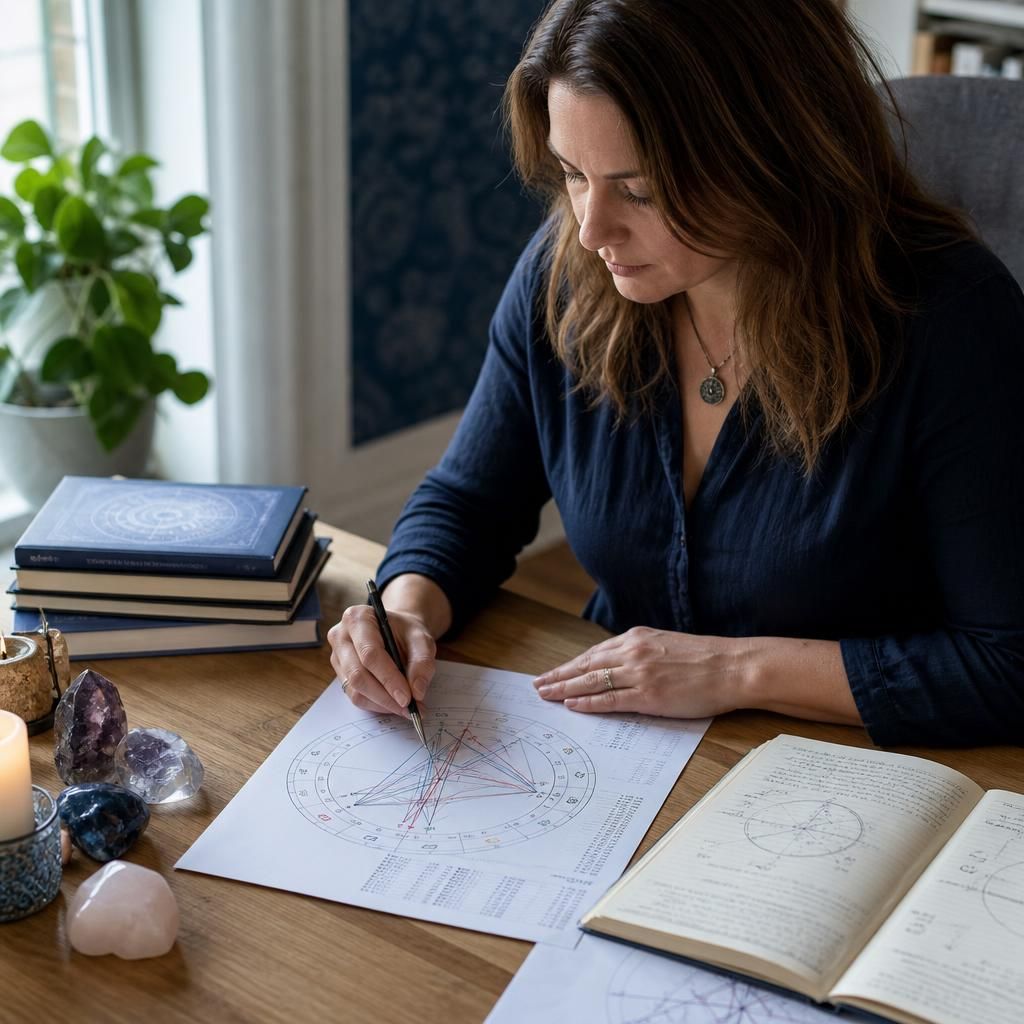
In synastry, an aspect pattern is a group of connected contacts that gives individual planetary aspects a broader relational context. Rather than interpreting each conjunction, opposition or trine separately, an astrologer considers whether several aspects combine around the same planets, signs or life areas.
For example, a cluster involving one person’s Moon and the other person’s Saturn, Venus and Mars may make emotional security a central relationship theme, with care, attraction and restraint operating together. A repeated pattern of harmonious aspects can make cooperation more consistent, while a configuration containing both supportive and tense contacts may show where natural rapport needs conscious handling. This approach helps distinguish an isolated influence from a recurring dynamic that is more likely to shape the relationship’s day-to-day experience.
Explore Planetary Aspects in Your Synastry Chart
For a personalised interpretation of how these aspect patterns relate to your relationship, consider requesting an email astrology compatibility and synastry reading from Elizabeth Rose Psychics. Provide accurate birth details and specific questions so the reading can focus on the dynamics you want to understand.