





How are planetary alignments interpreted in a Vedic birth chart reading?
In a Vedic birth chart reading, planetary alignments are interpreted by examining each planet’s position by sign, house and nakshatra, along with its conjunctions, aspects and strength. These relationships are then considered together to assess patterns relating to personality, life direction, relationships and significant periods of development.
Planetary alignments in Vedic astrology are read as interacting patterns rather than isolated placements. The interpretation asks which life themes are connected, whether the planets support or obstruct one another, and how those tendencies may unfold through planetary periods and transits.
The first consideration is the condition of each graha, or planetary influence. A planet is assessed according to its relationship with the sign it occupies, its dignity, and the role it serves in the individual chart. Exaltation, own-sign placement and friendly signs can give a planet greater coherence, while debilitation, an inimical sign or severe affliction may make its expression more complicated. These conditions do not automatically produce a good or bad result; their meaning depends on the houses and life subjects connected with that planet.
Vedic interpretation also distinguishes between a planet’s natural character and its functional role in a particular chart. Jupiter and Venus are traditionally natural benefics, while Saturn, Mars, Rahu and Ketu are often treated as natural malefics. However, house rulership can alter how a planet operates for a specific ascendant. A planet associated with challenging houses may bring demanding experiences but can also develop discipline, resilience or practical achievement. This is why a single placement should not be interpreted without considering the wider chart.
Conjunctions are examined for the way two or more planetary principles combine. A conjunction may create cooperation, tension or a mixture of both. For example, a connection between Mercury and Jupiter may bring together analytical thinking and broad judgement, whereas a close relationship between the Sun and Saturn may require careful interpretation because authority, responsibility and self-expression can pull in different directions. The exact result depends on sign, house, planetary dignity and the condition of the planets involved.
Vedic astrology gives particular importance to yogas, which are recognised combinations formed by relationships between planets, houses and their rulers. Some yogas are associated with learning, wealth, leadership, professional distinction, spiritual development or obstacles. A yoga is not treated as a guarantee of an event. Its relevance is stronger when the planets forming it are well placed and when the relevant planetary period or transit activates the combination.
Planetary aspects add another layer to the reading. In addition to the standard aspect considered for every planet, Vedic astrology gives special aspects to Mars, Jupiter and Saturn. These aspects show where a planet directs its influence, even when it is not physically placed in the aspected house. An aspect from a supportive planet may strengthen confidence, protection or opportunity, while a difficult aspect may indicate pressure, delay or the need for sustained effort.
Saturn’s influence is commonly interpreted through responsibility, structure, delay and long-term development. Mars may indicate initiative, competition, force and technical ability, but can also describe impatience or conflict when poorly integrated. Jupiter is connected with knowledge, ethics, guidance and expansion, while Venus relates to harmony, relationships, pleasure and artistic values. Mercury concerns reasoning, communication and commerce; the Moon reflects emotional responses and mental habits; and the Sun represents vitality, identity and authority. Rahu and Ketu are interpreted as intensifying worldly desire and encouraging detachment or release, respectively.
Interpretation also considers whether a planet is combust, retrograde or closely affected by another graha. Combustion occurs when a planet is very close to the Sun and may indicate that its qualities are overshadowed by solar concerns. Retrograde motion is often read as an inward, unusual or revisited expression of a planet rather than as an automatically negative condition. These factors must be weighed alongside dignity and house placement instead of being treated as decisive on their own.
The Moon and ascendant provide important reference points for judging an alignment. From the ascendant, the emphasis is often practical and relates to events, circumstances and observable areas of life. From the Moon, the same pattern may describe emotional experience, perception and psychological response. Comparing these viewpoints can show whether an alignment is likely to be experienced mainly as an external development, an internal process or both.
Timing is established through vimshottari dasha and other planetary-period systems, together with current transits. A natal alignment describes a potential pattern, but its effects become more prominent when the periods of the planets involved are operating. Transits can trigger, intensify or test that pattern, particularly when they contact important natal planets, house rulers or sensitive chart points. Timing techniques therefore help distinguish a lifelong tendency from a phase in which that tendency is more active.
A careful reading weighs supportive and challenging influences together. For instance, a demanding alignment affecting career houses may suggest pressure or a slower route to recognition, while helpful planetary support may provide persistence, skill or guidance that changes how the pressure is handled. Similarly, a relationship pattern is assessed through the relevant houses, their rulers, Venus, the Moon and timing factors rather than through one apparent indication.
In practical terms, the interpretation process usually follows this sequence:
- Identify the planets and houses involved in the alignment.
- Assess their dignity, rulership, strength and condition.
- Examine conjunctions, special aspects and recognised yogas.
- Compare the pattern from the ascendant and the Moon.
- Check whether planetary periods or transits activate the alignment.
- Relate the combined indications to the specific question being considered.
The result is a layered assessment of tendencies, challenges and periods of emphasis, not a fixed prediction. In an email Vedic birth chart reading, this framework can be used to explain how the chart’s planetary relationships relate to personality, relationships, work, personal development and other areas the reader wishes to explore.
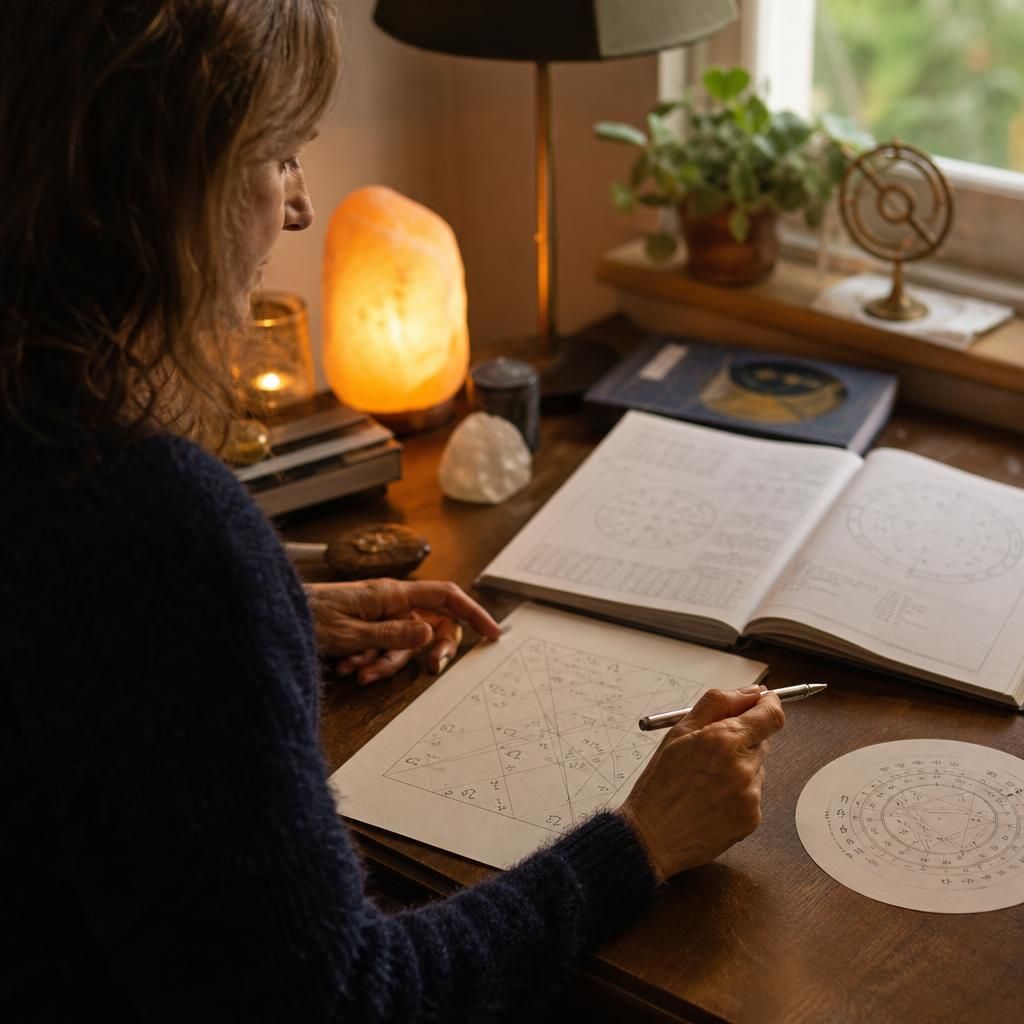
A planetary alignment in a Vedic birth chart is also interpreted through its dispositor: the planet that rules the sign occupied by another planet. This shows the underlying channel through which an alignment operates, beyond the visible connection between the planets themselves.
For example, if Mars is placed in a sign ruled by Saturn, the condition and placement of Saturn become relevant to how Mars expresses its initiative and drive. If Saturn is well supported, Mars may operate with greater discipline; if Saturn is compromised, the same placement may require more patience and produce frustration. A reading may trace several links in this way, creating a dispositor chain that reveals which planet ultimately carries the alignment’s influence.
When two planets occupy each other’s signs, known as a sign exchange or parivartana, their themes become closely connected even if they are not together in one house. The exchange is then judged by the condition of both planets and the life areas they govern. This helps distinguish a direct conjunction from an indirect but significant planetary relationship.