


What tools do clairvoyants use during a reading session?
Clairvoyants may use tarot cards, crystals, pendulums or astrology charts as optional aids during a reading session. These tools can provide symbolism, focus a question or structure the discussion, while the clairvoyant’s impressions and interpretation remain central.
Beyond the commonly recognised aids, a clairvoyant may use scrying surfaces, runes, oracle decks, photographs, personal objects, numerological calculations or written notes during a reading. None of these items is essential: some practitioners work without physical tools and rely primarily on clairvoyant impressions, while others use one or more objects to organise their observations and questions.
Scrying surfaces include reflective objects such as a dark mirror, a polished stone or a bowl of water. The clairvoyant gazes at the surface in a focused way, allowing images, colours, symbols or impressions to arise. In practical terms, the surface acts as a concentration point rather than a screen that objectively displays future events. The practitioner interprets what they perceive in relation to the client’s question and the wider conversation.
Runes are marked stones, pieces of wood or tiles bearing traditional symbols. A practitioner may draw or cast them and then consider the meaning, position and relationship of the symbols selected. Runes can introduce a structured framework for exploring choices, obstacles and possible directions. Their interpretation depends on the system being used and the practitioner’s knowledge, so the same symbol should not automatically be treated as a fixed prediction.
Oracle decks are another possible aid. Unlike systems with a more established set of traditional meanings, oracle decks can vary considerably in theme, structure and symbolism. A reader may select a card to encourage discussion about a particular issue, identify a theme or help the client consider an alternative perspective. The imagery is usually interpreted alongside the client’s circumstances rather than in isolation.
Photographs and personal objects may be used in readings involving personal history or mediumship. A photograph, piece of jewellery or other meaningful object can serve as a point of concentration. Some practitioners describe this as psychometry: attempting to receive impressions associated with an object or its owner. A responsible reader should distinguish an impression from a verified fact and should not present uncertain information as proof.
Numerology tools may include a written calculation sheet, reference table or software-free chart based on details such as a name or birth date. The resulting numbers are interpreted symbolically to discuss traits, patterns or recurring themes. This is different from clairvoyance itself, because it follows a defined interpretative system rather than relying solely on spontaneous visual or intuitive impressions.
Written notes and diagrams are among the most practical tools used in a session. A clairvoyant may record key details, recurring symbols, questions or points that need clarification. Simple diagrams can help organise relationships, timelines or possible areas of focus. During a phone reading, notes can provide structure when there is no visual contact. In an email reading, the written format itself allows the practitioner to set out observations in a considered sequence.
Tools can have several functions within a session:
- Focusing attention: a physical object or image can help the practitioner settle their attention on the subject being discussed.
- Creating structure: a symbolic system can divide a broad question into themes such as circumstances, influences and possible choices.
- Encouraging dialogue: an image or symbol can give the client a specific point to respond to, clarify or explore.
- Recording impressions: notes help separate several ideas and reduce the risk of overlooking an important detail during a longer discussion.
The presence of a tool does not establish that a reading is accurate, nor does its absence mean that a clairvoyant lacks skill. The useful question is how transparently the practitioner explains the tool, how carefully they distinguish interpretation from fact and whether they allow the client to make their own decisions. A tool should support reflection, not be used to create fear, pressure or dependence.
For a remote reading, the method may be adapted to the format. A phone session can involve tools held or arranged by the practitioner while the client discusses the issue verbally. An email consultation may refer to selected symbols, calculations or impressions in written form. If a particular method matters to you, ask beforehand which tools are used, what they represent and whether the reading can proceed without them. Clairvoyant readings are best approached as spiritual or reflective guidance, not as a substitute for qualified medical, legal, financial or mental-health advice.
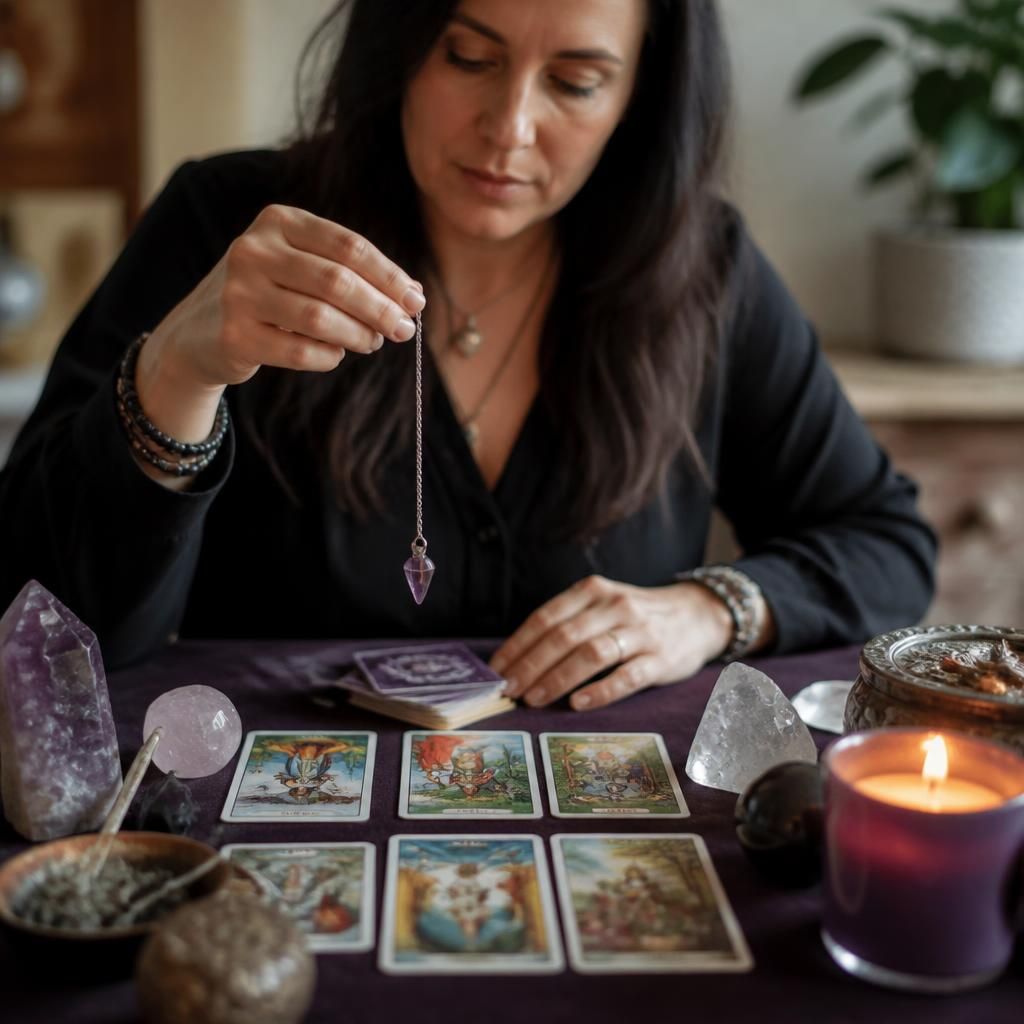
When a clairvoyant uses a photograph or personal object, privacy and consent should be considered before the session. Only share material you are comfortable discussing, and avoid sending original photographs, valuable jewellery or items containing sensitive personal information unless the arrangement is clearly explained.
- Ask whether an image or object is needed before the reading.
- Check how digital photographs or written details will be handled and whether they can be deleted afterwards.
- Obtain permission before sharing a photograph that identifies another person.
- Tell the practitioner if you do not want a particular item or image included.
A personal object should be treated as a voluntary aid to the discussion, not as evidence that establishes private facts about you or someone else. Clear boundaries help keep the session respectful and focused.
Ask About the Tools Used in Your Clairvoyant Reading
If you are considering a clairvoyant reading, contact Elizabeth Rose Psychics to discuss the approach that best suits your questions and preferences. You can then decide whether to arrange a consultation with a clear understanding of what to expect.