


How does psychic seeing differ from other intuitive practices?
Psychic seeing, or clairvoyance, involves receiving intuitive images, colours, symbols or visual impressions without relying on a physical tool. Tarot interprets cards, mediumship focuses on communication with spirits or the deceased, and astrology examines birth charts and planetary influences, so the main difference is the source and method of the insight.
Psychic seeing differs from other intuitive practices mainly through the way information is perceived and interpreted: it is centred on visual impressions arising directly in the reader’s awareness, whereas other approaches may rely on bodily sensations, inner sounds, symbolic systems, spiritual communication or calculated planetary patterns. The distinction is useful, but the practices can overlap when a reader uses more than one form of perception during a consultation.
Psychic seeing and general intuition
Intuition is a broad term for insight that appears without deliberate step-by-step reasoning. It may present as a feeling, an instinctive conclusion, a physical sensation or a sudden thought. Psychic seeing is a more specific form of intuitive perception because the information is experienced visually. A reader might notice a colour, place, object, face, movement or symbolic scene in the mind’s eye. These impressions are then considered in relation to the client’s question and circumstances.
This does not mean that every image has a fixed meaning. Interpretation depends on context, the sequence in which impressions arise and the associations they create for the reader or client. A bridge, for example, could suggest transition in one consultation and connection in another. Responsible interpretation therefore treats imagery as a prompt for reflection rather than as an automatic prediction.
Psychic seeing and other clair-based perception
Some intuitive practices are grouped under the term “clair” abilities, but they are distinguished by the sensory quality of the impression. Clairaudience is associated with words, sounds or phrases perceived internally. Clairsentience involves bodily sensations or emotional impressions, while claircognisance refers to a direct sense of knowing without a clearly visual, auditory or physical presentation.
Psychic seeing can occur alongside these forms. An image may be accompanied by a feeling, a phrase or a strong sense of significance. In practice, the useful distinction is not which ability is considered superior, but how the reader identifies, checks and communicates each impression. Separating what was seen from what was inferred helps keep the reading clear.
Psychic seeing and tarot
Tarot provides an organised framework for reflection. The cards offer established imagery, symbolic associations and a spread position that can shape the interpretation. Psychic seeing does not require that external structure, so the reader must observe the impression, establish its relevance and explain how it relates to the question.
The two approaches can complement one another. A card may prompt additional visual impressions, or a visual impression may add detail to a card-based interpretation. They should not be presented as identical methods: tarot gives the consultation a defined symbolic reference point, while psychic seeing is more dependent on the images that arise and the reader’s ability to interpret them responsibly.
Psychic seeing and mediumship
Mediumship has a particular focus on perceived communication involving spirits or people who have died. Visual impressions can form part of that work, but seeing an image does not automatically make an experience mediumistic. The purpose, perceived source and context of the information matter.
A reading focused on psychic seeing may explore symbols, circumstances or possible directions in a person’s life without making the consultation about contact with a deceased individual. Keeping these purposes separate helps the client understand what kind of guidance is being offered and prevents ordinary symbolic imagery from being treated as proof of spiritual communication.
Psychic seeing and astrology
Astrology uses a system based on birth details, planetary positions and the relationships between them. Its interpretation is structured around a chart and an established body of symbolism. Psychic seeing is not chart-dependent and is generally more immediate, with attention placed on the images perceived during the consultation.
Astrology may be used to examine themes, cycles and timing within its own framework, while psychic seeing may add a personal or symbolic perspective. If both are used, it is helpful to identify which observations come from the chart and which arise as visual impressions, rather than blending them into one unsupported conclusion.
How the approaches differ in practice
- Input: psychic seeing begins with an internally perceived image; other practices may begin with sensations, words, cards, a spiritual focus or chart information.
- Structure: visual impressions are usually less standardised than a card spread or astrological chart, so interpretation requires more contextual checking.
- Focus: psychic seeing often explores symbols, people, places and possible situations, whereas other methods may be designed around a specific interpretive system or type of communication.
- Verification: an image is considered more carefully when it can be clarified through questions, repeated themes or information supplied by the client, rather than accepted solely because it feels vivid.
- Communication: a clear reader distinguishes the original impression from personal interpretation and acknowledges uncertainty where an image has several possible meanings.
For anyone comparing these practices, the most suitable approach depends on the type of guidance sought. A person interested in symbolic visual impressions may prefer psychic seeing; someone wanting a defined interpretive framework may choose tarot or astrology; and someone specifically exploring perceived contact with the deceased may seek a mediumship-focused reading. Phone and email consultations can be used to discuss these different forms of spiritual guidance, provided the reader’s method and the limits of interpretation are understood in advance.
Psychic seeing should be treated as a reflective spiritual practice rather than a substitute for professional medical, legal or financial advice. Its value lies in how carefully impressions are explored, how clearly they are explained and how thoughtfully the client decides what, if anything, is relevant to their circumstances.
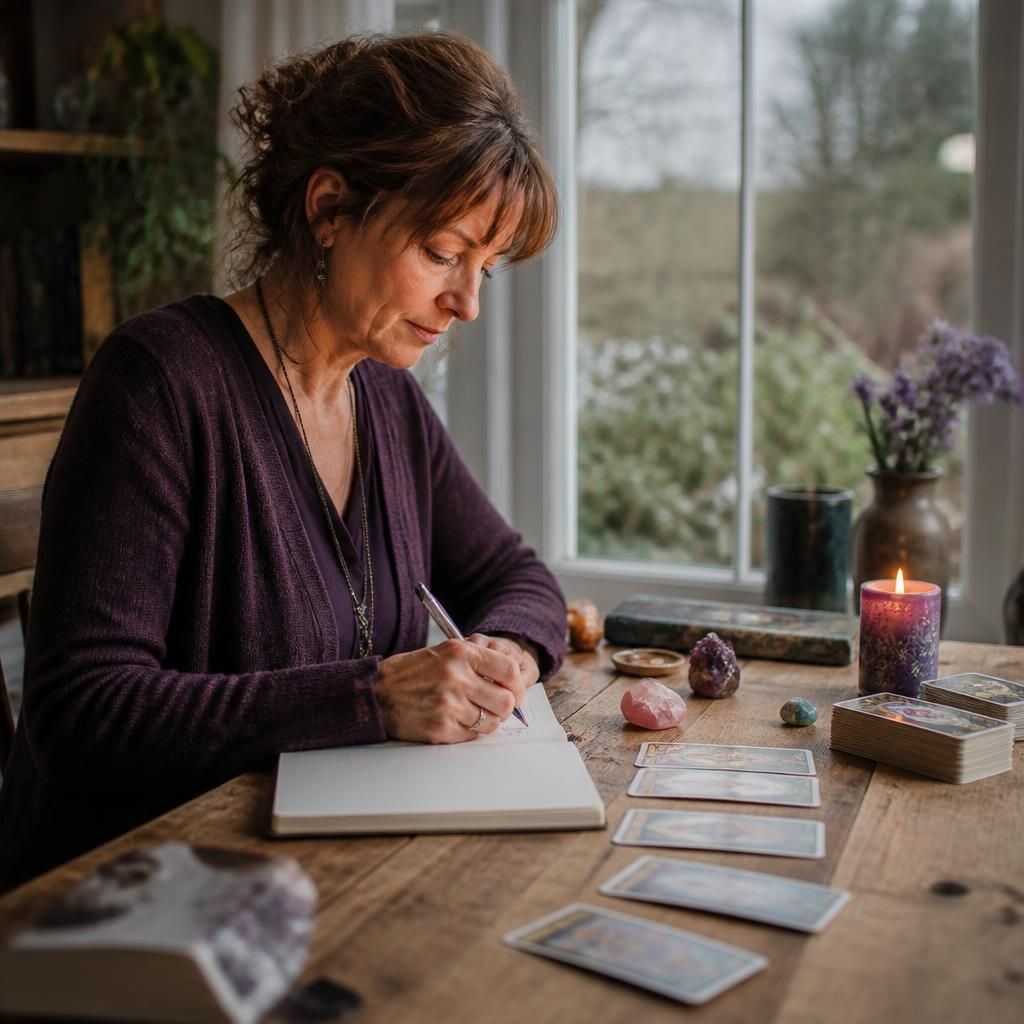
A further distinction is that psychic seeing is described as a spontaneous visual impression, rather than deliberate visualisation, ordinary imagination or a dream. In visualisation, a person intentionally creates a mental picture; in psychic seeing, the image is reported as arising without conscious effort during reflection or a reading.
This distinction still requires careful judgement. A vivid image is not automatically evidence of psychic information, and memories, expectations or emotions can influence what someone visualises. A responsible interpretation therefore considers whether the impression was unexpected, how it relates to the question and whether alternative explanations are plausible. This cautious approach separates claimed clairvoyant perception from ordinary mental imagery without treating either experience as a definitive fact.
Explore Psychic Seeing Through a Personalised Reading
If you would like to explore psychic seeing in relation to a specific question, consider arranging a personalised reading with Elizabeth Rose Psychics. You can discuss whether clairvoyance, tarot, mediumship or astrology best suits the type of guidance you are seeking through a phone or email consultation.