




How do astrological charts influence compatibility insights in email readings?
Astrological charts support compatibility insights by comparing two people’s birth details, including planetary placements, signs, houses and aspects. In an email reading, this comparison—known as synastry—can highlight areas of natural understanding, recurring tensions and differing emotional or communication styles, without treating compatibility as fixed or certain.
Astrological charts influence compatibility insights by providing a structured framework for interpreting how two individuals may relate, communicate and respond to one another. In an email reading, the charts help the reader organise observations into themes such as emotional security, attraction, shared values, conflict patterns and long-term expectations, rather than relying on a single sign or isolated feature.
The individual birth charts provide context. A compatibility interpretation is more useful when each person’s chart is considered on its own before the relationship is examined. This can show how someone typically gives and receives affection, processes stress, expresses needs and approaches commitment. The same relationship dynamic may feel supportive to one person but demanding to the other because their personal tendencies differ.
Synastry adds the relationship comparison. The reader can examine the connections between corresponding points in the two charts and assess whether they are harmonious, stimulating or more difficult to manage. For example, one person’s communication indicators may connect strongly with the other’s emotional indicators, suggesting that conversation and emotional understanding are closely linked. A challenging connection may point to misunderstandings or defensiveness, but it does not by itself establish that a relationship cannot work.
Composite charts offer a further perspective. Whereas synastry focuses on how two people affect each other, a composite chart symbolically treats the relationship as its own entity. It may be used to explore the tone of the partnership, the areas of life where the relationship is most active and the issues that require joint attention. This can be particularly relevant when the question concerns the direction or purpose of the relationship itself rather than either individual’s behaviour.
Charts can therefore contribute insight into several practical areas:
- Emotional compatibility: whether each person’s instinctive responses and emotional needs are likely to feel understood, supported or difficult to accommodate.
- Communication: how directly each person expresses ideas, how disagreements may develop and which misunderstandings could recur.
- Attraction and affection: the forms of attention, intimacy and reassurance that may feel meaningful to each person.
- Values and priorities: potential agreement or friction around independence, security, ambition, family life and personal principles.
- Pressure points: subjects that may require clearer boundaries, patience or deliberate compromise.
- Shared potential: qualities that can support cooperation, learning and mutual development when both people engage with them constructively.
Interpretation depends on the strength and repetition of a pattern. One isolated contact is rarely treated as decisive. Greater weight is usually given to themes that appear in several parts of the comparison, particularly when they involve important relationship indicators or are reinforced by the composite chart. A supportive feature may soften a more difficult pattern, while a demanding feature may create useful motivation for honesty and growth. This is why a responsible reading avoids reducing compatibility to a simple score.
The accuracy and depth of the chart work also depend on the information supplied. The date, place and precise time of birth can affect the calculation, especially where house positions or time-sensitive factors are involved. If a birth time is uncertain or unavailable, an email reading can still discuss some broader chart themes, but conclusions that depend on exact angles or houses should be treated more cautiously. Supplying the reader with the question behind the consultation can also help distinguish between general compatibility and a specific concern, such as communication after an argument or uncertainty about commitment.
An email format can make the chart interpretation easier to review because the explanation is presented in writing. The reader can separate the technical observations from the practical guidance, return to particular themes and consider how they relate to lived experience. It is still important to compare the interpretation with actual behaviour. Astrology can suggest tendencies and questions for reflection; it cannot replace direct communication, informed judgement or attention to patterns in the relationship.
For that reason, astrological charts are best used as interpretative tools rather than fixed verdicts. They may clarify why two people experience the same situation differently and identify areas where cooperation is more natural or requires conscious effort. The final insight comes from combining the chart symbolism with the circumstances described in the email, while keeping personal choice and changing relationship dynamics in view.
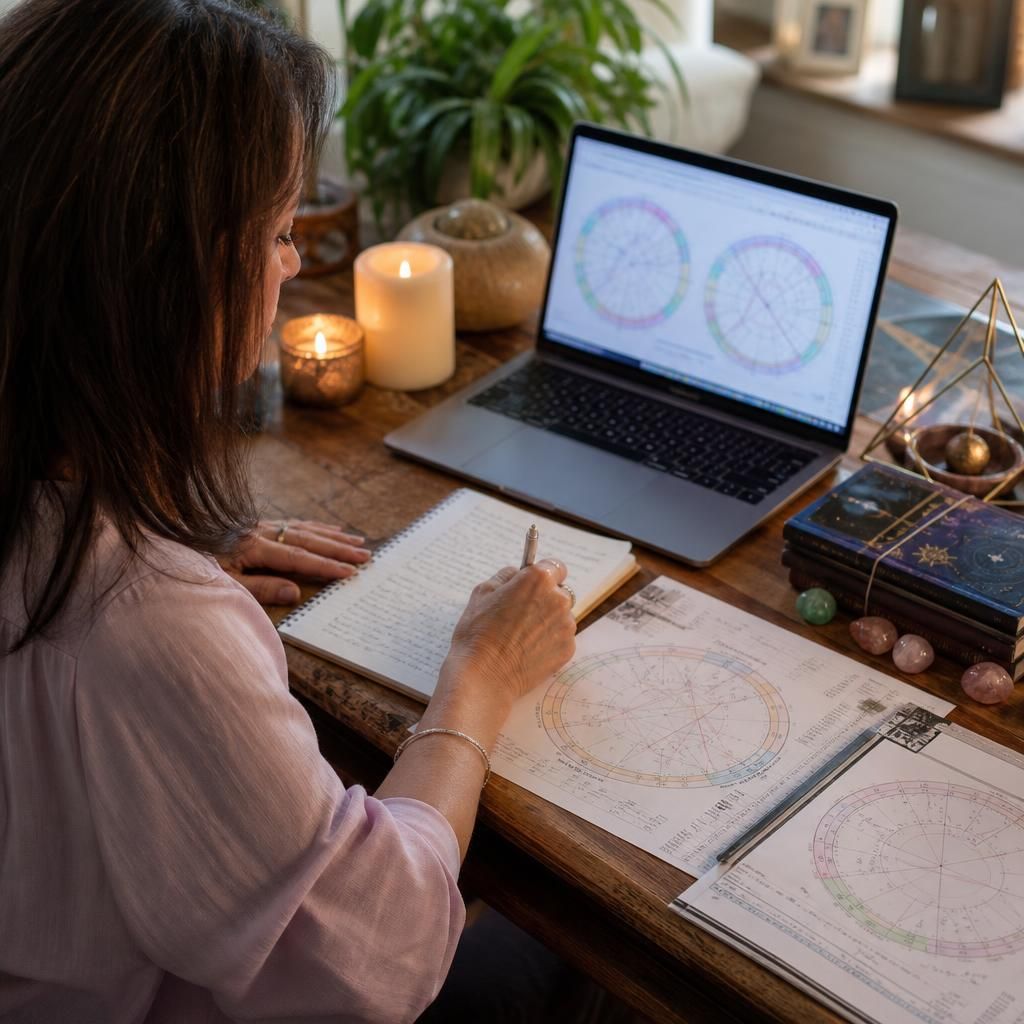
House overlays show where compatibility themes may be felt. In synastry, one person’s planets are examined in relation to the other person’s houses, linking the connection to particular areas of life. For example, activity involving the seventh house may bring partnership concerns into focus, while connections with the third, fourth or tenth houses may relate more closely to communication, home life or ambitions.
These overlays help an email reading move beyond general personality descriptions by identifying the relationship settings in which certain dynamics may become noticeable. They are not interpreted as fixed outcomes: the meaning of a house placement depends on the planet involved, its sign and its connections elsewhere in the charts. Used together, these factors provide a more specific account of how each person may experience the relationship.