


What should you expect during a telephone clairvoyance session?
During a telephone clairvoyance session, you discuss the focus of your reading, then the clairvoyant shares impressions and interpretations received through clairvoyant perception. You can ask relevant questions throughout, clarify what you hear and use the closing part of the session to reflect on the guidance provided.
A telephone clairvoyance session is a private, voice-based consultation in which a clairvoyant uses perceived impressions to offer spiritual insight about the areas you have chosen to explore. Because the reading takes place by phone, the session depends on spoken communication, attentive listening and the interpretation of impressions rather than on face-to-face observation.
Before the session, it is useful to identify the main area you want to understand. This might be a relationship, a career decision or a broader question about personal direction. You do not need to prepare a detailed account of your life. A short, honest outline gives the clairvoyant context while leaving room for the reading to develop naturally. Keeping a note of particular points you want to cover can also help you use the consultation constructively.
At the beginning, the clairvoyant will normally establish what you would like the session to address and may invite you to explain enough background to distinguish the central issue from surrounding details. You can decide how much personal information to disclose. A reading should not require you to reveal anything that makes you uncomfortable, and you can state boundaries around subjects you do not wish to discuss.
The main part of the session involves the clairvoyant describing impressions, symbols, feelings or possible patterns and then interpreting how these may relate to your circumstances. Clairvoyance is not a process of producing a fixed script of events. Interpretations can depend on the context you provide and on how particular impressions connect with your situation. You may therefore hear possibilities, themes or areas for consideration rather than definite predictions.
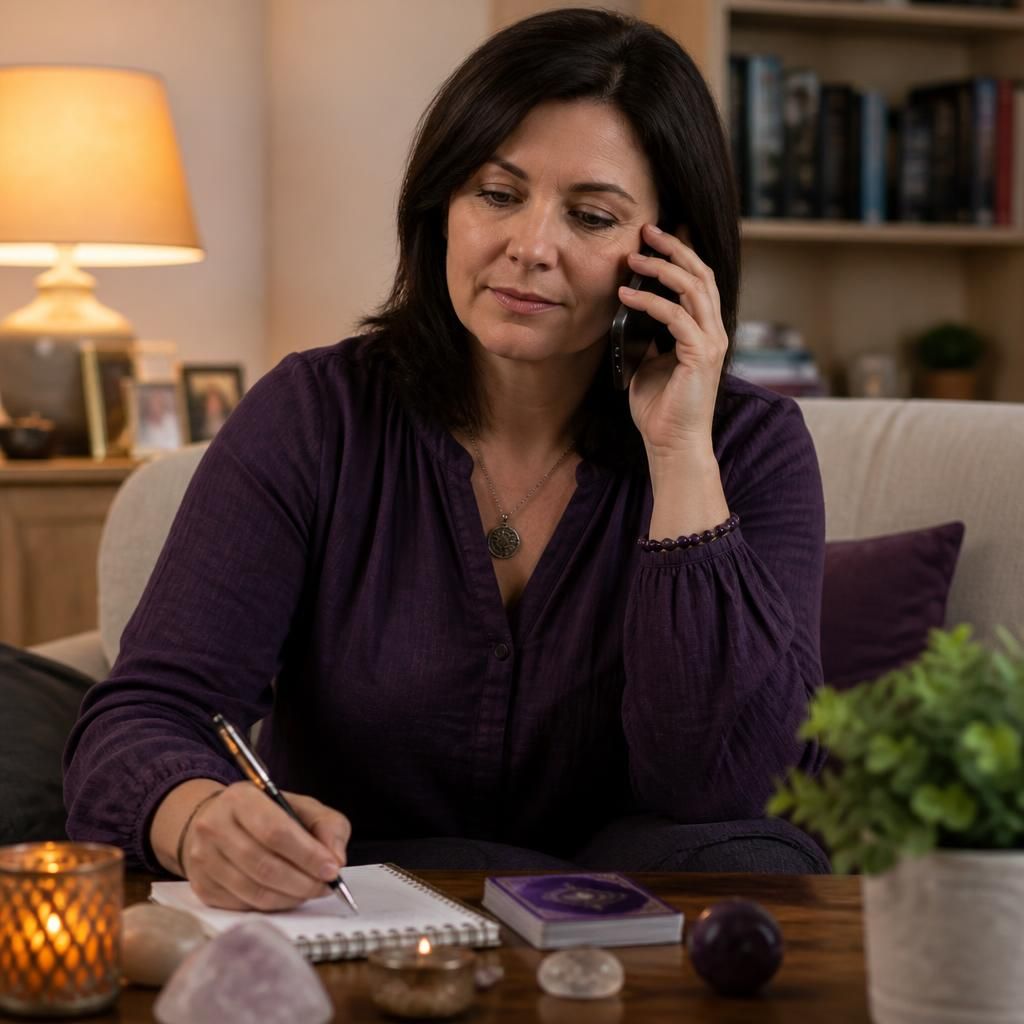
Telephone readings can feel different from in-person consultations because there is no shared physical setting to observe. The clairvoyant works through the conversation itself, while you listen for details that are relevant to your circumstances. Clear speech and a quiet, private place can make it easier to concentrate. If a point is unclear, ask for it to be explained in different words rather than assuming what it means.
A useful session is collaborative without requiring you to lead the interpretation. You can provide clarification when a detail is relevant, correct a misunderstanding and indicate when an interpretation does not fit. At the same time, it is sensible to consider the guidance carefully instead of treating every statement as an instruction. Personal judgement remains important, particularly where a reading touches on major decisions.
You may wish to take brief notes during or immediately after the call. Record recurring themes, practical suggestions and any points that require further reflection. Notes can help separate what was actually said from your first emotional response and give you time to consider whether the guidance is useful in the context of your values and circumstances.
Telephone clairvoyance can address personal and spiritual concerns, but it should be understood within appropriate limits. It is not a replacement for qualified medical, legal or financial advice, and no reading can guarantee a particular outcome. For health concerns or decisions with significant consequences, use the relevant professional support alongside any spiritual perspective you receive.
Elizabeth Rose Psychics provides telephone readings for people throughout the USA, allowing the consultation to take place remotely rather than requiring travel to a physical venue. The essential expectation is a focused conversation in which clairvoyant impressions are explored thoughtfully, with enough space for you to assess their relevance and decide what, if anything, you wish to take forward.
A telephone clairvoyance session is interpretive rather than evidential: the impressions shared during the call are material for consideration, not proof that a particular event will occur. Their value depends on how clearly they relate to the issue you brought to the session and whether they provide a useful perspective.
When assessing what you hear, separate the impression itself from the interpretation attached to it. Consider whether the explanation is specific enough to be meaningful, whether it fits the circumstances you described and whether it leaves you free to make your own choices. Guidance should support reflection, not create pressure to act immediately or follow a decision that does not feel appropriate.