


What factors determine horoscope compatibility between two zodiac signs?
Horoscope compatibility between two zodiac signs is assessed through their elements, modalities, planetary influences, communication styles, emotional needs and shared values. A fuller comparison considers how these factors interact, revealing areas of natural understanding as well as differences that may require awareness and compromise.
Horoscope compatibility is determined most accurately by comparing the two complete birth charts rather than judging the Sun signs alone. The most important considerations are the exact birth details, the relationships between planets in each chart, the houses activated by those contacts, and whether supportive and challenging patterns are balanced.
Sun-sign comparison is only a starting point. A zodiac sign describes the style in which a planet operates, but it does not show the whole personality or relationship pattern. Two people with supposedly compatible Sun signs may still have difficult chart contacts, while a pairing considered less obvious may work well because other placements create understanding and stability. A sign-to-sign comparison is therefore useful for broad themes, but a full synastry analysis gives a more individual assessment.
Accurate birth information affects the reliability of the comparison. The date and place of birth establish the planetary positions, while the birth time is particularly important for the Ascendant and house cusps. An uncertain birth time can make house overlays and some chart angles unreliable. It may also affect the position of the Moon if it changed signs on that date. Where birth data is incomplete, the interpretation should be treated as a general indication rather than a precise relationship analysis.
Planetary aspects show how the charts interact. In synastry, an aspect occurs when planets or sensitive points form a recognisable angle between the two charts. The type of aspect helps describe the quality of the interaction:
- Trines and sextiles often indicate ease, cooperation and a natural ability to support one another.
- Conjunctions can create a strong sense of recognition because the two energies are concentrated in the same area. Their effect depends on the planets involved and can be harmonious or demanding.
- Squares and oppositions may create friction, but they can also bring energy, motivation and awareness of differences. Their value depends on whether both people can respond constructively.
The closeness of an aspect, known as its orb, also matters. A close contact usually carries more weight than a wide one, although astrologers differ in the orbs they accept. One isolated aspect should not determine a verdict; repeated themes across several contacts are more significant.
The planets involved identify the relationship area being activated. Contacts involving the Sun can affect identity and recognition, while Moon contacts often describe instinctive responses and a sense of familiarity. Venus and Mars are commonly examined in attraction and relating patterns, but they should be interpreted alongside the rest of the chart rather than treated as a complete measure of romantic potential. Saturn contacts may point to responsibility, endurance or restriction, depending on the aspect. Outer-planet contacts can describe deeper generational themes and may be less personal unless they connect closely with important chart points.
House overlays add practical context. When one person’s planet falls into a particular house in the other person’s chart, it shows where that person may have the strongest influence. For example, activity around the fifth house can highlight romance, pleasure and creativity; the seventh house is associated with partnership; and the eighth house may intensify trust, vulnerability and shared resources. The twelfth house can introduce subtle, private or difficult-to-define dynamics. House placements do not automatically indicate a positive or negative outcome: the planet, sign and aspects must all be considered.
Chart rulers and angles can strengthen the connection. The Ascendant, Descendant, Midheaven and Imum Coeli are sensitive points linked with identity, partnership, public direction and private life. Close contacts to these angles can make an interaction feel particularly noticeable or consequential. The rulers of the seventh house and other relevant houses may also show what each person seeks in partnership and how those expectations are expressed.
Compatibility depends on balance, not on the absence of difficult contacts. A chart containing only easy aspects may suggest comfort but not necessarily growth or sustained engagement. Challenging contacts can expose differences in pace, priorities or responses, while supportive contacts may provide the patience and goodwill needed to manage them. The most useful interpretation weighs the whole pattern, identifying both resources and pressure points instead of labelling the pairing simply as compatible or incompatible.
Astrological compatibility is interpretive rather than deterministic. It describes tendencies and areas requiring attention; it does not establish whether a relationship will succeed or make personal decisions on either person’s behalf. Communication, consent, boundaries, circumstances and behaviour remain outside the chart and have a direct effect on relationship choices. Horoscope analysis is therefore best used as a framework for self-reflection, particularly when its observations are tested against the actual experience of the two people.
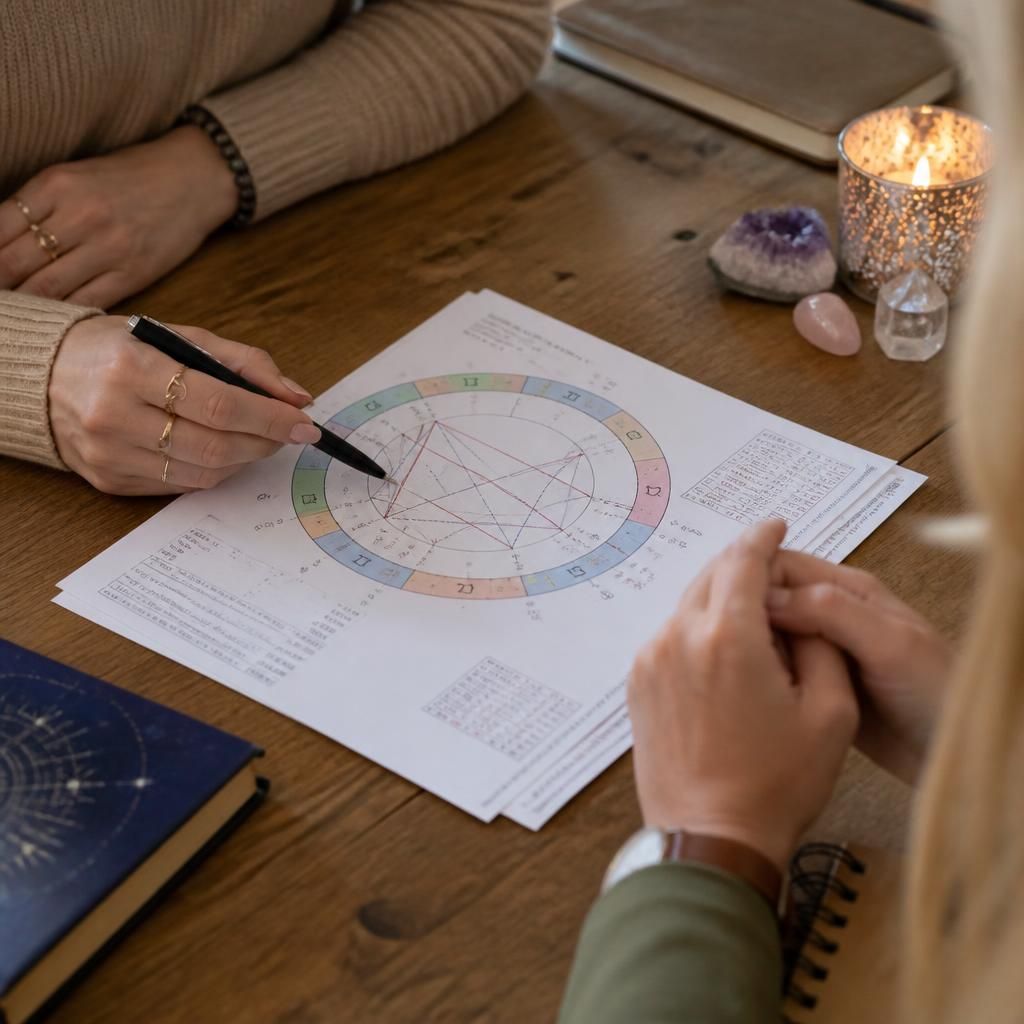
A composite chart is another factor astrologers may consider when assessing horoscope compatibility. Rather than comparing two birth charts directly, it combines them to describe the relationship as a distinct pattern, including its overall tone, priorities and likely areas of focus.
This approach can add context when the individual charts show mixed signals. For example, strong attraction in synastry may exist alongside a composite chart that emphasises practical responsibilities, communication or emotional sensitivity. The composite chart does not replace either person’s birth chart; it offers a separate perspective on how the connection may function as a partnership.