






What tools and methods are used in natal chart analysis?
Natal chart analysis combines an astrological chart calculated from your birth details with interpretive methods involving planets, zodiac signs, houses and aspects. Astrologers may also examine planetary transits and progressions to relate the birth chart to changing themes in relationships, career and personal development.
Natal chart analysis typically uses astronomical reference data, chart-calculation software and a structured interpretive process. The tools establish the chart’s technical details, while the method determines which patterns deserve attention and how they can be discussed in relation to a person’s questions.
Ephemerides and astronomical data
An ephemeris is a reference table showing the calculated positions of celestial bodies at particular times. Astrologers use it to verify the data behind a chart, especially when examining a birth date from an earlier period or checking a chart produced by different software. Modern digital ephemerides perform these calculations electronically, but the underlying purpose is the same: to provide a consistent astronomical basis for the interpretation.
Accurate time-zone and location data are also important. The location helps determine the local relationship between the sky and the horizon, while the recorded birth time affects the chart’s angular structure. A difference of only a short period can alter some of the chart’s time-sensitive features, so an astrologer may check whether the supplied details are precise or approximate before drawing detailed conclusions.
Chart-calculation software
Astrology software converts birth information into a visual chart wheel and supporting tables. Depending on the programme, it may display:
- the calculated positions used to create the chart;
- the beginning and end points of each house;
- angular relationships between chart factors;
- degrees, minutes and movement direction;
- alternative house systems and zodiac settings; and
- additional chart formats for comparison or further study.
Software is primarily a calculation and organisation tool, not an independent source of meaning. Two astrologers can use the same chart and reach different interpretations because they may prioritise different traditions, symbols or life themes. A careful reading therefore distinguishes between what the software calculates and what the astrologer infers from it.
House systems and zodiac settings
Astrologers may select from several house systems, which divide the chart into areas associated with different fields of experience. Common approaches include systems based on equal divisions and systems that take account of the local horizon and meridian. The choice can change the position of a chart factor near a boundary, so an astrologer may explain which system has been used and whether another system produces a substantially different emphasis.
Zodiac settings are another technical choice. Most Western natal work uses a seasonal zodiac, while some approaches use a star-based zodiac. These settings are not interchangeable, and they can assign chart factors to different signs. The important practical point is consistency: the interpretive rules should match the calculation system selected.
Chart synthesis
The central method is synthesis: combining individual indications into a coherent interpretation rather than treating every symbol as a separate prediction. An astrologer may assess the prominence of a chart factor by considering its position, condition, relationships with other factors and relevance to the reader’s question. Repeated themes generally receive more weight than an isolated indication.
This process involves prioritisation. A reading that lists every detail can be technically comprehensive but difficult to use. A more focused analysis usually begins with the strongest structural features, then connects them to specific subjects such as relationships, work or personal development. Interpretations should also account for apparent tensions, showing how contrasting tendencies might operate together rather than labelling one as wholly positive or negative.
Traditional and modern interpretive methods
Different schools of astrology apply different rules. Traditional approaches may give greater importance to rulership, essential condition and established interpretive techniques. Modern approaches may place more emphasis on psychological language, personal development and the way symbolism is experienced subjectively. Some astrologers combine these approaches, whereas others follow one system closely.
These differences explain why two qualified practitioners may use the same technical chart but describe it in different terms. The method should be made clear enough for the reader to understand whether an interpretation is based on traditional judgement, modern psychological symbolism or a blended approach.
Birth-time rectification
When the recorded birth time is uncertain, some astrologers offer rectification. This involves comparing possible chart times with significant past events and looking for a time that appears to produce a more consistent pattern. Rectification is interpretive rather than a way to retrieve a missing official record, so it should be treated as an estimated working time rather than a verified fact.
A responsible analysis can also proceed without rectification by concentrating on features that are less dependent on an exact time and clearly identifying the limits created by uncertainty. This is preferable to presenting an approximate time as precise.
How the methods are applied in a reading
In a phone reading, the astrologer may use a prepared digital chart while explaining the relevant patterns verbally. A typical analytical sequence is:
- confirm the birth information and the question the reader wants to explore;
- check the calculation settings and identify any uncertainty in the data;
- establish the chart’s most prominent recurring themes;
- relate those themes to the chosen subject without treating symbolism as fixed fate;
- invite clarification where the interpretation could apply in more than one way; and
- summarise the main points in practical, understandable language.
Astrological tools support symbolic interpretation; they do not diagnose medical or mental-health conditions, establish objective causes or guarantee a particular outcome. The most useful analysis presents its conclusions as reflective guidance, separates calculation from interpretation and leaves room for the reader’s own circumstances and judgement.
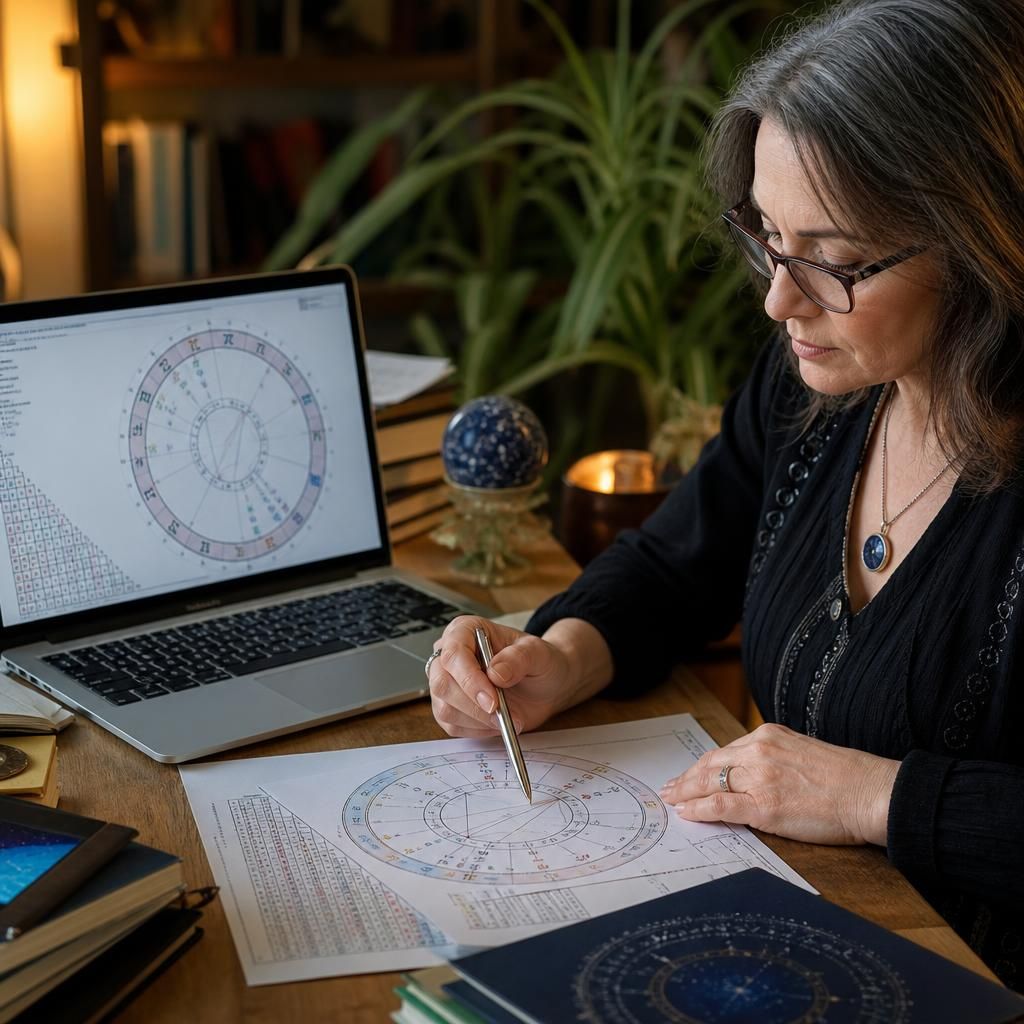
Aspect analysis adds structure to the chart. An aspect grid or aspectarian helps identify angular relationships between planets and other chart points, while the chart wheel shows how those relationships are distributed across signs and houses. Astrologers may consider the type of aspect, its closeness in degrees, and whether the planets are moving towards or away from exact alignment.
Some methods also look for larger configurations, such as a concentration of several connected aspects. These patterns can indicate where different parts of the chart operate together, rather than treating each planetary placement as an unrelated feature. The astrologer then compares the aspect pattern with the relevant houses and signs before deciding how much interpretive weight it deserves.