


A natal chart is made up of several connected layers: the positions of the planets at birth, the zodiac signs they occupied, the houses they fell into, and the angular relationships between them. A complete interpretation also considers the chart’s angles, planetary dignity, motion, elemental balance and recurring patterns, rather than treating any single placement as a standalone prediction.
Planets and luminaries
The Sun, Moon and planets represent different functions within the personality and life experience:
- Sun: identity, vitality, purpose and the drive to express oneself.
- Moon: emotional responses, instinctive habits, security needs and inner life.
- Mercury: thinking, learning, speech and information processing.
- Venus: affection, attraction, values, pleasure and relating.
- Mars: desire, initiative, competition, anger and the way action is taken.
- Jupiter: growth, confidence, belief, opportunity and broader understanding.
- Saturn: responsibility, limits, discipline, structure and long-term development.
- Uranus: independence, disruption, innovation and sudden change.
- Neptune: imagination, spirituality, ideals, sensitivity and uncertainty.
- Pluto: transformation, power, deep psychological processes and regeneration.
The Sun and Moon are often called the luminaries because they describe central conscious and emotional functions. The inner planets tend to be read more personally, while the slower outer planets can describe broader generational influences unless they closely connect with a personal planet or angle.
Signs and their qualities
A planet’s sign describes how its function is expressed. Signs are commonly assessed through their element and modality. Fire signs are associated with action and enthusiasm, earth with practicality and material focus, air with thought and communication, and water with feeling and intuition. Cardinal signs initiate, fixed signs sustain, and mutable signs adapt. The balance of these qualities can suggest whether a chart is more action-oriented, stable, analytical or responsive.
Sign rulership adds another layer. Each sign is traditionally associated with a ruling planet, and that planet’s position can provide further context for how a placement operates. Astrologers may also consider whether a planet is particularly comfortable or challenged in a sign, using concepts such as domicile, exaltation, detriment and fall. These terms describe symbolic strength or ease, not a fixed judgement about a person.
Houses and life areas
The twelve houses locate chart symbolism in areas of life. The first concerns identity and self-presentation; the second resources and values; the third communication and immediate surroundings; and the fourth home, family and roots. The fifth relates to creativity, romance and enjoyment, while the sixth concerns routines, work habits and wellbeing. The seventh addresses committed partnerships, the eighth shared resources and profound change, and the ninth study, travel, belief and worldview. The tenth is associated with career and public direction, the eleventh with groups and aspirations, and the twelfth with retreat, unconscious material and private processes.
Planets placed in a house indicate where their themes are most visible. The sign on the beginning of a house, known as its cusp, describes the style of that area, while the house ruler can show where related developments may unfold. Different house systems can place a cusp or planet slightly differently, so the system used is relevant when comparing interpretations.
The chart angles
The four angles are especially prominent points:
- Ascendant: the eastern horizon at birth, linked with first impressions, approach to life and personal presentation.
- Descendant: opposite the Ascendant, associated with close partnerships and qualities encountered through others.
- Midheaven: the highest point of the chart, connected with public role, achievement and direction.
- Imum Coeli: opposite the Midheaven, relating to roots, home and private foundations.
A planet close to an angle is often given extra interpretive weight because its symbolism may be expressed prominently. Calculating these points accurately requires a reliable birth time; without one, the Ascendant, house cusps and Midheaven may be uncertain.
Aspects and planetary relationships
Aspects are measured angles between planets and other important points. A conjunction brings two influences together. An opposition creates polarity that may require balance, while a square indicates friction or pressure that can prompt development. Trines and sextiles are generally associated with easier flow or opportunities for cooperation. The closer an aspect is to its exact angle, the stronger it is usually considered, although interpretation also depends on the planets involved.
Some charts contain notable configurations, such as a grand trine, T-square, grand cross or yod. These patterns combine several aspects and can highlight recurring themes, concentrated strengths or areas requiring conscious integration. They should be interpreted alongside the individual planets rather than used as isolated labels.
Additional points and conditions
Astrologers may include the lunar nodes, which are points where the Moon’s orbit intersects the ecliptic. They are commonly used to explore patterns of familiarity, development and direction, although their meaning varies between traditions. Chiron may be considered in relation to vulnerability and healing themes, while asteroids and other points are usually treated as supplementary rather than fundamental components.
A planet’s condition also matters. Retrograde motion is an apparent backward movement from Earth’s perspective and is often interpreted as a more inward, reflective or individually expressed version of that planet’s themes. Sect, speed, visibility and proximity to the Sun may also be assessed in more traditional approaches.
Finally, the chart is read as an integrated system. A strong interpretation compares the planet, its sign, its house, its ruler and its aspects, then checks whether the same theme appears elsewhere. This prevents one placement from being treated as a complete description of personality, relationships or life direction.
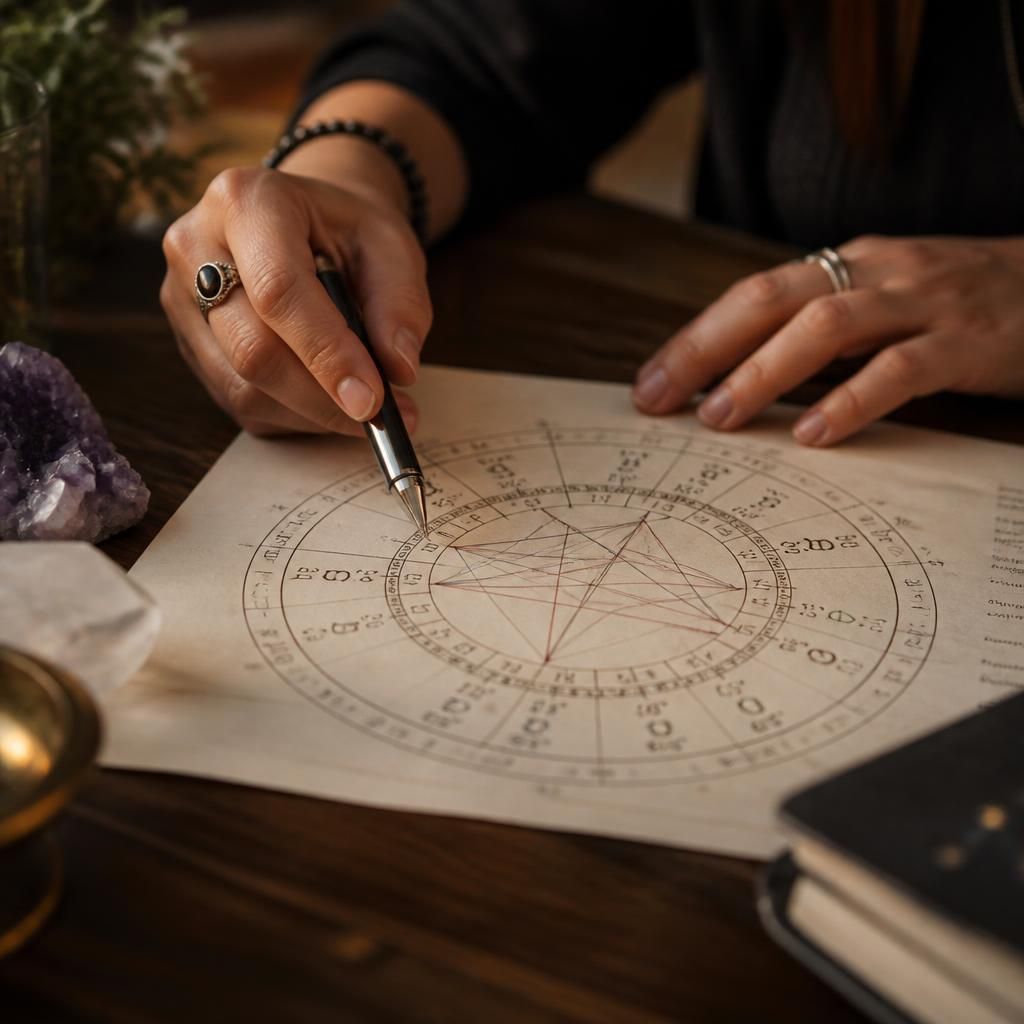
The chart ruler is an additional component that helps identify which planetary influence gives the natal chart a particular emphasis. It is the planet that rules the sign on the Ascendant. For example, if the Ascendant is in Gemini, Mercury becomes the chart ruler; its sign, house and aspects can show how the person approaches life and where attention is often directed.
Astrologers may also trace the chart ruler to the planet ruling its sign, creating a chain of rulership. This can connect apparently separate parts of the chart and indicate which placements have greater interpretive significance. The chart ruler does not override the other components, but it provides a useful organising principle when assessing the chart as a whole.
Explore the Key Components of Your Natal Chart
If you want to understand how your natal chart’s components work together, consider arranging a personalised natal chart analysis phone reading with Elizabeth Rose Psychics. A reading can place individual symbols within the wider structure of your chart and address the themes most relevant to your questions.