


Can a love fortune teller help with relationship decision-making?
Yes, a love fortune teller may help with relationship decision-making by offering a different perspective on emotional patterns, possible influences and personal priorities. A reading should support your reflection and confidence, rather than replace direct communication, careful judgement or professional advice where needed.
A love fortune teller can assist with relationship decisions by helping you examine a situation from several angles, identify the questions behind your uncertainty and consider how different choices may affect you. The value of a reading lies in structured reflection and spiritual interpretation, not in receiving an unchangeable verdict about what you must do.
Relationship decisions often involve incomplete information. You may be weighing whether to begin or end a relationship, address recurring conflict, rebuild trust, disclose your feelings, or decide whether a connection is compatible with your longer-term needs. A reading may explore the emotional themes surrounding the situation and highlight areas that deserve closer attention. It cannot establish another person’s thoughts as fact or guarantee a particular outcome.
During a consultation, the reader may use clairvoyance, mediumship, tarot or astrology, depending on the approach being offered. These methods are interpreted in different ways:
- Clairvoyance may provide impressions or images that the reader connects with your circumstances.
- Tarot uses symbolic cards to examine influences, behaviour patterns, possible developments and alternative courses of action.
- Astrology considers birth information and planetary patterns as a framework for discussing temperament, timing and relationship dynamics.
- Mediumship is intended to address spiritual communication and may be relevant when grief, remembrance or a sense of connection with someone who has died forms part of the consultation.
These approaches are spiritual practices rather than methods for proving future events. Their interpretations should be treated as material for consideration alongside what you know, what has actually happened and what the other person communicates directly.
To make a reading more useful, define the decision before the session. A broad question such as “Will this relationship work?” may produce less practical guidance than focused questions such as:
- What behaviour in this relationship needs my attention?
- What may I be overlooking before making a commitment?
- What could be the consequences of continuing with the current arrangement?
- How can I approach an honest conversation?
- Which information would I need before deciding?
Open questions generally leave more room for interpretation than questions seeking a simple yes or no. It can also help to explain the relevant context without trying to lead the reader towards a preferred answer. If the situation changes, a later reading may offer a different interpretation because the circumstances and your own response have changed.
After the consultation, separate the reading into three categories: observations that seem relevant, predictions that remain uncertain, and actions that are within your control. Compare the first category with specific evidence from the relationship. Treat the second as a possibility rather than a promise. The third can help you identify a sensible next step, such as setting a boundary, asking for clarification or taking time before committing yourself.
There are important limits to using a love fortune teller for decisions. Do not use a reading as the sole basis for choices involving coercion, abuse, stalking, financial dependence, legal matters or immediate personal safety. In those circumstances, factual support from an appropriate professional, trusted person or relevant service should take priority. Similarly, a reading cannot replace a medical, mental-health or legal assessment where one is needed.
Phone and email psychic readings can provide different formats for this kind of reflection. A phone consultation allows a direct exchange in which you can clarify an interpretation, while an email reading gives you written material to revisit. In either format, useful decision-making depends on keeping your own agency: listen critically, ask for clarification and avoid making a major commitment solely because a prediction sounds definite.
The most balanced way to use a love fortune teller is therefore as one input in a wider decision process. Combine the reading with direct conversation, observed conduct, practical circumstances, your boundaries and the advice appropriate to the seriousness of the issue. This approach allows spiritual insight to inform your thinking without handing control of the decision to someone else.
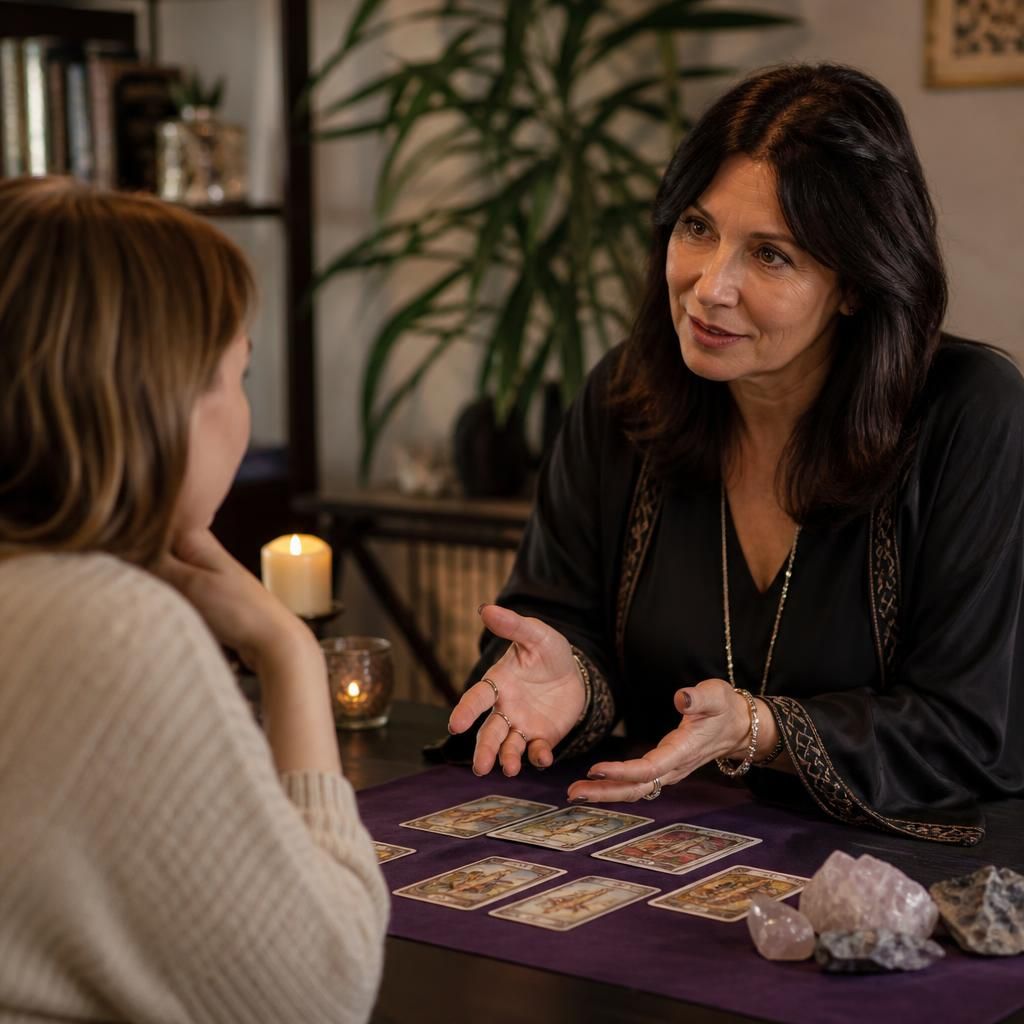
A love fortune teller is most useful for relationship decision-making when the reading preserves your independence. A responsible reader should present interpretations as possibilities, acknowledge uncertainty and allow you to disagree. They should not pressure you to continue booking readings, claim exclusive knowledge of another person’s thoughts, or tell you to ignore trusted people and relevant professional advice.
Before relying on a reading, consider whether it gives you practical questions to examine rather than fear-based predictions to follow. Useful prompts might encourage you to assess consistency, communication, shared expectations and how the relationship affects your wellbeing. This makes the consultation a tool for clearer thinking, not an authority that decides on your behalf.