





What types of questions can I ask during an online psychic reading?
During an online psychic reading, you can ask focused questions about relationships, career, health, personal growth and possible future developments. Open-ended questions often allow the reader to explore the surrounding circumstances, while specific questions can help keep the consultation centred on the issue you want to understand.
Questions for an online psychic reading are best framed around a particular situation, decision or pattern you want to understand. A reader may work more effectively with questions that invite insight into influences, possibilities and your own choices, rather than questions that demand an absolute prediction.
Relationships and emotional matters
Relationship questions can address an existing partnership, a developing connection, a separation or recurring difficulties. Useful examples include:
- What should I understand about the current dynamic between us?
- What influences may be affecting communication in this relationship?
- What can I learn from this situation before deciding how to proceed?
- What patterns should I be aware of in my romantic relationships?
- How might I approach a difficult conversation constructively?
Rather than asking only whether someone is “the one”, consider asking what supports compatibility, what obstacles may need attention and which factors are within your control. Questions about another person should be treated as guidance about the relationship, not as a substitute for direct communication or consent.
Career, work and decisions
Career questions can help you examine competing options, professional priorities and possible obstacles. You might ask:
- What should I consider before accepting this role?
- Which strengths could I develop or use more effectively at work?
- What may be influencing my uncertainty about changing direction?
- What lessons or opportunities are associated with my current career path?
- How can I approach a workplace decision with greater clarity?
When comparing choices, give enough context for the reader to understand the decision without presenting a long, leading account. Asking about the implications of each option can produce more useful discussion than asking for a simple instruction to choose one path.
Personal growth and recurring patterns
A reading can also focus on self-reflection. These questions move attention towards beliefs, habits and responses that may be shaping a situation:
- What personal pattern is worth examining at this point?
- What may be preventing me from moving forwards?
- Where could I benefit from setting a clearer boundary?
- What perspective might I be overlooking?
- What qualities can I draw on while handling this transition?
These prompts are particularly suitable when you do not have one defined prediction in mind. They allow the discussion to explore possible causes and constructive choices while leaving room for your own judgement.
Questions about possible future developments
Future-focused questions should be viewed as exploratory rather than certain forecasts. Instead of asking, “Exactly what will happen and when?”, you could ask:
- What possibilities appear to be developing around this situation?
- What factors could change the likely direction?
- What should I prepare for as I consider this option?
- What signs might indicate that circumstances are changing?
- What choices could influence the outcome?
Predictions are affected by circumstances and decisions, so asking about conditions, alternatives and areas of influence generally gives a more balanced basis for reflection. Avoid treating a reading as a guaranteed timetable or as proof that a particular event must occur.
How to make questions more useful
- Choose a central subject. Identify whether the main concern is a relationship, decision, professional issue or personal pattern. This helps prevent the consultation becoming a collection of unrelated questions.
- Use neutral wording. “What should I understand about this situation?” leaves more scope for insight than “You agree that I should leave, don’t you?”
- Separate connected issues. If a question involves both a relationship and a career decision, divide it into two prompts so that each matter can be considered properly.
- Ask about your choices. Questions concerning your actions, boundaries and preparation are usually more practical than attempts to control another person’s behaviour.
- Prioritise. Prepare a short list and place the most important issue first. Follow-up questions can then clarify points that arise during the reading.
Follow-up questions to consider
After an initial response, concise follow-ups can test your understanding without directing the answer. For example, ask what may be contributing to the situation, what alternative interpretation should be considered, what practical step is within your control, or what could make the circumstances change. You can also ask the reader to distinguish between a present influence and a possible future development.
Keep important decisions grounded in evidence and independent judgement. Psychic guidance may be used as a reflective tool, but it should not replace qualified medical, legal or financial advice, crisis support, or direct conversations with the people involved.
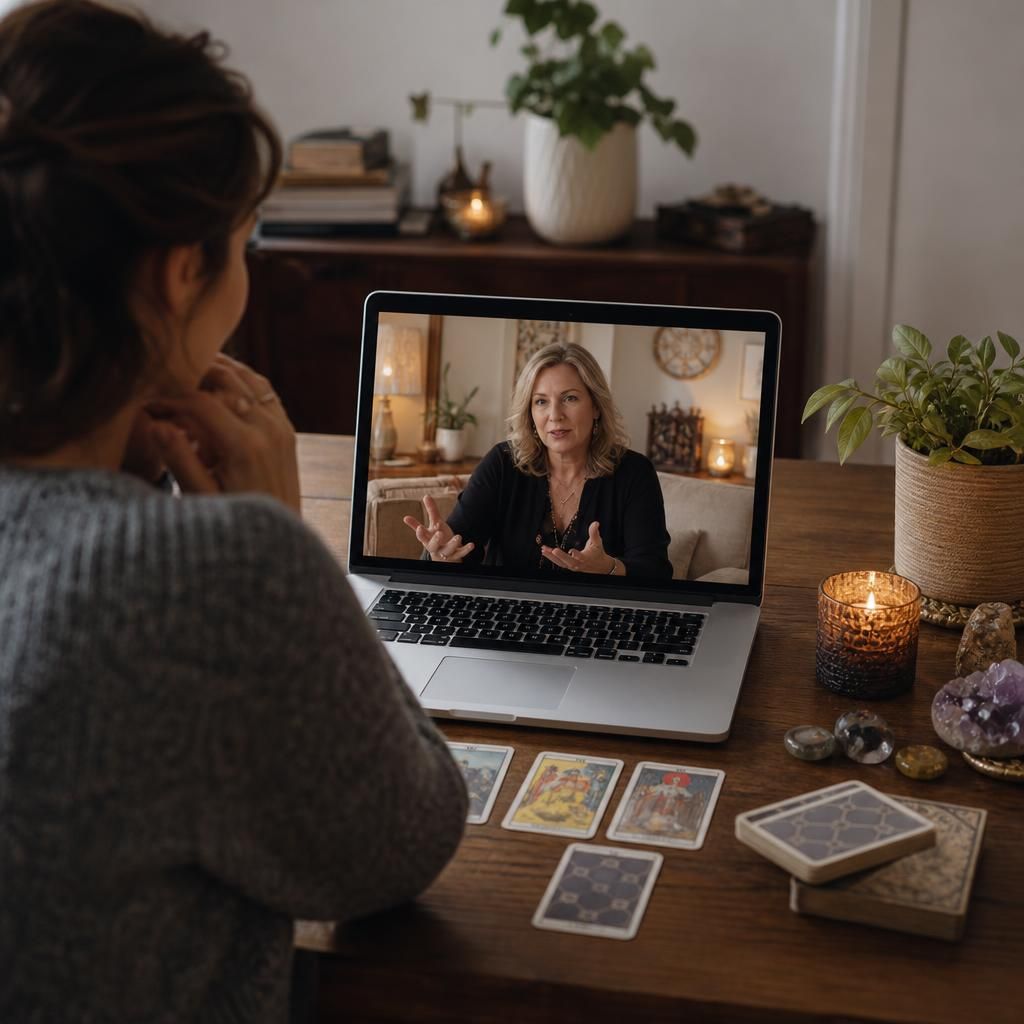
The most useful questions usually fall into one of four purposes: understanding a situation, exploring options, preparing for change or reflecting on your own response. Identifying the purpose before a reading helps you judge whether the answer addresses what you actually wanted to know.
- Understanding: What underlying influences may be shaping this situation?
- Exploring options: What are the potential implications of each path I am considering?
- Preparing: What should I keep in mind if circumstances begin to change?
- Reflecting: What assumption or reaction might be affecting my perspective?
You can then use the response to refine your enquiry. For example, if the discussion identifies uncertainty as an influence, ask how that uncertainty could be examined rather than immediately requesting another prediction. This keeps the reading focused on useful information and gives you a clearer basis for evaluating the guidance afterwards.