


What types of cards are used in psychic card readings for love?
Psychic card readings for love most commonly use tarot cards and oracle cards. Tarot offers structured symbolism through the Major and Minor Arcana, while oracle decks use varied themes and imagery to explore feelings, relationship dynamics and possible directions.
Psychic card readings for love may use several different systems, with tarot, oracle, Lenormand and ordinary playing-card decks being the main options. Each system has its own symbols, structure and method of interpretation, so the most suitable deck depends on the reader’s training and the type of relationship question being explored.
Tarot cards are widely used when a reading needs detail about emotional patterns, choices and relationship development. A full tarot deck contains Major Arcana cards, which are often associated with significant themes or turning points, and Minor Arcana cards, which can add detail about communication, feelings, behaviour and day-to-day circumstances. The four Minor Arcana suits are commonly linked with different areas of experience:
- Cups are traditionally associated with emotions, affection, intimacy and emotional connection.
- Wands can relate to attraction, desire, confidence and the energy a person brings to a relationship.
- Swords often concern thoughts, conversations, decisions, conflict and mental tension.
- Pentacles may highlight stability, practical commitments, shared responsibilities and the tangible side of a partnership.
Tarot court cards can also be relevant in love readings. They may represent people, personality traits or different ways of responding to a situation. For example, a court card might suggest someone who is emotionally expressive, intellectually guarded, dependable or impulsive, although its meaning depends on the surrounding cards and the reader’s interpretation.
Oracle cards are less standardised than tarot. An oracle deck may focus on relationships, emotions, personal development, archetypes, affirmations or particular spiritual themes. Some decks have a short phrase or direct message on each card, while others rely mainly on artwork and symbolism. This makes oracle cards adaptable for questions about feelings, intentions, personal boundaries and possible approaches to a relationship.
Lenormand cards use concise symbols such as the heart, ring, bouquet, crossroads, rider and anchor. Their meanings are usually read in combinations rather than as isolated messages. In a romantic reading, a heart may point towards affection, while a ring can raise themes of commitment or an agreement; the cards beside them help determine the more specific context. Lenormand is often chosen when the reader wants a direct, situational style of interpretation rather than a highly psychological one.
Playing cards can also be used in cartomancy, a form of divination based on a standard pack. The suits are commonly interpreted as broad areas of life, while the numbers and court cards add detail. In a love-focused reading, the meanings may be adapted to examine attraction, communication, practical compatibility or obstacles. Because playing-card traditions differ, it is useful to ask the reader which system they follow before attaching a fixed meaning to a card.
Some readers combine a primary deck with a secondary deck. For example, tarot may provide the main structure of a reading, while an oracle card is drawn to summarise a theme or suggest a reflective question. Other readers use clarifying cards when a symbol is ambiguous. A clarifying card does not necessarily override the first card; it is better understood as additional context.
The artwork and design of a deck can influence how a reader works, but the deck itself does not determine the quality or certainty of an interpretation. A thoughtful reading considers the question, the position of each card in the spread, the relationship between cards and the circumstances described by the client. Cards are best treated as interpretive tools for reflection rather than objective proof of another person’s private thoughts or a guaranteed prediction of future events.
When choosing a psychic card reading for love, ask which deck or decks will be used, whether the reader follows a particular tradition and how they handle sensitive questions about another person. A clear reader should distinguish symbolic guidance from verifiable fact and encourage decisions based on direct communication, personal judgement and real-world circumstances.
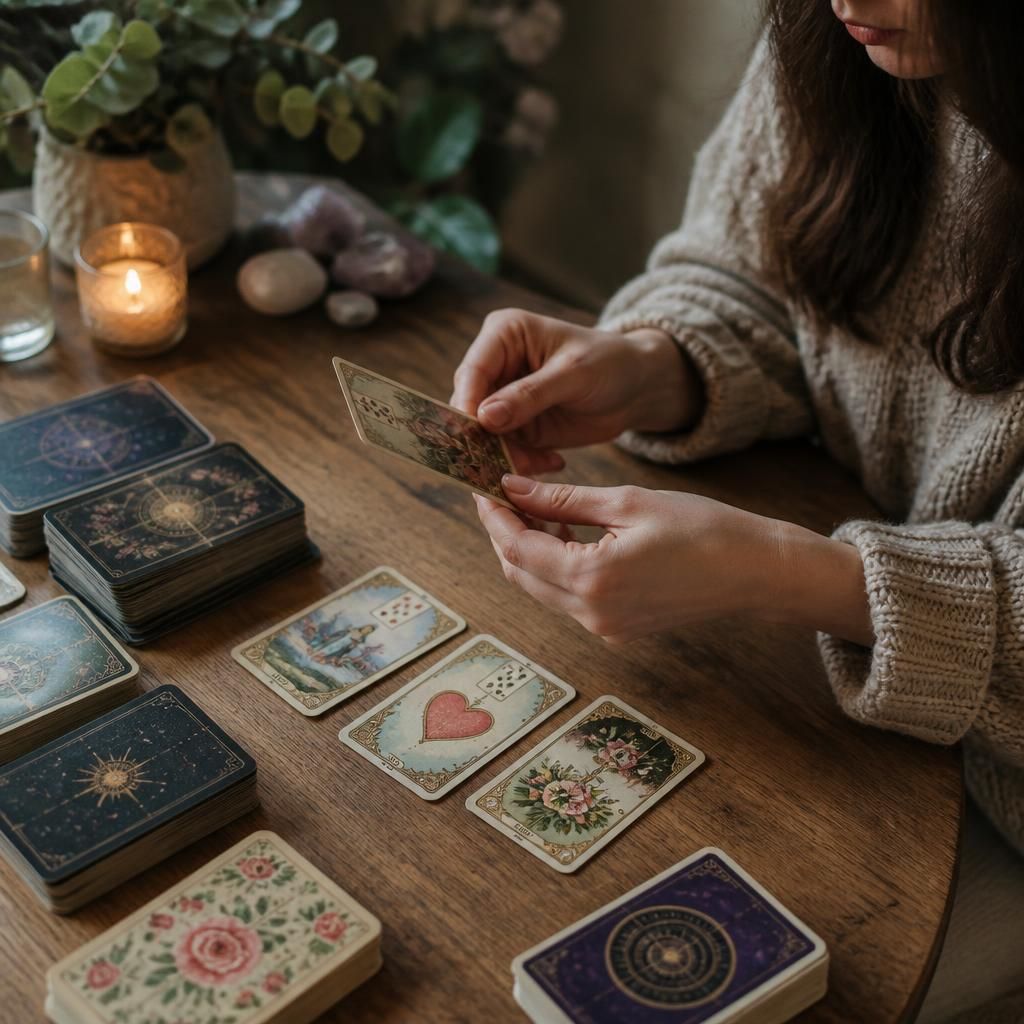
There is no single, universally recognised “love card” system. A deck marketed for romance may be a themed tarot deck or an oracle deck, while the underlying reading method still depends on the deck’s structure and the reader’s tradition. Romantic artwork alone does not make a deck more suitable for relationship questions.
When assessing a deck for a love reading, consider whether its imagery helps explore the issue you want to understand. A relationship-focused deck may use direct language about attraction, boundaries or commitment, whereas a general deck may offer broader symbols that require more interpretation. The important distinction is how clearly the reader explains the system and applies it to your question, rather than whether the cards are labelled specifically for love.