



How does a cartomancy love reading differ from other types of love readings?
A cartomancy love reading interprets cards—often through their suits, numbers and combinations—to explore romantic circumstances, influences and possible developments. Unlike astrology, which examines birth details and planetary movements, or a psychic reading based primarily on intuitive perception, cartomancy uses a card spread as the main framework; tarot also uses cards but follows a distinct, more symbolically structured deck and tradition.
A cartomancy love reading differs from other love readings primarily through its method of interpretation: it uses a defined card spread to examine relationship dynamics, influences and possible directions. The cards provide a structured reference for the reading, whereas astrology relies on birth information and planetary patterns, clairvoyance centres on intuitive impressions, and mediumship focuses on communication associated with someone who has died.
The term cartomancy can be used broadly to describe divination with cards, which means tarot may technically fall within the wider category. In everyday reading services, however, “cartomancy” commonly refers to interpretations using standard playing cards or other non-tarot card systems. Tarot has its own deck structure, imagery and established symbolic tradition. This distinction matters because the card meanings, spread conventions and interpretive vocabulary may differ even when both readings involve drawing cards.
Compared with astrology, cartomancy is less dependent on personal birth data. An astrological love reading may consider details such as birth dates, birth times and locations before examining planetary placements, transits or relationship charts. A cartomancy reading instead begins with the question and the cards drawn for that situation. It can therefore be used to explore a particular concern without building a chart first, although the usefulness of any reading still depends on the clarity of the question and the reader’s interpretive skill.
Cartomancy also differs from a purely psychic or clairvoyant reading. In a clairvoyant consultation, the practitioner may describe impressions, images, feelings or perceptions received intuitively. In cartomancy, those impressions are interpreted alongside visible card symbols, positions and combinations. The cards create a traceable framework: a reader can explain how a suit, number, court card or relationship between cards contributes to an interpretation. This does not make the reading an objective prediction, but it can make the discussion easier to follow and review.
Mediumship has a different purpose again. A mediumship reading is concerned with an apparent connection to a deceased person and may address memories, character, messages or unresolved feelings associated with that person. A cartomancy love reading is ordinarily concerned with the living relationship itself, such as communication patterns, emotional priorities, obstacles or the choices available to the people involved. If grief or a deceased partner is central to the question, mediumship may be the more relevant category; if the concern is how to understand a current romantic situation, card-based interpretation is more directly aligned.
The differences can be considered across several practical features:
- Primary source of information: cartomancy uses a card spread; astrology uses chart data; clairvoyance uses intuitive perception; and mediumship is framed around connection with the deceased.
- Shape of the enquiry: cards are well suited to a focused question about a present situation, a choice or a developing pattern. Astrology often takes a broader, time-based view, while psychic readings may be more open-ended.
- Interpretive structure: cartomancy considers individual cards, their positions, suits, numbers and combinations. Other methods use different systems, so the same relationship question can produce a different style of explanation.
- Role of the reader: a card reader interprets a spread rather than simply reporting a card’s dictionary meaning. Context, wording, surrounding cards and the reader’s professional judgement all affect the final explanation.
- Type of guidance: cartomancy can help organise reflection around influences, options and likely tendencies. It should not be treated as proof that another person will act in a particular way or as a substitute for direct communication and personal judgement.
Another important difference is how the reading handles uncertainty. A responsible cartomancy interpretation describes possibilities and patterns rather than presenting the future as fixed. For example, cards may be read as indicating hesitation, competing priorities or a need for clearer communication. That interpretation can help a client examine the situation, but it cannot establish another person’s private thoughts or guarantee a particular romantic outcome. The same principle applies to tarot, astrology and psychic readings: their value lies in the framework they offer for considering a concern, not in certainty about events.
The quality of a comparison also depends on whether the practitioner uses one method consistently or combines several. Some readers may draw cards and then add intuitive impressions or astrological context. That is a blended reading rather than a strictly card-led cartomancy reading. Before proceeding, it is reasonable to ask which deck or card system will be used, whether the interpretation will be based mainly on the spread, and whether other methods will be included.
For an email reading, the method can be particularly clear when the practitioner sets out the question, spread and interpretation in writing. The reader can distinguish the meaning of the individual cards from the conclusion drawn about the relationship, and the client can return to the explanation when considering it later. A precise question and relevant context help keep the interpretation focused, without requiring unnecessary personal information about another person.
In short, cartomancy is distinguished by its card-led structure and its emphasis on interpreting relationships through a spread rather than through a birth chart, undirected intuition or mediumistic communication. It may overlap with tarot in the broad meaning of card divination, but the systems are not necessarily identical in practice. Choosing between them depends on whether you want a focused symbolic framework, a chart-based view of relationship patterns, intuitive impressions, or a mediumship-based discussion.
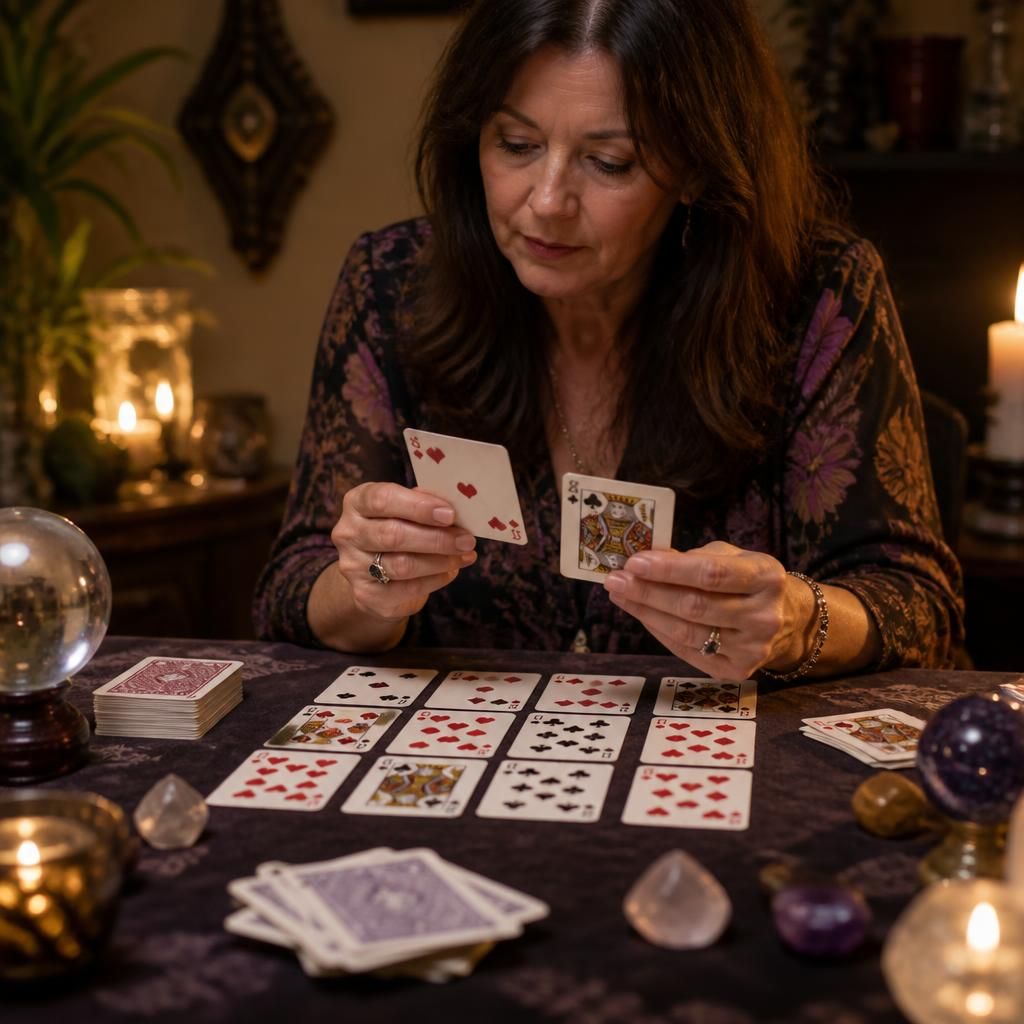
One practical difference within card-based love readings is the level and style of symbolism used. Cartomancy based on standard playing cards often works with suits, ranks and court cards to identify practical influences, interpersonal roles or changing circumstances. Tarot uses a larger symbolic system, including illustrated major and minor arcana, which may encourage a more layered exploration of emotions, themes and personal development.
This means that two card readings about the same relationship may not produce equivalent forms of guidance. A cartomancy spread may help organise the immediate dynamics of a conversation, decision or developing connection, while a tarot reading may place that issue within broader symbolic or psychological themes. Neither approach is automatically more accurate; the distinction lies in the card system and interpretive language used.
When arranging a reading, ask the practitioner which cards will be used and what the spread is designed to examine. That information helps you judge whether the reading’s structure suits your question, particularly if you want a practical account of a current romantic situation rather than a wider symbolic exploration.