


What is a tarot and love card reading?
A tarot and love card reading is a relationship-focused consultation in which tarot cards are interpreted to explore emotional patterns, romantic dynamics, personal concerns and possible directions. It offers reflective guidance rather than a guaranteed prediction, helping you consider your circumstances and choices with greater clarity.
A tarot and love card reading is a structured interpretation of tarot imagery applied to romantic and interpersonal concerns. Rather than treating the cards as a fixed script, the reading examines symbols, positions and relationships between cards to help identify emotional influences, communication patterns, likely pressures and the choices available to you.
Tarot and love readings are not a separate form of card reading. “Love cards” generally refers to a tarot consultation centred on relationships. The same tarot deck may be used for questions about a new connection, an established partnership, separation, reconciliation, dating decisions or uncertainty about another person’s intentions. The subject of the question affects the spread and interpretation more than the deck itself.
Most traditional tarot decks contain 78 cards divided into the Major Arcana and Minor Arcana. The Major Arcana is commonly associated with significant life themes, turning points and deeper personal lessons. The Minor Arcana explores more immediate experiences and is divided into four suits. Although suit names and imagery vary between decks, they are often linked with areas such as emotion, thought, action and practical circumstances. In a relationship reading, these themes can help distinguish between feelings, assumptions, behaviour and external pressures.
The reading usually begins with a focused concern. The reader may ask for background information so that the cards are considered in context, but a detailed personal history is not required for every question. A broad request such as “What will happen in my love life?” can produce a less precise interpretation than a question about a particular decision or pattern. Clearer questions give the reading a defined point of reference without requiring the cards to provide an absolute yes-or-no answer.
- What is influencing the way I am approaching this relationship?
- What may be preventing honest communication between us?
- What should I consider before deciding whether to continue dating this person?
- How can I respond more constructively to a recurring conflict?
- What personal pattern would be useful for me to examine?
After the question is established, cards are selected and placed in positions within a spread. Each position gives a card a particular function, such as describing the present dynamic, an underlying influence, a challenge, a possible response or an area requiring attention. A single-card reading may provide a concise prompt, while a larger spread can compare several factors and show how they interact. More cards do not automatically make a reading more accurate; relevance, clarity and careful interpretation are more important than quantity.
Interpretation depends on context. A card does not have one universal meaning that applies identically to every relationship. Its symbolism is considered alongside the question, its position in the spread, nearby cards and the reader’s understanding of the situation. A card traditionally associated with loss, for example, might point to grief, the need to release an unhelpful expectation or a change in the form of a relationship. It should not automatically be read as proof of a breakup.
Reversed cards may also be used. When a card appears upside down, some readers interpret it as an internalised quality, a blocked expression, a delay or an imbalance. Others read all cards upright and use the surrounding spread to identify difficult or less developed aspects. Neither approach is inherently required. What matters is that the method is applied consistently and explained clearly.
A relationship reading can explore more than whether two people are compatible. It may examine how each person communicates, what expectations are shaping the connection, where boundaries are unclear and whether actions support stated intentions. In an established partnership, the cards can be used to reflect on recurring disagreements or unmet needs. In a new connection, they may help you consider whether attraction is being confused with trust, consistency or shared values.
The reader’s role is interpretive rather than controlling. A professional reading should distinguish between what the cards symbolically suggest and what can be established through direct evidence. Tarot cannot verify another person’s private thoughts, remove the need for conversation or replace practical judgement. It is also not a substitute for medical, legal or mental health advice. Decisions involving safety, finances or serious wellbeing concerns should be based on appropriate professional support and reliable information.
The most useful way to approach a reading is to treat it as a reflective framework. Note which interpretations are supported by observable behaviour, which ones challenge your assumptions and which questions remain unanswered. You can then use the reading to prepare for a conversation, review your boundaries or decide what information you need before acting. The value lies in gaining a clearer view of your own responses and options, not in surrendering responsibility for the decision.
Tarot and love card readings can be delivered through a live consultation or by email, depending on the service chosen. In either format, a meaningful reading should set out the question, explain the spread, connect the card meanings to the relationship context and leave room for your own judgement. A personalised interpretation is most useful when it is specific enough to address the concern while remaining open about uncertainty and the influence of personal choice.
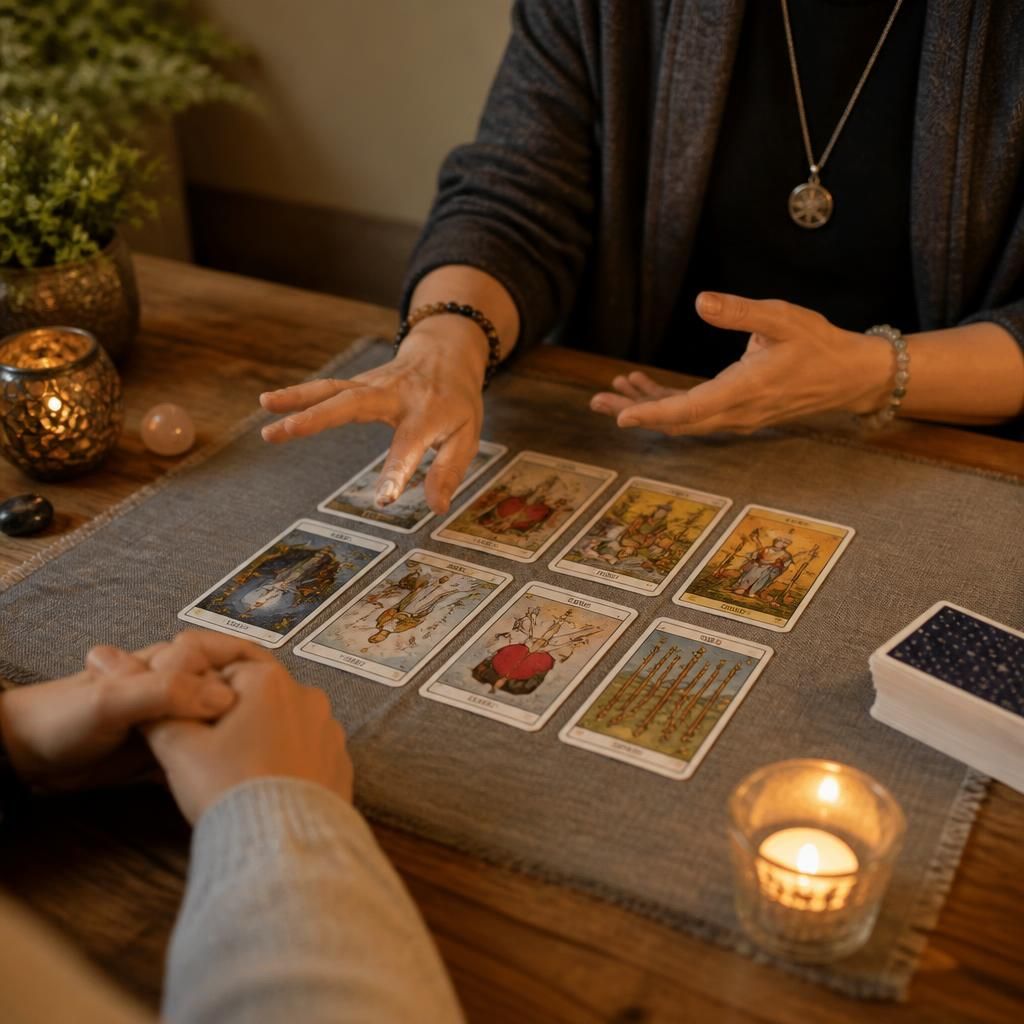
A tarot and love card reading can help separate the question being asked from the concern beneath it. For example, “Will this person come back?” may also involve questions about trust, closure, or whether repeating the relationship would meet your needs. Exploring these underlying issues gives the reading a broader and more practical focus than treating one predicted event as the entire answer.
This approach also helps distinguish facts from interpretation. Observable behaviour, such as whether someone communicates consistently or respects an agreed boundary, remains separate from symbolic suggestions in the cards. Used in this way, a love card reading can organise your concerns, identify assumptions worth examining and clarify which matters require a direct conversation or further evidence.
Explore a Tarot and Love Card Reading
If you would like to explore a relationship question through tarot, consider arranging a personalised tarot and love card reading with Elizabeth Rose Psychics. Bring a specific concern or decision to help keep the consultation focused and relevant to your circumstances.