


Are there different types of clairvoyant abilities?
Yes. Clairvoyant abilities are commonly described by the form psychic information takes, including visual impressions (clairvoyance), inner sounds or messages (clairaudience), intuitive knowing (claircognisance), and sensed emotions or physical impressions (clairsentience).
Yes. Clairvoyant abilities are often grouped not only by the way information is perceived, but also by the kind of insight received and how it arises. Common distinctions include symbolic and literal clairvoyance, spontaneous and deliberate perception, impressions relating to time, and insight focused on people, situations or possible outcomes. These categories can overlap, and one practitioner may describe their experience using more than one of them.
Symbolic clairvoyance involves images, scenes or symbols that appear to represent an idea rather than show it exactly as it will occur. For example, a bridge might suggest a transition, while a closed door could represent hesitation or an unavailable option. Interpreting symbolic material requires context, because the same image may have a different meaning for different people.
Literal clairvoyance is described as a more direct visual impression. A practitioner may report noticing a particular setting, object, colour or physical detail connected with the person or situation being discussed. Literal impressions are not necessarily predictions; they may relate to current circumstances, memories or factors influencing a decision.
Spontaneous clairvoyance occurs without deliberate concentration. An image or scene may arise unexpectedly during an ordinary conversation or while a practitioner is considering a particular issue. By contrast, focused clairvoyance involves intentionally directing attention towards a question, person, event or theme. A reading may include both forms, with spontaneous impressions providing starting points and focused attention helping to explore them further.
Clairvoyant impressions are also sometimes categorised by their relationship to time:
- Present-focused impressions relate to a person’s current circumstances, behaviour patterns or immediate surroundings.
- Past-oriented impressions may concern earlier experiences, influences or unresolved events that remain relevant to the issue being discussed.
- Future-oriented impressions concern possible developments, likely directions or choices that could affect what happens next.
Future-oriented clairvoyance should be understood as interpretative rather than certain forecasting. Decisions, new information and changing circumstances can alter an outcome. A responsible reading therefore presents possible patterns and considerations instead of treating a prediction as fixed or unavoidable.
Another useful distinction concerns the subject of the impression. Personal clairvoyance centres on an individual’s experiences, tendencies, motivations or choices. Situational clairvoyance addresses a particular circumstance, such as a relationship, workplace decision or period of uncertainty. Environmental or spatial impressions focus on a location or the atmosphere associated with it. These forms may be used together when the surroundings appear relevant to a person’s question.
Some practitioners also describe clairvoyance in terms of how detailed the image is. A brief impression may be a single colour, object or visual fragment. A more developed impression may take the form of a sequence, scene or moving mental picture. Detail alone does not establish accuracy, so it is normally considered alongside the question, the wider conversation and the meaning the client assigns to it.
Clairvoyance is often discussed alongside mediumship, tarot and astrology, but these are different frameworks. Mediumship traditionally concerns communication with a deceased person or spirit, while tarot uses the structure and symbolism of cards. Astrology interprets planetary positions and birth information. A clairvoyant reading may incorporate none of these tools, or a practitioner may combine approaches while making clear which method is being used.
The terms used for psychic abilities are not standardised, and definitions vary between practitioners. A reader may call a visual symbol clairvoyance, intuitive perception or psychic vision, while another may place the same experience within a broader category. It is therefore sensible to ask how a practitioner defines their ability, whether impressions are presented as possibilities or certainties, and how they distinguish personal interpretation from information received during a session.
Because clairvoyant abilities are part of spiritual and metaphysical practice rather than an established scientific method, they should not replace medical, legal, financial or mental-health advice. They are best approached as a reflective form of guidance. Elizabeth Rose Psychics provides personalised psychic consultations by phone and email, allowing individuals across the USA to explore clairvoyant perspectives in a format suited to their circumstances.
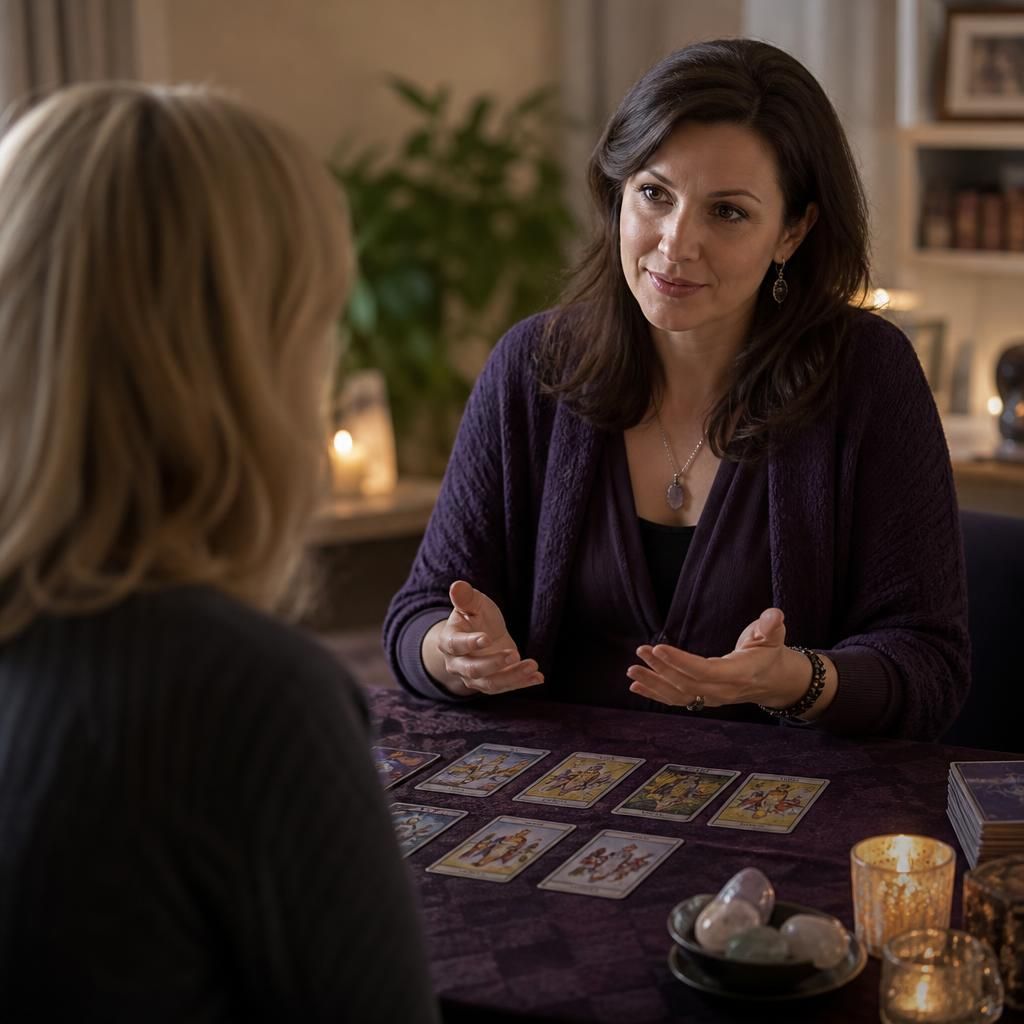
Different clairvoyant abilities are descriptive categories rather than a ranking system. A vivid image is not automatically more meaningful than a brief symbol, and a detailed impression is not necessarily more useful than a subtle one. The value of an impression depends on its relevance to the question, how consistently it develops, and whether its interpretation makes sense in the wider context of the reading.
Abilities may also overlap during one consultation. An initial visual impression might be accompanied by a felt sense, a phrase or an immediate understanding of its significance. These layers do not necessarily represent separate abilities; they may be different ways of processing the same impression. For this reason, it is more useful to ask how a practitioner experiences and explains their perceptions than to look for a single fixed label.
Explore Clairvoyant Abilities in a Personalised Reading
To explore how these categories may relate to a specific question, consider a personalised clairvoyant reading with Elizabeth Rose Psychics. Bring an open, focused question and ask the practitioner to explain how they interpret the impressions they receive.