





What are the common challenges faced during psychic seeing, and how can they be overcome?
Common challenges in psychic seeing include mental distraction, personal bias, unclear imagery and difficulty separating intuitive impressions from ordinary thoughts. They can be managed by using grounding techniques, recording impressions without immediate interpretation, checking patterns over time and maintaining clear emotional boundaries.
Psychic seeing can be made clearer and more reliable as a personal practice by treating impressions as information to examine rather than conclusions to accept immediately. The main difficulties are inconsistent concentration caused by tiredness, symbols that have different meanings for different people, incomplete or non-specific impressions, outside information influencing the session, and the risk of relying on a reading for decisions that require practical evidence. A defined process, careful language, consent and independent checking help manage these difficulties.
Physical tiredness and sensory overload
Psychic seeing requires sustained attention, and physical exhaustion, illness, a noisy environment or prolonged screen use can make any internal image harder to assess. This does not necessarily indicate that an impression is inaccurate; it may simply reduce the practitioner’s ability to notice detail and distinguish separate elements.
- Choose a quiet setting with limited visual and auditory stimulation.
- Keep a session proportionate to your ability to concentrate rather than continuing when attention has deteriorated.
- Use a consistent preparation routine so that changes in perception are easier to identify.
- Stop if the experience becomes distressing, disorientating or physically uncomfortable.
Symbols without a fixed meaning
A colour, animal, object or place may carry a personal, cultural or spiritual association. A bridge, for example, might suggest transition to one person and travel to another. Treating a symbol dictionary as a set of universal definitions can therefore produce neat but inaccurate interpretations.
Start with the image’s observable qualities: its shape, movement, setting, mood and relationship to other details. Then consider what the symbol means to the person involved, alongside the circumstances being explored. When several interpretations remain possible, retain that uncertainty instead of forcing one explanation. The strongest interpretation is usually the one that fits the wider context without requiring a series of unsupported assumptions.
Impressions that are broad or incomplete
Some impressions appear as a mood, bodily sensation, fragment of a scene or isolated word rather than a complete narrative. Trying to turn a fragment into a precise prediction can add details that were not actually perceived. It is more accurate to describe the scope of the impression and distinguish what was directly noticed from what was inferred afterwards.
A useful approach is to use qualified wording such as “this may relate to” or “the image suggests a theme of” rather than presenting a possibility as a confirmed event. This preserves meaning while making clear where interpretation begins. Avoid adding dates, names or outcomes solely to make an account sound more definite.
Influence from questions and surrounding information
Leading questions, previous conversations, online research and reactions from the person receiving a reading can shape interpretation. This is especially relevant when a practitioner already knows extensive background information. It can become difficult to tell whether a detail arose during the session or was unconsciously selected because it appeared likely.
To reduce this effect, agree the subject and boundaries beforehand, use open questions, and allow the initial impression to be expressed before seeking clarification. Separate information supplied by the client from information arising during the reading. A practitioner should also be willing to say that no clear impression is present instead of filling a gap with speculation.
Difficulty judging whether an impression is meaningful
A single striking image is not necessarily more significant than a quieter, recurring theme. Equally, a detail that appears to fit after an event may be remembered more strongly than details that did not fit. Reviewing impressions against agreed facts over time provides a more balanced assessment than judging accuracy by one memorable coincidence.
Use an independent review method: define what an impression means before looking for confirmation, retain statements that do not appear to fit, and assess the whole set rather than selecting only successful examples. This process does not prove a spiritual explanation, but it can reveal whether the practice is becoming more consistent or whether interpretation is being shaped retrospectively.
Ethical and practical boundaries
Psychic seeing should not be used to claim certainty about another person’s private thoughts, diagnose a health condition, establish a legal fact or replace qualified financial, medical or mental-health advice. Questions involving someone who has not consented require particular care, because an impression cannot provide permission to disclose or act on private information.
Set the purpose of the session in advance and identify decisions that must remain with the individual. Responsible guidance presents options for reflection rather than instructions that create dependence. If a reading causes escalating fear or encourages repeated checking, pause the practice and seek grounded support from an appropriate professional or trusted person.
Challenges in remote readings
Phone and email readings remove some visual and conversational cues that are available in person. A practitioner may not see a client’s expression, posture or hesitation, while written exchanges can make tone and uncertainty easier to misunderstand. This can be managed by defining terms, asking the client to explain relevant context in their own words and summarising the interpretation so both sides can identify any misunderstanding.
Whether a reading is conducted by phone or email, clarity improves when the practitioner states what was perceived, what it may represent and what remains unknown. The client can then decide which parts are useful for reflection without treating every image as a fixed prediction.
A practical process for overcoming these challenges
- Set a specific, ethical intention and obtain consent for the subject being explored.
- Check that the setting and physical condition support sustained attention.
- Describe impressions in neutral terms before assigning symbolic meaning.
- Separate direct perception, personal association and contextual inference.
- Ask open questions and avoid supplying missing details through guesswork.
- Compare interpretations with independently observable information where appropriate.
- Review the process afterwards, including uncertainty and apparent mismatches.
- Use the reading as reflective guidance, while making important decisions through relevant practical evidence and professional advice.
These safeguards do not guarantee that psychic seeing will produce a particular result. They make the practice more disciplined by limiting overinterpretation, protecting consent and showing where an impression ends and a conclusion begins.
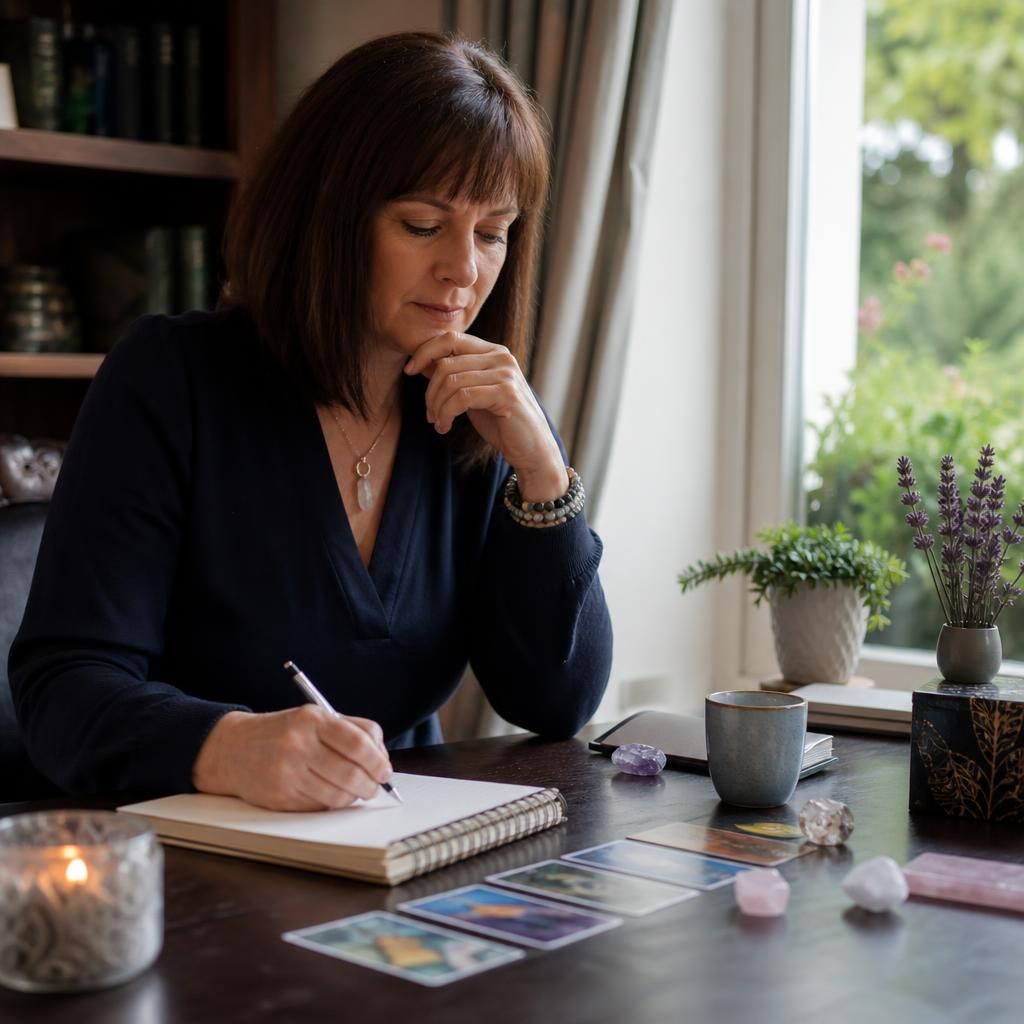
Interpretive drift occurs when the meaning assigned to an impression changes gradually as more information becomes available. An image initially recorded as a general theme may later be treated as evidence for a specific event, particularly if the reader revisits it after a significant development. This can make an interpretation appear more precise than the original impression justified.
To limit this effect, preserve the first description before discussing possible meanings, add the date and the question being explored, and distinguish later reflections from the original record. Reviewing the impression against the circumstances as they develop can show whether its meaning remains stable or has been altered by hindsight. If the interpretation changes, record that change openly rather than presenting the revised version as the initial insight.
Explore Psychic Seeing with a Personal Reading
For a personal perspective on the questions you are exploring, consider arranging a phone or email reading with Elizabeth Rose Psychics. Use the consultation to reflect on your circumstances while keeping practical decisions grounded in relevant evidence and professional advice.