





What are the most common signs or symbols experienced in psychic seeing?
The most common signs and symbols reported in psychic seeing include colours, animals, numbers, people, objects, locations and repeated visual patterns. Their possible meaning depends on the surrounding imagery, the person’s circumstances and the intuitive context, so symbols are best explored as personal or spiritual prompts rather than fixed predictions.
The signs most often described in psychic seeing are vivid light, meaningful objects, natural imagery, repeated numbers, familiar faces, places and geometric patterns. These images may appear briefly, develop as a scene or recur across separate readings. Their significance is usually assessed by examining the image’s details, emotional tone and connection with the person’s circumstances rather than by applying a universal symbol dictionary.
Light and colour: Coloured light, flashes, glowing outlines and changes in brightness are frequently reported. White or gold may be associated with clarity, attention or spiritual presence, while darker or muted tones can suggest uncertainty, withdrawal or an unresolved issue. These associations are not fixed. A colour connected with a person, memory or cultural tradition may carry a completely different meaning.
Animals and birds: An animal may represent a characteristic, relationship or type of behaviour rather than an actual creature. A dog could point towards loyalty or companionship; a fox might suggest caution or adaptability; a bird may relate to freedom, communication or movement. The animal’s behaviour is often more informative than its identity. An approaching animal, an injured animal and a protective animal create very different impressions.
Natural elements: Water, fire, trees, flowers, weather and landscapes are common forms of symbolic imagery. Calm water can suggest emotional steadiness, whereas turbulent water may reflect pressure or conflicting feelings. Fire can indicate change, intensity or destruction, while a growing plant may represent development. Such interpretations should be tested against the wider image instead of being treated as automatic predictions.
Paths, doors and buildings: Roads, bridges, staircases, windows and doorways often appear when the focus concerns a choice, transition or change in perspective. An open door may suggest an available option; a locked door may reflect hesitation, limited information or a boundary. Houses and rooms can also function as representations of different areas of life. A kitchen, bedroom, office or unfamiliar room may direct attention towards practical, private, professional or unexplored concerns.
Objects and personal items: Keys, rings, books, photographs, clocks, bags and pieces of jewellery can carry a highly specific message. A key might relate to access or a solution, but it could equally identify a particular person who owns a key or recall a significant event. When an object feels unusually precise, useful questions include who is associated with it, where it has been seen before and what action or memory it prompts.
People, faces and figures: Psychic seeing may involve a recognisable person, an unknown figure, a partial face or an impression of someone who has died. Details such as clothing, age, posture, gesture and location may be more informative than the face alone. A figure should not automatically be interpreted as a prediction, proof of contact or instruction. It may represent a memory, a relationship dynamic or an aspect of the person’s own concerns.
Numbers, letters and repeated sequences: Numbers may appear on clocks, documents, signs or in an apparently separate visual flash. They can refer to a date, age, address, quantity or sequence of events, although repetition alone does not establish a specific meaning. Letters may identify a name or place, but they can also be fragments of a longer word. Recording the exact form and surrounding imagery helps prevent the mind from forcing a convenient interpretation.
Geometric forms and movement: Spirals, circles, grids, triangles, lines and flashes of colour are sometimes experienced without a recognisable scene. Their meaning may come from movement, direction, symmetry or the sensation they produce. A circle may suggest completion or repetition, while a dividing line might indicate separation; these are working interpretations rather than established facts.
To interpret a sign carefully, record it before analysing it. Note what appeared, its size and position, any movement, the accompanying feeling, and the first association that came to mind. Then consider:
- Whether the image was literal, symbolic or a mixture of both.
- Which detail attracted attention most strongly.
- Whether it connects with a known person, place, date or memory.
- Whether similar imagery has appeared repeatedly without being deliberately sought.
- Whether the interpretation remains reasonable when alternative explanations are considered.
Personal symbolism should take priority over generic meanings. Someone who works with horses may experience a horse as a practical reference, whereas another person may associate it with independence, fear or a family memory. Cultural and religious backgrounds also influence interpretation, so a symbol cannot be separated from the individual who experiences it.
A responsible reading distinguishes an impression from a confirmed fact. Psychic imagery can support reflection, but it should not replace medical, legal or financial advice, and it should not be used to make decisions on behalf of another person. If visual flashes, shapes or figures occur outside an intentional spiritual practice, particularly if they are new, persistent or accompanied by other physical symptoms, they should also be discussed with a qualified healthcare professional.
The most useful sign is therefore not necessarily the most dramatic one. A modest, clearly remembered image with several relevant connections may provide more insight than a striking scene that has no consistent link to the person’s question.
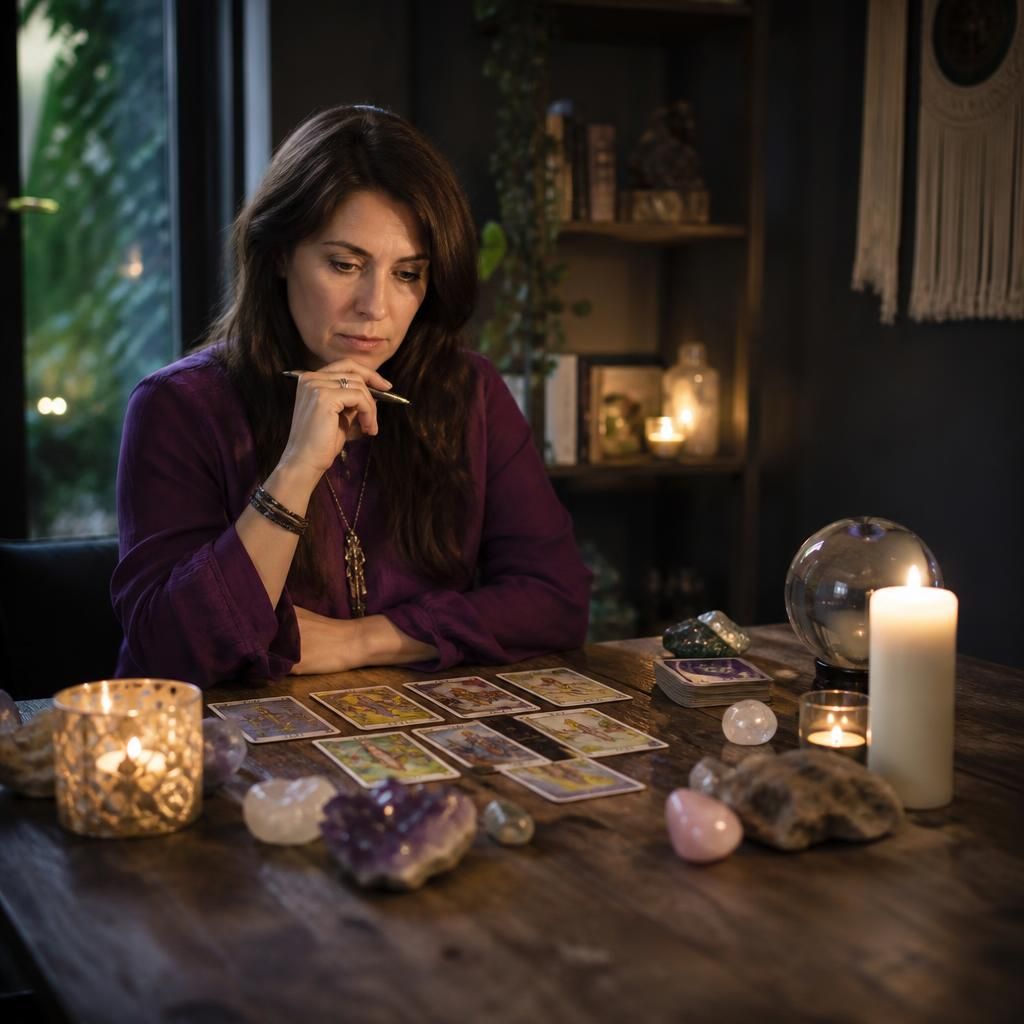
Psychic symbols are often understood as combinations rather than isolated images. An object, its setting and the action taking place around it can create a more precise message: a key on a desk may suggest a practical decision, while the same key beside a closed gate may point towards restricted access or hesitation. The relationship between the details usually matters more than any single symbol.
When several images appear together, identify the central element first, then consider how the remaining details modify it. This approach helps distinguish the main theme from incidental visual material and reduces reliance on fixed interpretations.