





What techniques are best suited for enhancing clairvoyant skills in psychic seeing?
The most useful techniques for enhancing clairvoyant skills include focused meditation, visualisation, symbol journalling and deliberate observation of mental imagery. Grounding before practice, recording impressions without immediate interpretation, and reviewing them later can help distinguish consistent intuitive patterns from imagination or expectation.
The techniques best suited to enhancing clairvoyant skills are those that make visual impressions more distinct, testable and easier to distinguish from memory, expectation or imagination. A useful practice combines receptive attention with structured questioning, sensory discrimination, ethical boundaries and careful review of results. Clairvoyance is understood within spiritual traditions as receiving information through inner visual impressions; it is not a scientifically established method of obtaining objective knowledge, so responsible practice should avoid treating every image as fact.
Develop a precise inner-image vocabulary
Rather than treating an impression simply as a picture, describe its separate qualities. Note whether it appears sharp or indistinct, still or moving, near or distant, coloured or monochrome, flat or three-dimensional, and whether it carries a particular emotional tone. This helps identify how information is experienced personally. One practitioner may receive a strong sense of shape, while another notices colour, movement or a symbolic scene first.
Use neutral descriptions before assigning meaning. “A narrow vertical shape with a bright edge” is more useful initially than “a tower” because the second description introduces an interpretation. Separating visual detail from meaning reduces the risk of turning an uncertain impression into a confident conclusion.
Practise receptive attention without forcing an image
Clairvoyant practice is generally more effective when attention is alert but not strained. Select a quiet subject, settle into a comfortable posture and allow impressions to arise rather than manufacturing a scene deliberately. If nothing appears, do not fill the gap with an invented answer. The ability to recognise absence, uncertainty or incomplete information is as important as noticing an image.
Short, regular exercises are usually easier to assess than occasional, lengthy sessions. End the exercise when concentration becomes effortful or when the material starts to become repetitive and speculative. This protects the distinction between a spontaneous impression and a consciously constructed image.
Use blind targets and delayed checking
Blind-target exercises provide a practical way to examine impressions without knowing the subject in advance. Another person can place an ordinary photograph, object or description in a sealed envelope, or select one item from several possibilities without revealing the choice. Record the first visual qualities that arise before seeing the target, then compare the notes with the actual subject afterwards.
The purpose is not to force a match. Look for specific correspondences as well as incorrect details, and avoid changing the original notes after the result is known. A fair record should preserve misses, vague impressions and alternative explanations. This approach helps reveal whether a technique produces useful consistency or whether interpretation is being shaped by hindsight.
Separate perception from interpretation
When an image appears, ask two different questions: “What am I perceiving?” and “What might it represent?” The first concerns the impression itself; the second concerns possible meaning. For example, seeing water does not automatically mean emotional change, travel or cleansing. Its significance depends on the context, the question being explored and any associated details.
Write down several possible meanings rather than selecting the most dramatic one immediately. Revisit the alternatives only after considering the wider context. This is particularly important in readings about health, relationships or major decisions, where symbolic material can be misunderstood or given more authority than it deserves.
Train with sensory cross-checking
Although clairvoyance refers primarily to visual impressions, an image may be accompanied by a bodily sensation, word, sound or emotional response. Record these elements separately instead of blending them into one interpretation. For instance, distinguish a visual impression of a closed door from a feeling of hesitation or a word that arises alongside it.
Cross-checking should clarify an impression, not make it seem more certain merely because several sensations occur together. Treat each channel as additional information to examine. If the visual detail and accompanying response conflict, preserve the conflict rather than forcing them into a single explanation.
Work with questions that have defined boundaries
Specific questions are easier to assess than broad requests to “show everything”. A useful practice question identifies a subject and a limited purpose, such as exploring the main factor affecting a planned career decision. Avoid questions that encourage fear, dependence or claims of certainty about another person’s private thoughts.
Before beginning, decide what would count as relevant information and what remains outside the exercise. This prevents unrelated images from being absorbed into the answer. It also encourages a disciplined response when the impression is incomplete or does not address the question directly.
Study recurring personal symbols critically
Symbols can acquire individual meanings through repeated experience, but they should not be treated as having one universal interpretation. A bridge might suggest transition in one context and a practical journey in another. Create a reference of recurring symbols alongside the circumstances in which they appeared and the interpretations that proved useful or unhelpful.
Review this reference for patterns rather than assigning fixed definitions. A symbol is more informative when its meaning is supported by context and repeated observation. Cultural associations, personal memories and current concerns can all influence symbolic content, so consider these factors before describing an image as external or predictive.
Use peer feedback with clear safeguards
Practice with a trusted partner who can provide factual feedback without revealing unnecessary personal information. Ask the partner to identify which statements were accurate, incorrect or too general. Feedback is most useful when it is specific and given after the initial impression has been documented.
Maintain confidentiality and obtain consent before discussing another person’s circumstances. A practice session should not become a way to investigate someone who has not agreed to it. It is also good practice to present impressions as possibilities, not diagnoses, instructions or proof of another person’s intentions.
Recognise cognitive and practical limits
Memory reconstruction, selective attention, wishful thinking and the tendency to find meaningful patterns can affect any intuitive exercise. Fatigue, anxiety and strong personal expectations may also change the character of inner imagery. A technique is more credible when it includes the possibility that an impression is mistaken.
Do not use clairvoyant impressions as a substitute for medical, legal, financial or mental-health advice. In a professional reading, the responsible approach is to explain the nature of the impression, acknowledge uncertainty and encourage the client to make decisions using appropriate evidence and qualified support.
Build a measured development plan
A balanced programme can include one receptive exercise, one blind-target exercise and one review of previous impressions. Assess clarity, specificity, emotional neutrality and factual correspondence separately. Improvement should mean becoming more observant and more accurate in describing uncertainty, rather than simply producing more vivid imagery.
Professional psychic readings can offer an opportunity to observe how clairvoyant impressions, symbolism and interpretation are handled in a structured consultation. Whether practising independently or learning from a reader, retain a questioning attitude: useful spiritual guidance should remain personalised, transparent about uncertainty and respectful of the reader’s own judgement.
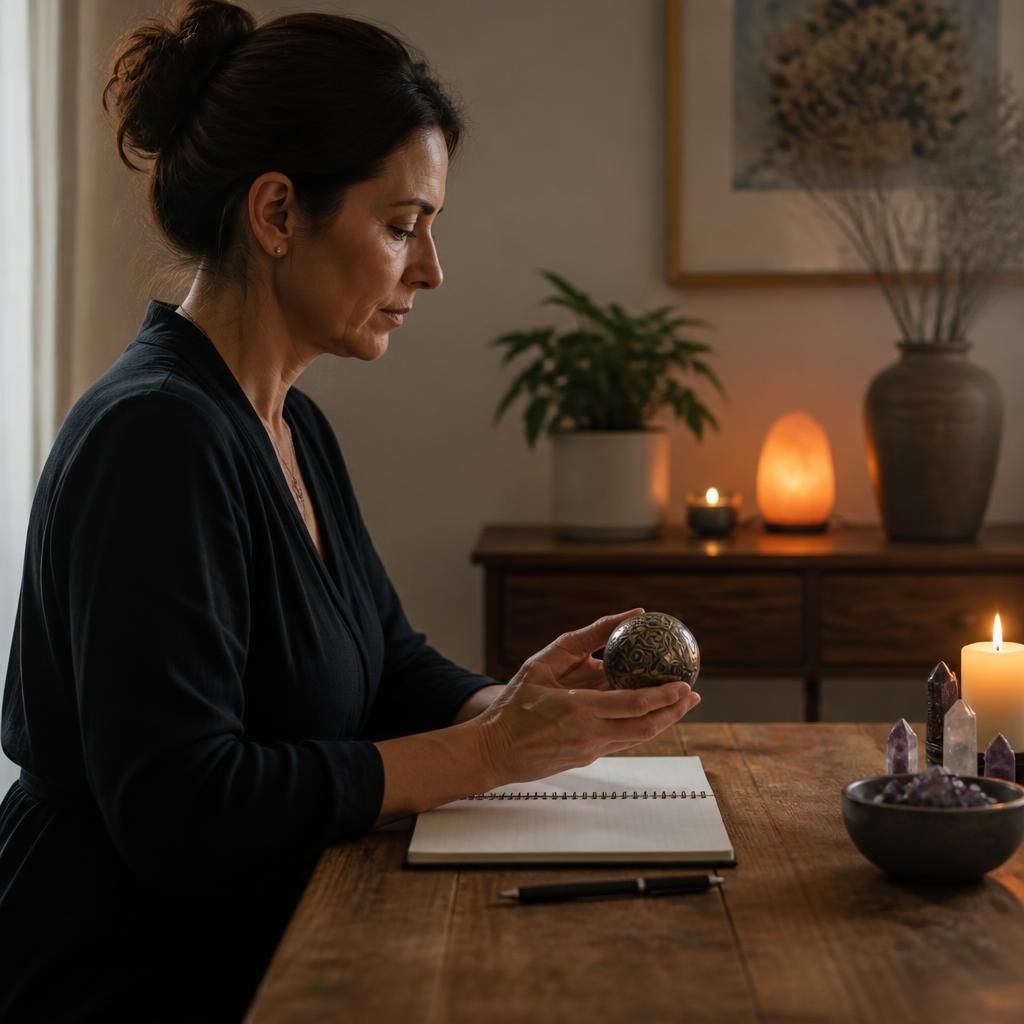
Object-observation drills can strengthen the visual attention needed for clairvoyant practice. Study an ordinary object for a short period, noting its outline, texture, colour, shadows and distinctive features. Put it out of sight and reconstruct the image mentally, then compare the reconstruction with the object. Repeat the exercise with different objects and record which details remain clear or become distorted.
This technique develops visual recall and helps distinguish a stable image from a vague impression. It should be treated as a concentration exercise rather than evidence of psychic perception: accurate memory of a visible object does not establish clairvoyance. Its value lies in improving precision, patience and awareness of how the mind creates and alters imagery.