



What types of methods are commonly used in psychic seeing to interpret spiritual signs?
Common methods include clairvoyance, tarot, mediumship and astrology, each offering a different framework for interpreting perceived images, symbols, messages or patterns. Practitioners may use one method alone or combine several to form a more contextual reading.
Psychic seeing commonly interprets spiritual signs through a combination of visual perception, symbolic systems, intuitive impressions and contextual questioning. The method provides a structure for considering an image, feeling, word or pattern, rather than treating every impression as a fixed prediction. Experienced practitioners usually compare the sign with the person’s circumstances, distinguish observation from interpretation, and allow room for uncertainty.
Clairvoyant perception: Clairvoyance refers to receiving information as mental images, colours, scenes, symbols or brief visual impressions. A practitioner may notice an object, location, person or action and then examine its possible significance. Interpretation depends on context: water might suggest emotion, movement or a literal connection to a place, while a locked door could represent restriction, privacy or an unresolved decision. The image itself is only the starting point; its relevance is assessed alongside the question and any further impressions.
Clairaudience and related intuitive senses: Some readings involve perceived words, names, sounds or phrases rather than pictures. This is often described as clairaudience. Other recognised forms include clairsentience, in which information is experienced as bodily or emotional sensation, and claircognisance, in which an apparently immediate sense of knowing arises without a clear image. These impressions can add detail to visual material, but they should not automatically be treated as literal instructions or verified facts.
Symbolic interpretation: Signs are often interpreted through commonly recognised symbolism, personal associations and the circumstances of the reading. A bird may represent freedom to one person and a specific memory to another. Personal meaning is therefore important. Practitioners may ask what a symbol brings to mind, whether it has appeared repeatedly and how it relates to the issue being explored. This approach reduces the risk of applying a rigid symbol dictionary to every client.
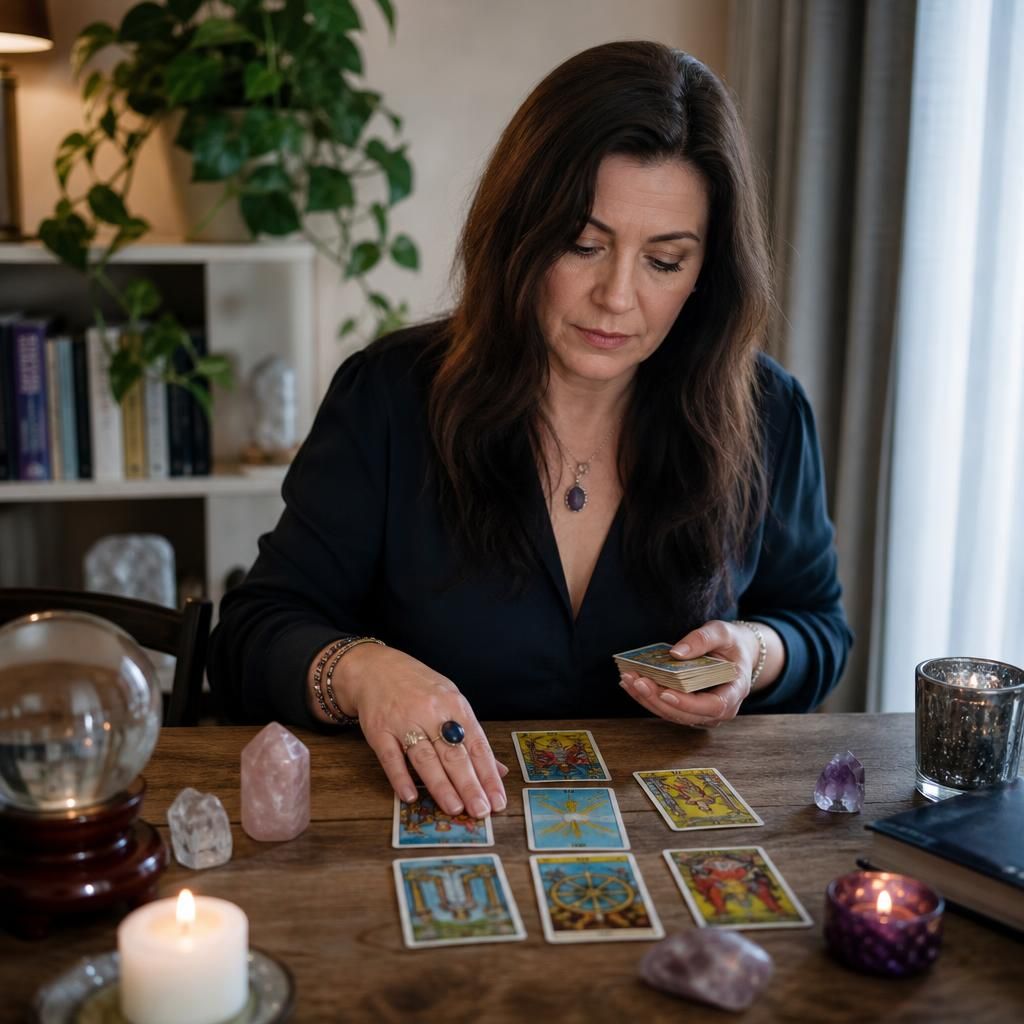
Tarot-based interpretation: Tarot uses the imagery, themes and relationships between cards to organise a reading. A card’s meaning may change according to its position in a spread, its relationship with neighbouring cards and the question being considered. For example, a card placed in a position concerning an obstacle may be read differently from the same card in a position concerning available resources. Reversed cards, repeated suits and recurring numbers may also be considered, although not every reader uses reversals or the same spread structure.
Tarot is best understood as a reflective framework within psychic seeing. The cards provide defined images and concepts, while the practitioner’s interpretation connects those elements with the client’s circumstances. A careful reading separates the traditional associations of a card from the additional impressions arising during the consultation.
Mediumistic methods: Mediumship focuses on perceived communication connected with someone who has died. Practitioners may describe names, personality traits, memories, objects or situations that they understand as evidence of a particular person. The interpretation depends on how several details fit together rather than on one isolated statement. Because memories and emotions can be sensitive, responsible practice presents impressions as information to consider, not as proof that a client must accept.
Astrological analysis: Astrology interprets the positions and relationships of celestial bodies using a birth chart or another chart calculated for a particular time. Common considerations include planets, zodiac signs, houses and aspects. A planet’s position can be read as a theme, while an aspect describes how two planetary principles are thought to interact. Transits and progressions may be used to examine changing periods, but interpretations vary according to the astrological tradition and the accuracy of the supplied birth details.
Psychometry and object-based impressions: In psychometry, a practitioner holds or examines an object and reports impressions associated with its owner, history or emotional significance. The object is treated as a focus for perception rather than as an independently proven source of information. This method is particularly dependent on careful questioning and clear boundaries, since an object may have several owners or meanings.
Dream and vision analysis: Dreams, meditation images and recurring visions may be explored as symbolic material. Interpretation generally considers the dreamer’s personal experiences, emotional response, repeated motifs and the point at which the image appeared. A snake, house or journey does not have one universal meaning. The useful question is often what the image represents in that person’s life, rather than what it supposedly means in isolation.
Cross-checking and contextual reading: Skilled interpretation involves comparing impressions across methods. A visual symbol might be considered alongside a tarot card, an emotional sensation or an astrological theme. Agreement can provide a coherent line of inquiry, while disagreement may indicate that the impression is unclear or has been interpreted too quickly. Notes, clarifying questions and requests for concrete context help separate the original perception from later assumptions.
Readers should also distinguish spiritual interpretation from professional diagnosis, legal advice, financial advice or guaranteed prediction. A responsible consultation can offer a perspective for reflection, but decisions involving health, safety, money or legal rights require appropriately qualified advice. When assessing any psychic seeing method, consider whether the practitioner explains the approach, acknowledges uncertainty, protects confidentiality and allows you to decide what meaning, if any, the signs hold for you.
Psychic seeing methods can be grouped by how they organise perceived information: some rely on spontaneous impressions, some use established symbolic systems, and others focus on a person, object or relationship as the source of meaning. This classification helps explain why different practitioners may interpret the same spiritual sign in different ways without necessarily using contradictory techniques.
The method affects the questions asked and the type of detail examined. A spontaneous impression may be explored for its visual or sensory qualities, while a structured system may provide positions, symbols or patterns for comparison. The resulting interpretation is therefore shaped both by the sign itself and by the framework used to examine it. Comparing these frameworks can be useful, provided their conclusions are treated as perspectives rather than independently verified facts.
Explore Psychic Seeing Methods in a Personal Reading
If you would like to explore how different psychic seeing methods may relate to your circumstances, consider arranging a personalised reading with Elizabeth Rose Psychics by phone or email. Use the consultation to ask how impressions will be interpreted and which approach best suits your questions.