








What types of psychic abilities are utilised during a world phone psychic reading?
A world phone psychic reading may draw on clairvoyance, mediumship, tarot and astrology, depending on the reader’s methods and the focus of the consultation. These abilities and practices are used to explore personal questions about relationships, career and personal growth through a remote conversation.
The abilities and methods used in a world phone psychic reading vary by practitioner, but commonly include clairvoyance, clairaudience, clairsentience, claircognizance, mediumship, tarot interpretation and astrology. These terms describe different ways a reader may interpret impressions or symbolic information; they are not necessarily used together, and a consultation normally follows the reader’s established approach and the subject of the client’s question.
Clairvoyance is traditionally described as receiving images, colours, scenes or visual symbols intuitively rather than through ordinary sight. A reader might interpret an image as representing a person, a possible development or an emotional pattern. Such impressions are usually explored through conversation instead of treated as literal predictions. Symbolic meaning can depend on the context of the question and the reader’s own system of interpretation.
Clairaudience refers to intuitive impressions experienced as words, names, phrases or sounds. In a phone consultation, this may be discussed verbally as the reader explains what has come to mind. Clairaudience should not be confused with simply listening to the client’s voice: a responsible reader distinguishes an intuitive impression from information directly supplied during the conversation.
Clairsentience is associated with sensing feelings, bodily sensations or the emotional atmosphere connected with a person or situation. A reader may use this form of perception when exploring relationship dynamics, personal uncertainty or recurring emotional themes. These impressions are subjective and should be presented as possibilities for reflection, not as medical diagnoses or definitive statements about another person’s private thoughts.
Claircognizance means an apparent intuitive knowing without a clearly identified visual, auditory or physical sensation. Readers who work in this way may receive a direct idea about the central issue in a question and then test or clarify it through discussion. The value of this approach depends on how carefully the reader explains the impression and avoids presenting uncertainty as fact.
Mediumship is a distinct practice from general psychic perception. A medium traditionally seeks to interpret impressions believed to relate to someone who has died, such as a personality trait, memory or message. The client may use the reading to reflect on bereavement or a continuing sense of connection. Mediumship is not a substitute for grief counselling, mental-health care or practical support, and no reader should use it to pressure a client into accepting a claim.
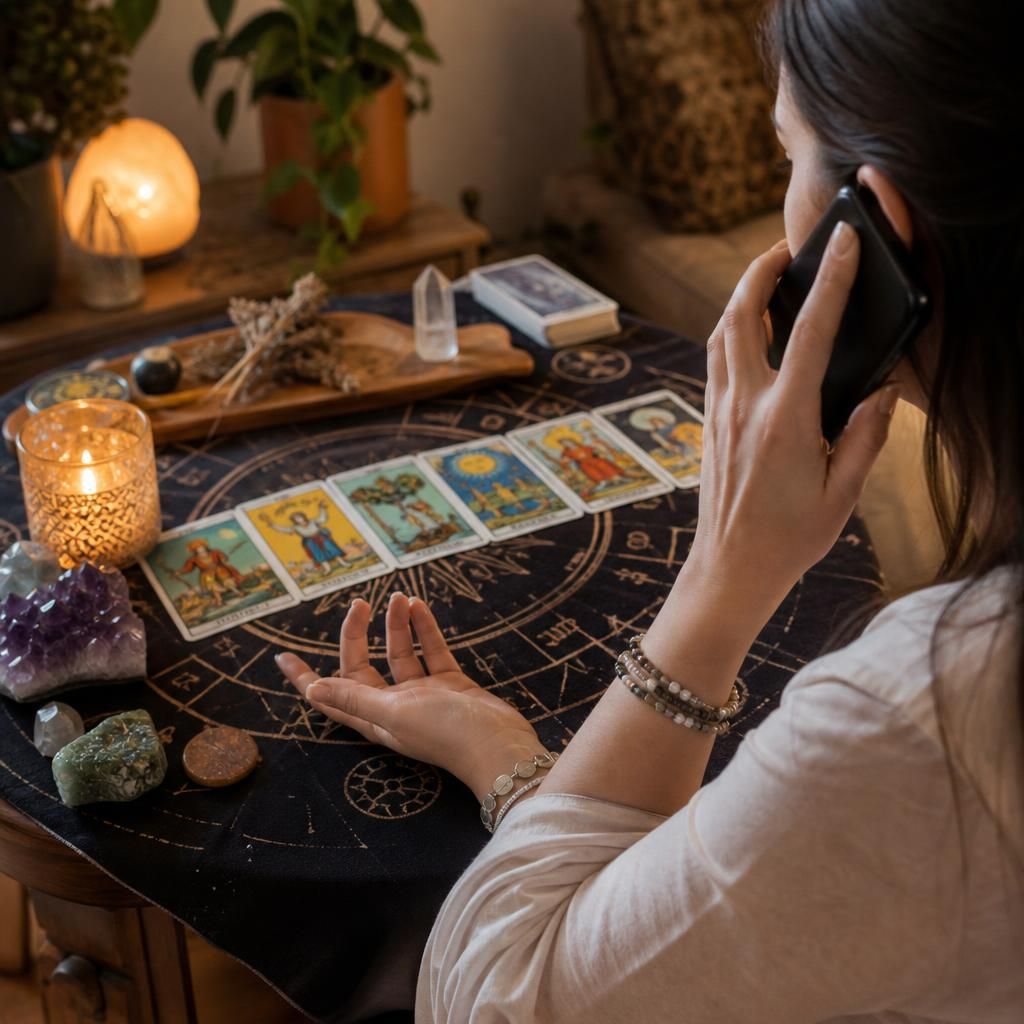
Tarot is a structured divination practice rather than a psychic ability in itself. The reader lays out cards according to a chosen spread and interprets their images, positions and relationships. The cards can provide a framework for examining choices, influences and possible directions. Some readers combine card symbolism with clairvoyant or clairsentient impressions, while others focus mainly on established meanings and the client’s question.
Astrology uses a birth chart or another astrological chart as a symbolic framework. The reader may consider planetary positions, signs, houses and aspects to discuss tendencies, timing themes or areas of attention. Astrology differs from spontaneous psychic perception because it begins with chart information and applies an interpretive system. The quality of an astrology-based reading therefore depends on accurate details supplied by the client and the reader’s chosen method.
Other terms may also be used within psychic traditions. Clairalience describes an intuitive impression of a smell, while clairgustance describes an impression of taste. These abilities are less commonly discussed than visual, auditory, emotional and knowing-based impressions. Their presence should be treated as part of a reader’s personal vocabulary rather than as a standard feature of every consultation.
During a phone reading, the reader may combine one or more of these approaches. For example, a relationship question might involve an initial intuitive impression, clarifying questions, tarot cards and a discussion of possible emotional patterns. A career question might be approached through symbolic cards, astrology or claircognizant impressions. The method should remain clear enough for the client to understand whether a statement is based on an intuitive impression, a card, a chart or information already discussed.
Phone delivery changes the way the session is conducted, but it does not create a separate psychic ability. Without face-to-face visual contact, the reader generally relies on spoken interaction, pauses, questions and the chosen divination tools. This makes clear communication important: the client can ask what a particular impression means, whether it is symbolic, and how firmly the reader holds it. Personal information volunteered during the call should not be confused with evidence of psychic perception.
Psychic readings are interpretive and cannot establish certainty about future events, guarantee a particular outcome or replace qualified advice. Health concerns should be discussed with an appropriate healthcare professional, and financial, legal or safety decisions require relevant professional guidance. A useful reading should leave room for the client’s judgement, acknowledge uncertainty and avoid fear-based claims or instructions to make urgent, high-impact decisions.
Before a session, it can help to ask which abilities or methods the reader uses, whether tarot or astrology forms part of the process, and how intuitive information is distinguished from practical discussion. This gives the client a clearer basis for assessing whether the reading’s approach matches the type of guidance they are seeking.
Psychic ability labels are not standardised classifications. Different readers may use the same term in slightly different ways, while describing a similar experience with different terminology. For example, an impression understood as clairsentience by one practitioner might be explained as intuitive empathy by another. The label alone therefore does not establish how a session will be conducted or how dependable an interpretation may be.
When comparing approaches, focus on the reader’s explanation of each term, the information or tools used, and how uncertainty is communicated. This provides a more useful understanding of the consultation than choosing a reading solely because it lists a particular psychic ability.