



How can Vedic Astrology help in understanding personal relationships?
Vedic Astrology can help interpret personal relationship patterns by examining a birth chart’s planetary placements, houses and aspects linked with communication, attachment, partnership and emotional needs. Comparing two charts may highlight areas of compatibility, recurring tensions and practical ways to build greater understanding.
Vedic Astrology can help explain personal relationship patterns by interpreting how an individual approaches intimacy, commitment, trust, attraction and conflict. Rather than treating compatibility as a simple yes-or-no result, a Vedic reading examines the tendencies shown in each birth chart and considers how those tendencies may interact in a partnership.
It can clarify relationship expectations. People often enter relationships with different assumptions about loyalty, independence, affection and long-term commitment. In Jyotish, the seventh bhava and its ruling planet are central to partnership themes, while Venus, Jupiter and the Moon can add information about affection, judgement, emotional security and personal values. This symbolism may help a person recognise whether they seek reassurance, freedom, structure, intellectual stimulation or a strong sense of shared purpose.
This interpretation is not limited to marriage. It can also be applied to dating relationships, close friendships and other significant one-to-one connections. The chart may be used to explore how someone forms bonds, what they find attractive in others and which relationship qualities they are likely to prioritise.
It can highlight recurring patterns. A reading may examine repeated experiences such as becoming attached quickly, avoiding emotional vulnerability, choosing unavailable partners, taking excessive responsibility or struggling to express dissatisfaction. In Vedic terms, these patterns may be considered through the condition of relevant planets, their dignity, associations and divisional charts. The purpose is not to assign blame, but to identify habitual responses that a person can examine more consciously.
The Navamsa, or D9 chart, is particularly important in many Vedic relationship readings. It is traditionally used to add depth to the interpretation of partnership potential, values and the development of relationship themes over time. It should not be read in isolation: an astrologer normally compares it with the main birth chart and considers whether the same themes are repeated or modified.
It can distinguish attraction from long-term compatibility. Strong romantic or physical attraction does not necessarily indicate similar priorities or an easy partnership. Vedic analysis can separate different layers of a connection, including:
- initial attraction and romantic interest;
- emotional safety and the ability to provide mutual support;
- communication habits and responses to disagreement;
- shared attitudes towards responsibility, family and commitment;
- physical chemistry and personal boundaries; and
- the capacity to maintain the relationship through changing circumstances.
When two charts are compared, this process is often called synastry or kundali matching. The comparison may show where two people naturally reinforce one another and where their needs could conflict. For example, one person may prefer direct discussion while the other needs time and privacy before responding. That difference does not automatically make the relationship unsuitable, but it can indicate an area requiring patience and clear agreements.
It can provide context for relationship changes. Vedic Astrology also considers planetary periods and current movements when examining why relationship concerns may feel more prominent at a particular stage of life. These techniques are used symbolically to assess periods associated with reflection, commitment, separation, renewed attraction or changes in personal priorities. They are best treated as timing frameworks rather than fixed predictions of what another person will do.
A responsible interpretation keeps timing in context. The same planetary period may correspond with different experiences for different people, depending on the complete chart and the choices being made. Astrology cannot remove free will, guarantee a particular relationship outcome or replace communication, counselling or practical decision-making.
It can support more informed choices. The most useful outcome of a relationship reading is often greater self-awareness. A person may use the interpretation to consider questions such as:
- What do I need in order to feel respected and secure?
- Which behaviours do I repeatedly tolerate or overlook?
- How do I respond when I feel rejected, criticised or uncertain?
- Am I confusing intensity with compatibility?
- Which boundaries and expectations need to be discussed directly?
Birth information should be as accurate as possible, particularly the time of birth, because changes in the recorded time can affect house cusps, ascendant calculations and divisional-chart interpretation. If the time is uncertain, the astrologer should explain how that limitation affects the reading instead of presenting every conclusion as definite.
Vedic Astrology is therefore most useful as a reflective framework for understanding relationship tendencies, not as a substitute for observing conduct in real life. A chart can suggest themes to investigate, but trust, respect, consent, compatibility and sustained communication remain matters that must be assessed through lived experience.
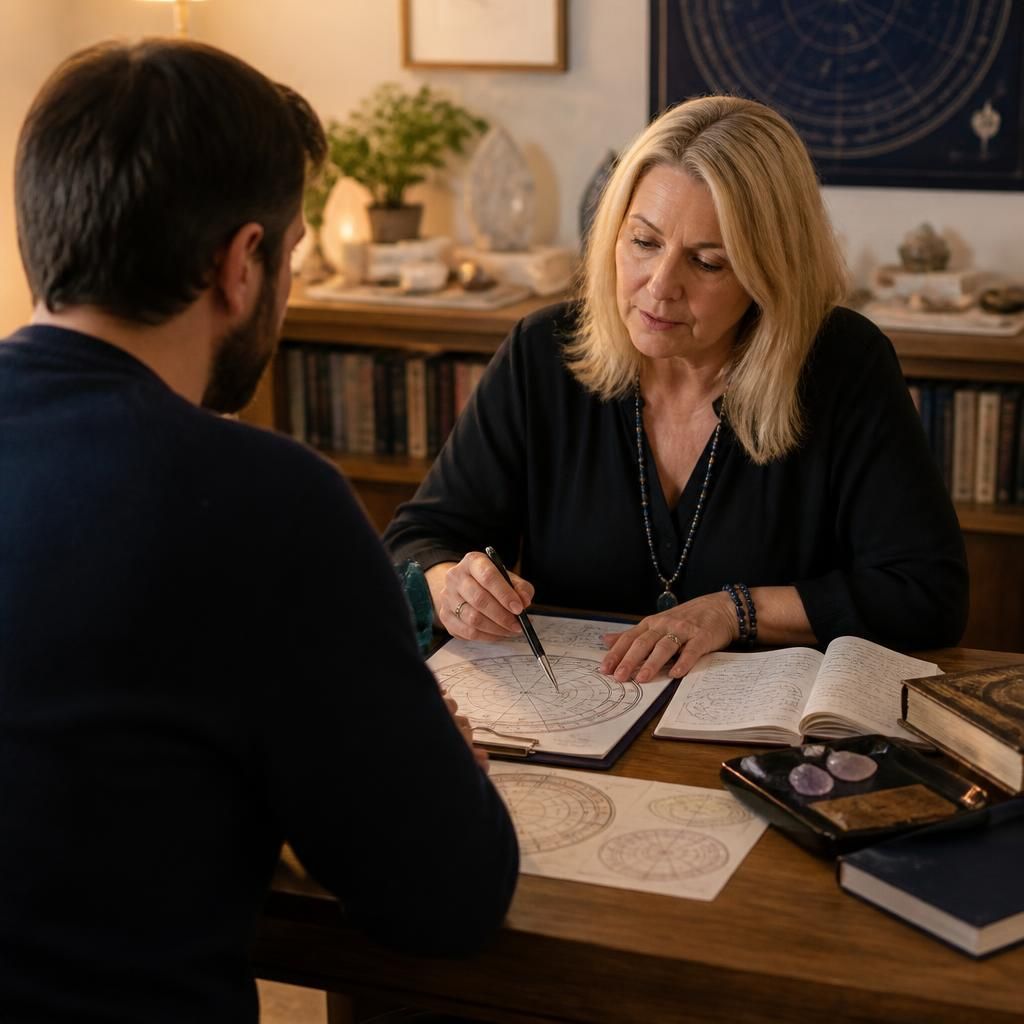
A Vedic relationship analysis should begin with each person’s chart separately before the charts are compared. This distinguishes an individual’s established emotional and behavioural tendencies from patterns that arise specifically between two people.
The astrologer may first assess each person’s approach to attachment, communication, responsibility and intimacy. The comparison can then show whether a difficulty reflects a shared dynamic, such as mismatched expectations, or an existing personal pattern that may appear in several relationships. This prevents one partner from being treated as the sole cause of every problem.
Used in this way, Vedic Astrology provides a structured language for discussing differences. For example, contrasting needs for reassurance and autonomy can be recognised as a relationship issue to negotiate rather than interpreted automatically as incompatibility. The chart comparison is most useful when it leads to specific conversations about expectations, responsibilities and acceptable behaviour.
Explore Your Relationship Patterns Through Vedic Astrology
If you want to explore your relationship themes in greater depth, consider arranging a personalised Vedic Astrology reading based on your birth details. A phone or email consultation can help you identify which chart factors are most relevant to the questions you are considering.