







What are the key components of a Vedic birth chart?
A Vedic birth chart is built from the ascendant (Lagna), the twelve houses, zodiac signs, planetary placements, nakshatras and their ruling periods, known as Dashas. Together, these components provide a structured framework for interpreting personality, life themes, strengths and potential challenges.
A Vedic birth chart is a calculated map of the sky at a person’s birth, interpreted through planetary degrees, rulerships, house relationships, lunar divisions, strengths and timing systems. Its meaning comes from how these factors interact rather than from any single placement considered on its own.
Birth data and chart calculation
The chart depends on the date, precise time and place of birth. These details establish the eastern horizon, determine the rising degree and place the planets within the chart. Even a modest difference in recorded time can alter house cusps, the ascendant degree or the starting point of a Dasha sequence, so the reliability of the birth information is an important part of interpretation.
Vedic astrology commonly uses a sidereal zodiac, which measures planetary positions in relation to the stars rather than the seasonal points used by most Western systems. An ayanamsa, or calculation of the difference between these reference systems, is applied when converting astronomical positions into the chart used for interpretation.
Planetary degrees and exact positions
Each graha is assessed by its precise degree, sign, house position and proximity to other bodies. The Sun, Moon, Mars, Mercury, Jupiter, Venus and Saturn are traditionally treated as the principal visible planets, while Rahu and Ketu represent the lunar nodes. Their positions are examined for themes such as vitality, emotional processing, communication, motivation, learning, relationships, responsibility and material priorities.
Degree-based analysis adds detail that a sign placement alone cannot provide. A planet near the beginning or end of a sign may be interpreted differently from one firmly established within it. Close planetary contacts can also intensify or combine themes, although the effect depends on the planets involved, their condition and the houses they govern.
House ownership and lordship
In Vedic interpretation, a planet’s importance is partly determined by the houses it rules from the rising sign. This is known as lordship. A planet may occupy one house while governing another, linking the subjects of those areas. For example, a connection between the house associated with education and the house associated with vocation may be considered when assessing how learning could relate to professional direction.
House ownership is interpreted alongside the functional role of a planet for that particular chart. The same planet can therefore have a different significance for two people with different ascendants. This is one reason why general statements based only on a person’s Sun sign provide limited information in a full Vedic analysis.
Planetary strength and condition
A chart assessment considers whether a planet is supported, weakened or placed under pressure. Traditional measures include exaltation, debilitation, own-sign placement, friendly or hostile sign relationships, combustion by proximity to the Sun and retrograde motion. These conditions do not simply label a placement as good or bad; they describe how easily a planet’s themes may operate and where effort, delay or development may be indicated.
Strength can also be judged through positional measures, such as whether a planet is placed in an angular house, a trinal house or another significant location. A planet with strong dignity but difficult associations may express its qualities forcefully while still producing complex results. Interpretation therefore requires several factors to be weighed together.
Aspects and planetary relationships
Vedic astrology uses drishti, or planetary aspect, to show where a planet directs influence. All planets have a traditional seventh aspect, while Mars, Jupiter and Saturn are also associated with additional special aspects. These lines of influence can connect otherwise separate parts of a chart. A planet may affect a house without occupying it, or influence another planet without sharing the same sign.
Relationships between planets are also assessed through conjunctions, sign friendships, mutual exchange and connections between their ruling houses. These combinations may form recognised yogas. A yoga is not interpreted as an automatic promise of a particular outcome; its expression depends on planetary strength, supporting factors and the periods in which the relevant planets become active.
The Moon’s position and nakshatra detail
The Moon receives particular attention because it is traditionally associated with the mind, perception, habits and emotional responses. Its exact lunar mansion provides a finer layer of interpretation than its sign alone. The mansion’s quarter, known as a pada, further narrows the degree range and can influence the qualities attributed to the placement.
This lunar detail is also essential for calculating the starting point of the Vimshottari Dasha system, where planetary periods are arranged according to the Moon’s position at birth. Dasha analysis is therefore linked directly to the chart’s astronomical calculation rather than being an unrelated add-on.
Divisional charts
Vedic astrology may divide the main chart into specialised charts called vargas. The Navamsa, or D9, is widely used to examine the deeper strength of planets, principles connected with partnership and the longer-term expression of a chart. Other divisional charts may be consulted for subjects such as career, children, property, spiritual development or accumulated resources.
A divisional chart is normally read alongside the main birth chart, not as a replacement for it. A promising indication generally carries more weight when it is supported across relevant charts and by the applicable planetary periods.
How the components are combined
A careful reading usually begins with the rising degree and the overall pattern of angular and trinal houses. It then examines the condition of their rulers, the Moon’s position, notable aspects, yogas and relevant divisional charts. Finally, Dasha periods and current transits are used to assess when particular themes may become more prominent.
This layered method prevents one placement from being treated as a complete personality description or a certain prediction. For instance, a planet associated with career may indicate ambition or responsibility, but its sign, house ruler, aspects, strength and active period all affect how that theme is interpreted.
In practical terms, a Vedic birth chart provides a symbolic framework for discussing tendencies, priorities, challenges and possible periods of emphasis. It is best used as a reflective spiritual system rather than a substitute for professional medical, legal or financial advice. A Vedic reading through Elizabeth Rose Psychics can use these chart components to organise a personalised discussion of relationships, career and personal development for clients throughout the USA.
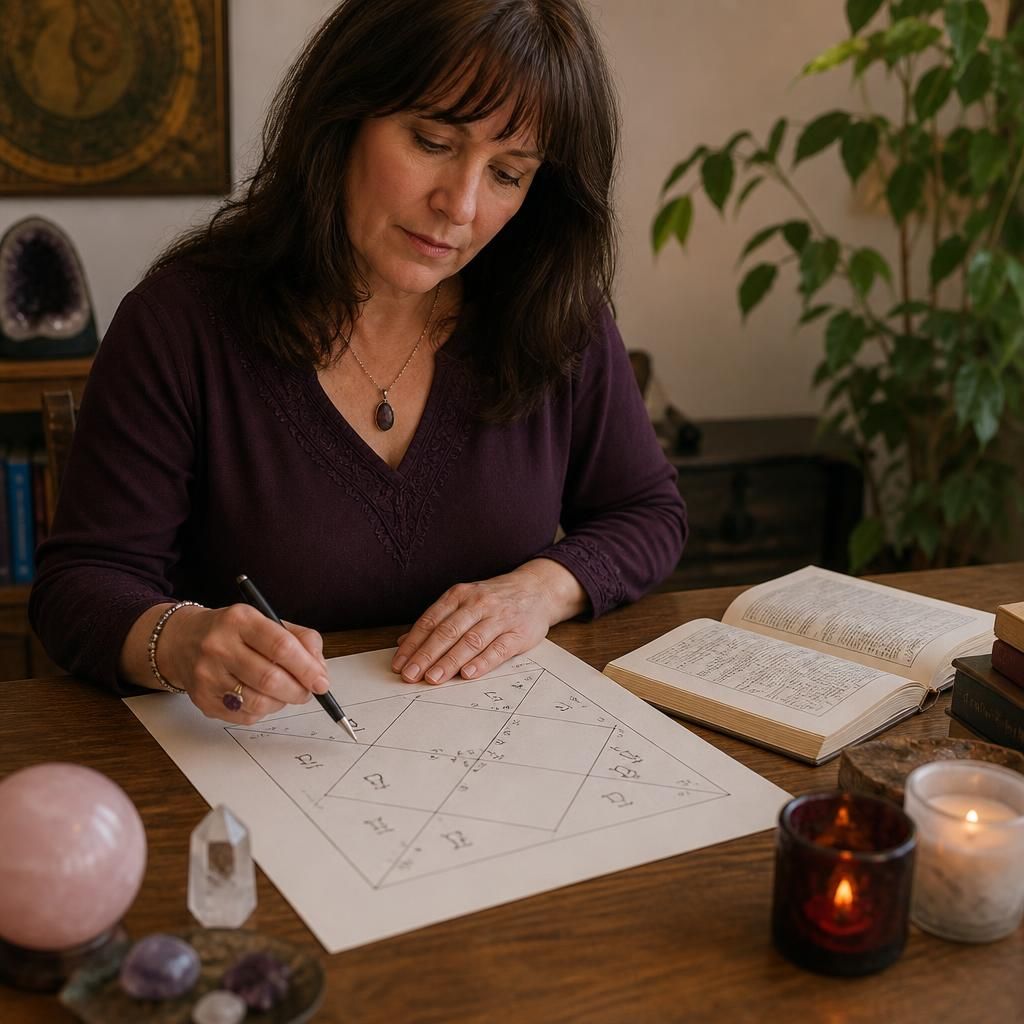
The visual layout of a Vedic birth chart is another important component because it shows how signs and houses are arranged around the ascendant. In the North Indian style, the house positions remain fixed while the signs are placed within them. In the South Indian style, the signs remain fixed and the houses are identified from the ascendant. Although the formats look different, they represent the same astronomical information.
When examining a chart image, first identify the Lagna or ascendant, then follow the house sequence and note the planetary symbols placed in each section. This prevents a common mistake: assuming that a planet’s position in a particular box has the same meaning in every chart style. The chart format is therefore a presentation framework, while interpretation depends on correctly identifying the ascendant, signs, houses and planetary placements shown within it.
Explore Your Vedic Birth Chart with a Personal Reading
For a personalised interpretation of your Vedic birth chart, consider arranging a reading with Elizabeth Rose Psychics by phone or email. You can use the consultation to explore how the chart’s components relate to your questions about relationships, career or personal development.