


How does a love fortune teller conduct a phone reading session?
A love fortune teller typically begins by discussing your relationship question, then uses intuitive insight, mediumship, tarot or astrology as appropriate to explore the circumstances and themes involved. The session continues as a focused conversation, allowing you to clarify details and consider the guidance in relation to your own decisions.
A phone reading session is usually conducted as a structured verbal consultation: the reader establishes the purpose of the call, gathers only the context needed to understand the situation, offers an interpretation, and gives you opportunities to test whether the discussion is relevant. The emphasis is on focused dialogue rather than observing facial expressions, body language or physical surroundings.
Before the interpretation begins
You may be asked to state the area of your love life you want to examine, such as the direction of a relationship, the possibility of reconciliation, uncertainty about a partner’s intentions or patterns affecting your dating life. A useful question is specific enough to explore but open enough to allow more than a yes-or-no answer. For example, asking what may be influencing communication is generally more informative than asking only whether a particular event will happen.
The reader may also establish whether you want a broad overview or a discussion centred on one person or decision. This helps define the scope of the session and reduces the risk of moving between several unrelated concerns without examining any of them properly.
How information is handled
A professional reader should distinguish between information you volunteer and impressions that arise during the reading. You can provide relevant background, but you do not need to disclose every personal detail. Limiting the information shared at the outset can help you assess whether the interpretation addresses your question rather than simply repeating what you have already said.
Because the reader cannot see you, clarity in the conversation matters. You may need to explain a relationship term, correct a mistaken assumption or identify which part of a complex situation you want to explore. These corrections are not a failure of the session; they help refine the subject being considered.
The interpretation stage
Once the focus is established, the reader explains the impressions or symbolic themes relevant to it. In a phone consultation, this is normally delivered verbally and in stages. The reader may describe a perceived emotional dynamic, a recurring pattern, a possible influence on communication or an issue that deserves attention. Rather than treating every statement as a fixed prediction, it is more useful to consider how it relates to the circumstances you have described.
Different forms of reading may produce different kinds of discussion. Tarot can provide symbols and positions to interpret, astrology can provide a framework based on birth information or timing, clairvoyant impressions may be expressed as direct perceptions, and mediumship may be used where communication with someone who has died is the stated focus. The chosen approach should be relevant to the question, not used to make every issue appear identical.
Questions and clarification
You should be able to ask what a phrase means, request an explanation of how a conclusion was reached or point out where an interpretation does not fit. A careful reader will separate an impression from a confirmed fact and avoid presenting uncertainty as certainty. They should also avoid pressuring you to accept a particular interpretation or to disclose information that is unrelated to the purpose of the call.
It can help to keep notes during the session. Write down recurring themes, practical suggestions and questions that remain unresolved. Notes make it easier to reflect afterwards, particularly where the reading raises several possible interpretations rather than one clear answer.
How the session concludes
The closing part should bring the discussion back to your original concern. The reader may summarise the main themes, identify areas requiring further reflection and distinguish between what was presented as an impression and what you know from direct experience. You can then decide which points are useful and which do not apply.
A phone reading should support personal reflection rather than replace your judgement. Relationship choices remain your responsibility, and a psychic interpretation cannot verify another person’s private thoughts, guarantee a particular outcome or substitute for professional advice where safety, mental health or legal matters are involved. The most constructive use of the session is to treat it as one perspective that may help you examine your feelings, options and patterns more deliberately.
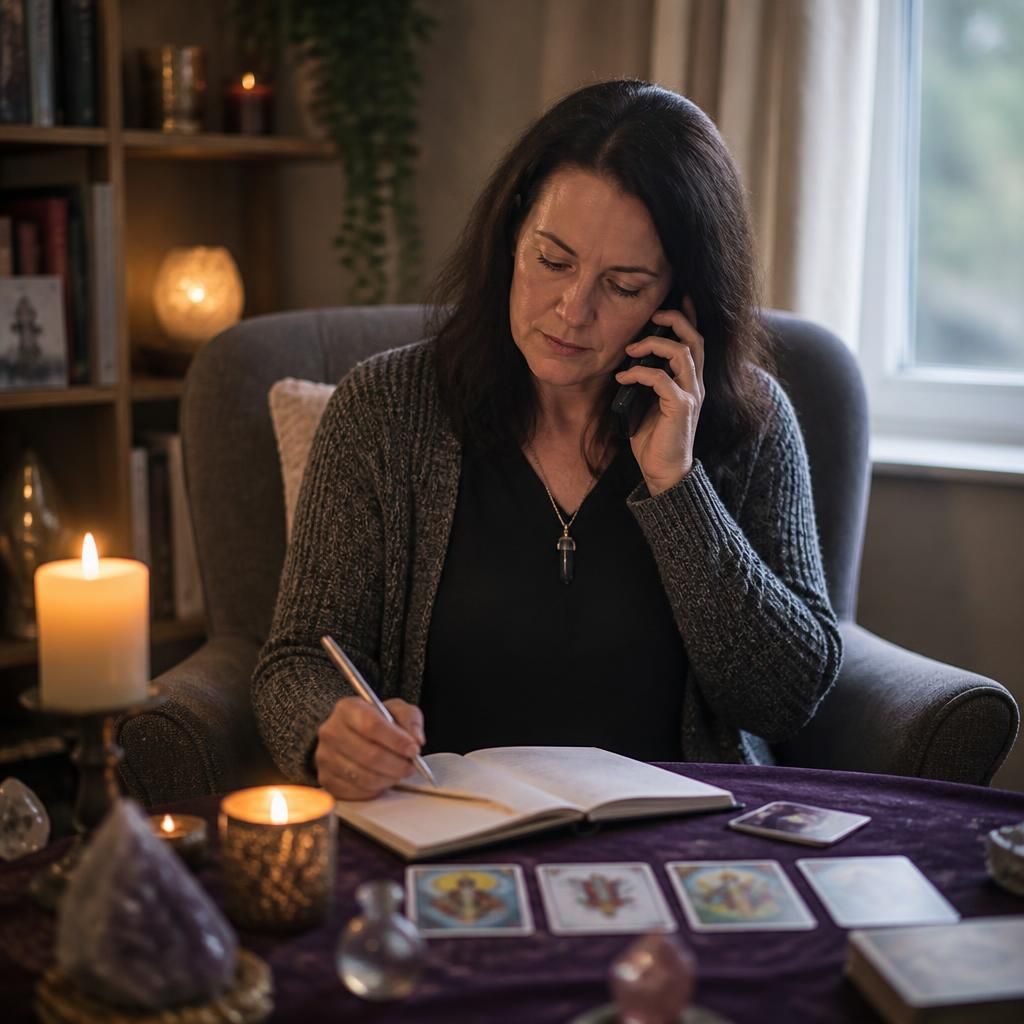
Privacy is an important practical part of a phone reading session. Because relationship discussions may involve sensitive personal information, choose a private setting and share only details relevant to the question. If you want to record the call, ask the reader first; consent requirements may vary depending on where each participant is located.
It is also sensible to decide how you will handle notes or written messages after the session. Keep personal information secure, particularly if the reading includes details about a partner, family member or former partner. These precautions do not affect the intuitive or symbolic aspects of the reading, but they help maintain clear boundaries around the information discussed.