


How does meditation enhance intuitive abilities during psychic readings?
Meditation can enhance intuitive abilities during psychic readings by training focused attention, reducing mental distraction and helping you notice subtle thoughts, feelings and impressions. It may also make it easier to distinguish a calm intuitive impression from anxiety, expectation or analytical overthinking, supporting a clearer and more reflective reading process.
Meditation can enhance intuitive abilities during psychic readings by developing receptive awareness, emotional regulation and sensitivity to internal signals. In practical terms, it gives the reader a steadier way to observe impressions, symbols and bodily responses without immediately assigning them a meaning, while also helping the client engage with the reading more thoughtfully.
It strengthens observation rather than guaranteeing psychic accuracy. Meditation does not prove that an impression is objectively psychic, and it cannot ensure a particular outcome. Its value is that it can improve the quality of attention brought to a reading. A calmer, more observant state makes it easier to examine an impression before presenting it as guidance.
It develops metacognition. Metacognition is the ability to notice how the mind is processing information. During meditation, a person can observe thoughts, memories, assumptions and emotional reactions without treating each one as fact. This skill is relevant during clairvoyant or mediumistic work because it encourages the reader to ask:
- Is this an immediate impression or an interpretation added afterwards?
- Does the image or feeling remain consistent when examined calmly?
- Could personal experience, expectation or the client’s wording be influencing the response?
This reflective pause can reduce premature conclusions and support more responsible communication.
Meditation can also improve awareness of bodily signals. Practices that focus on physical sensations may make changes in breathing, muscle tension, warmth or discomfort easier to notice. In a spiritual reading, these sensations may be treated as prompts for further reflection, but they should not automatically be presented as evidence. Physical responses can have ordinary causes, including stress, posture or tiredness. Recognising that distinction helps prevent intuition from being confused with anxiety or physical strain.
It supports the use of symbolic material. Tarot cards, visual impressions and astrological themes often require interpretation rather than literal translation. Meditation can create enough mental space to explore several possible meanings instead of selecting the first association that appears. For example, an image of a closed door might suggest hesitation, privacy, an ending or a need for protection, depending on the wider context. Meditation does not determine which meaning is correct; it supports a more measured process of considering the symbol alongside the question being explored.
It may improve tolerance of uncertainty. Intuitive work rarely provides information in a perfectly complete sequence. An impression may be partial, metaphorical or open to more than one explanation. A regular contemplative practice can help a reader remain attentive without forcing a conclusion simply to remove ambiguity. This is particularly important when discussing relationships, career choices or personal development, where an individual may need options and context rather than a fixed prediction.
For a client, meditation can make participation in a reading more purposeful. A short period of quiet beforehand may help the client identify the main issue, separate the question from a strong emotional reaction and decide which points require clarification. The aim is not to produce a blank mind. A useful preparation is to settle physically, notice the present concern and remain open to information without demanding a particular answer.
A practical meditation-based approach to a reading may include:
- Settle the body: adopt a comfortable position and allow the breathing to become natural rather than deliberately forcing it.
- Notice the present state: identify prominent emotions, physical tension and recurring thoughts without judging them.
- Define the purpose: formulate one clear area for exploration, such as understanding a relationship pattern or considering a career decision.
- Observe impressions: allow images, words or sensations to arise without immediately turning them into predictions.
- Test the interpretation: compare the impression with the question, the available context and alternative explanations.
- Record useful points: write down themes and follow-up questions rather than treating every detail as a definite message.
There are limits to this approach. Meditation may make an experience feel more vivid, but vividness is not the same as reliability. It can also bring suppressed memories or strong emotions into awareness, which may affect interpretation. Anyone experiencing persistent distress, confusion or unusual perceptions should seek appropriate mental-health or medical support rather than relying on a psychic reading alone.
Used carefully, meditation enhances intuitive practice by improving self-observation, symbolic reflection and the ability to pause before making meaning from an impression. The result is not certainty, but a more disciplined framework for exploring spiritual insights and deciding how much weight they deserve.
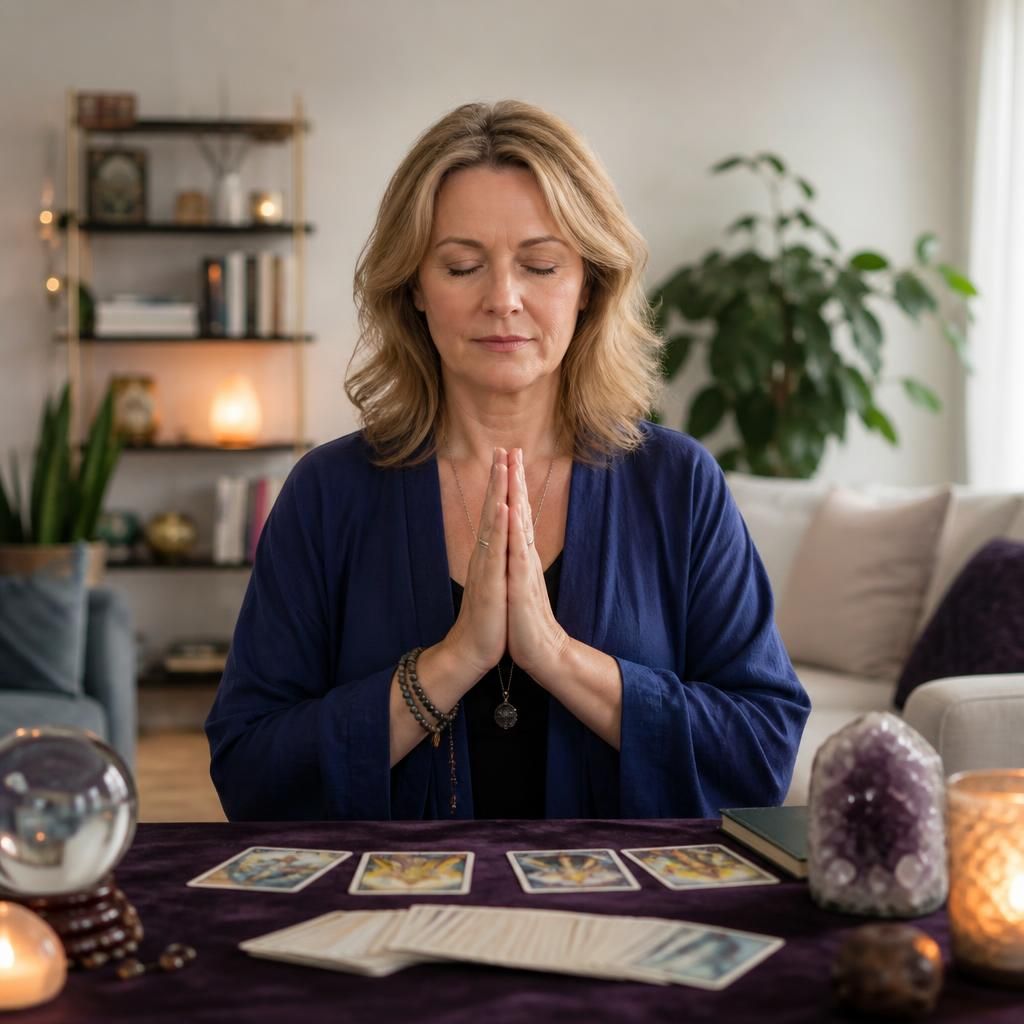
Meditation can support intuitive abilities during a psychic reading by reducing cognitive load. When attention is occupied by planning the next question, recalling previous details or forming an immediate response, less mental capacity remains for noticing relationships between separate impressions. A settled mind can hold several pieces of information together long enough for a more coherent interpretation to emerge.
This is particularly relevant when a reading develops through several layers, such as a client’s question, a tarot image and an emotional theme. Rather than reacting to each element in isolation, the practitioner can compare them and identify whether they form a consistent pattern. Meditation does not create information or confirm that a pattern is meaningful; it helps prevent mental overload from distorting the process.
For the person receiving a reading, the same principle can improve listening. A less hurried state makes it easier to remember what was actually said, distinguish a central theme from a passing detail and consider how the information relates to the original question. This supports informed reflection after the reading instead of encouraging an immediate, unexamined reaction.