


How are psychic phone readings conducted and what techniques are used?
Psychic phone readings are conducted through a private conversation in which the reader focuses on your questions, circumstances and the impressions they receive. Depending on the consultation, techniques may include clairvoyance, tarot, mediumship or astrology to provide personalised insight into relationships, career and personal decisions.
Psychic phone readings are usually conducted as structured, one-to-one consultations: the reader establishes the focus of the call, uses a chosen divination or psychic method, describes the impressions or symbols that arise, and works with the caller to interpret their relevance. The telephone provides the spoken connection, while the reading itself may rely on clairvoyant perception, tarot cards, mediumship, astrology, or a combination of techniques.
A typical reading process
- Setting the focus: The caller identifies the area they want to explore, such as a relationship, career choice or personal direction. A focused question generally gives the consultation a clearer starting point than a broad request for predictions.
- Establishing context: The reader may ask for limited background information to understand the situation and avoid making assumptions. The caller remains responsible for deciding which details to share.
- Selecting a method: The approach can depend on the reader’s practice and the nature of the enquiry. Some consultations use one primary technique, while others combine methods to examine the same issue from different perspectives.
- Interpreting impressions: The reader explains images, feelings, symbols, cards, astrological patterns or perceived messages as they arise. The caller can clarify unfamiliar references and correct misunderstandings during the discussion.
- Applying the information: The final part of the conversation usually involves considering possible meanings, patterns and practical choices. A reading is best treated as reflective guidance rather than a substitute for professional medical, legal or financial advice.
Clairvoyance refers to the interpretation of perceived visual impressions, such as images, colours, places or symbolic scenes. A reader may connect these impressions with the caller’s circumstances and explain that the meaning can be personal rather than literal. Other intuitive impressions may involve emotions, physical sensations or a sense of recognition.
Tarot uses a deck of illustrated cards as a framework for exploring a question. The reader may arrange a spread in which each position represents an aspect of the situation, such as underlying influences, current considerations or possible developments. Interpretation draws on the individual card, its position, relationships with surrounding cards and the question being considered. Tarot is therefore not simply a process of reading a single card in isolation.
Mediumship is intended to focus on impressions associated with a deceased person or the spiritual realm. A medium may describe characteristics, memories, names, places or other details and invite the caller to assess whether they are meaningful. Such information can be subjective, so a responsible consultation should allow the caller to decide whether an impression is relevant instead of presenting uncertainty as established fact.
Astrology interprets the positions and relationships of celestial bodies in a birth chart or another astrological chart. A more detailed chart normally requires relevant birth information, while the reading may examine themes such as temperament, recurring patterns, relationships or periods of change. Astrological interpretation is different from a spontaneous intuitive reading because it uses a symbolic system based on chart data.
Phone delivery changes how these techniques are used. Because the reader and caller cannot rely on shared physical surroundings or visible gestures, the conversation depends more heavily on verbal descriptions, listening and clarification. Cards or charts can still be used by the reader away from the caller’s view, but their significance needs to be explained clearly in words. The caller does not need to see the tools for the interpretation to be discussed.
The quality of a session is not measured only by how specific a statement sounds. Useful points should be considered alongside the context in which they arise, whether they answer the original concern and whether they support sensible reflection. It is reasonable to ask the reader to explain an unclear interpretation, to pause before accepting a conclusion and to distinguish an impression from a definite claim.
For practical decision-making, the most appropriate use of a phone reading is as one source of perspective. Compare what is discussed with reliable information, your own judgement and advice from qualified professionals where the subject involves health, legal responsibilities, money or safety. No psychic technique can remove uncertainty or guarantee a particular outcome.
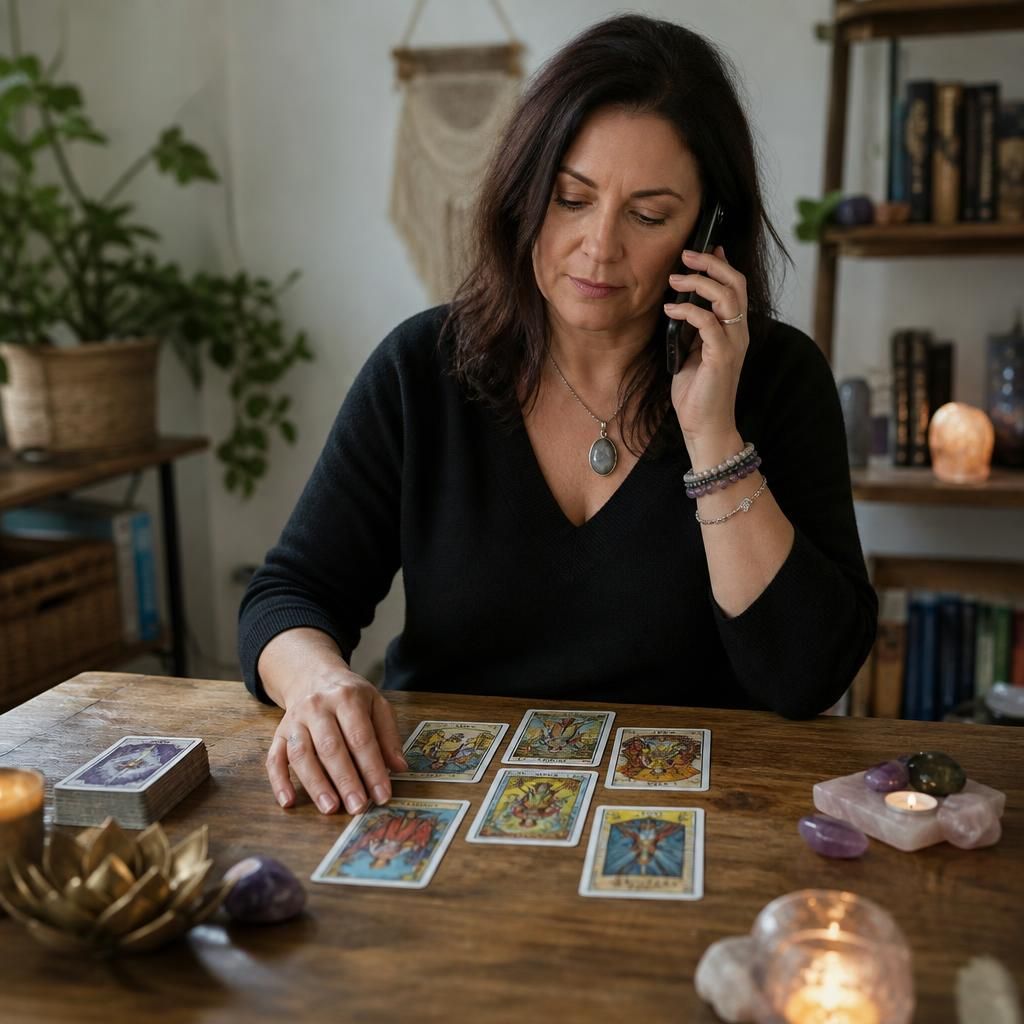
The main difference between psychic phone-reading techniques is the source of the interpretation. Clairvoyance and mediumship are perception-led approaches, relying on impressions the reader describes during the conversation. Tarot is tool-mediated: the cards provide symbols and positions for exploring the question. Astrology is chart-led, using birth details and planetary relationships as the basis for interpretation.
This distinction can help you understand why a reader may ask different questions or request different information. A tarot consultation may begin with the subject of the enquiry, whereas an astrological reading may require accurate birth data. The method shapes the language and structure of the discussion, but it does not turn an interpretation into a certain prediction.