



What types of psychic abilities are commonly used in phone readings and how do they differ?
Phone readings commonly draw on clairvoyance, mediumship, tarot and astrology, but each approach uses a different source of insight. Clairvoyance involves intuitive impressions, mediumship focuses on perceived communication with spirits, tarot interprets card symbolism, and astrology examines patterns associated with birth details and planetary movements.
Psychic abilities used in phone readings differ mainly in how information is interpreted: some practitioners describe receiving impressions directly, some focus on spiritual communication, while others use an established system such as cards or birth-chart symbolism to structure the reading. The same reader may combine several approaches, but each has a distinct method, language and type of guidance.
Clairvoyance is traditionally associated with receiving visual impressions, such as images, colours, scenes or symbolic details. These impressions may be literal, but they can also require interpretation. A reader might describe an image and explore what it represents in relation to your circumstances. Clairvoyance is therefore usually impression-led rather than based on a fixed tool.
Clairaudience and clairsentience are related intuitive practices that are sometimes included alongside clairvoyance. Clairaudience refers to perceived words, phrases or sounds, whereas clairsentience refers to bodily or emotional sensations that the practitioner interprets as meaningful. These terms describe different forms of claimed perception, not separate guarantees of accuracy. A reader may use one or more of them when exploring a situation by phone.
Mediumship has a narrower focus than general psychic insight. The practitioner aims to interpret impressions believed to come from a deceased person or another spiritual source, rather than concentrating only on the caller’s present circumstances or possible future directions. A mediumship reading may involve descriptions of personality, memories or recognisable details. Because these impressions can be personal and subjective, it is sensible to treat them as spiritual interpretation rather than independently verified evidence.
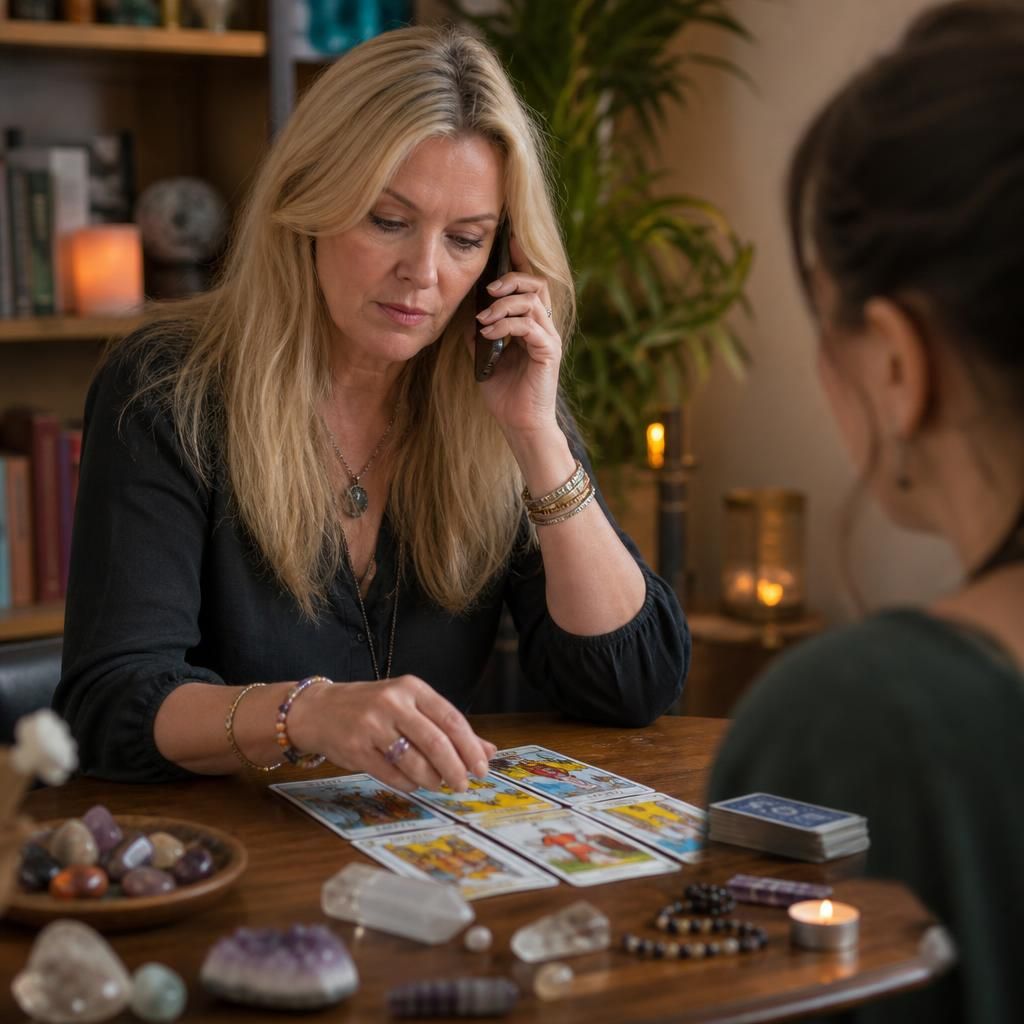
Tarot uses a deck of cards as a visual and symbolic framework. The reader considers the meaning of individual cards, their positions in a spread and the relationship between them. The question, spread and discussion all influence how the symbols are interpreted. Tarot can make a reading more structured and conversational, especially for questions about choices, patterns or competing possibilities. It is not the same as clairvoyance, although a tarot reader may also use intuitive impressions while interpreting the cards.
Astrology uses birth details and the positions of celestial bodies within an astrological chart. A reading may examine broad personality themes, relationship dynamics or periods that are traditionally associated with change and development. Unlike an impression-based reading, astrology begins with a system of calculated placements and established interpretations. The quality of the discussion depends on the accuracy of the birth information supplied and the astrologer’s chosen approach.
The main differences can be summarised as follows:
- Source of information: clairvoyance, clairaudience and clairsentience rely on reported intuitive impressions; mediumship centres on perceived spiritual communication; tarot uses card symbolism; astrology uses chart placements.
- Structure: direct intuitive work may be relatively open-ended, while tarot and astrology provide a defined framework for organising the discussion.
- Primary focus: mediumship concerns connection with the deceased or spiritual sources, whereas other approaches may address relationships, decisions, career questions or personal patterns.
- Role of the caller: an open intuitive reading may develop from the impressions that arise, while tarot and astrology usually involve specific questions, a card spread or accurate birth details.
- Language used: intuitive readings often use descriptions of feelings or images; tarot uses card names and symbolism; astrology uses signs, planets, houses and aspects.
Phone delivery can accommodate each of these approaches, but it changes the practical process rather than the underlying method. A clairvoyant or clairsentient reader may work without visual contact, relying on the conversation and the impressions they report. A tarot reader can draw cards during the call and explain the spread verbally. An astrologer can refer to chart calculations prepared from the caller’s birth information. For mediumship, the reader may invite the caller to respond to details while keeping the discussion focused on the reported impressions.
These approaches should not be treated as interchangeable forms of evidence. Tarot and astrology are interpretive systems, while clairvoyance, clairaudience, clairsentience and mediumship involve claims of extrasensory or spiritual perception that cannot be independently confirmed simply because a reading takes place. A careful reader should distinguish interpretation from fact and avoid presenting uncertain impressions as medical, legal or financial certainty.
When deciding which type may suit your purpose, consider the kind of conversation you want. Tarot can be useful if you prefer symbols and a clear spread to examine a decision. Astrology may suit someone interested in longer-term themes or chart-based patterns. Mediumship is specifically relevant to those seeking a spiritual connection with someone who has died. Clairvoyant or other intuitive approaches may be preferable if you want a more open discussion without a particular tool. You can also ask the practitioner which methods they use, how they handle uncertainty and whether they combine techniques during one reading.
Whichever ability is offered, a phone reading is best approached as reflective spiritual guidance rather than a substitute for qualified professional advice. Keep responsibility for important decisions with you, particularly where health, safety, money or legal matters are involved, and use the reading to consider questions and possibilities rather than as a guaranteed prediction.
Labels for psychic abilities are not always used consistently. Two practitioners may both describe their work as clairvoyant, for example, while one focuses on spontaneous images and the other combines intuitive impressions with tarot or mediumship. The label alone therefore does not fully explain what a phone reading involves.
Before booking, ask the practitioner to clarify:
- which ability or system forms the main basis of the reading;
- whether they use cards, birth details or another framework;
- how much the session depends on your questions and conversation; and
- whether different methods are combined and, if so, how they relate to one another.
This comparison helps you choose a format that matches your expectations. It also separates the name of an ability from the practical method used during the call, making it easier to understand the type of guidance being offered.