








Are telephone psychic readings accurate?
Telephone psychic readings can feel accurate and personally relevant, but their insights cannot be verified or guaranteed as factual predictions. The quality of a session depends on factors such as the reader’s methods and experience, the clarity of the questions asked, and how thoughtfully the guidance is interpreted.
Telephone psychic readings should not be treated as objectively accurate forecasts. They are better understood as interpretive sessions that may offer personal reflection, possible perspectives and prompts for considering a situation. Whether a reading feels accurate can depend on how specific the information is, how it relates to your circumstances and how you choose to evaluate it afterwards.
What “accurate” can mean
People use the word accuracy in different ways. One person may mean that a prediction later matches an event. Another may mean that the reader identifies a feeling, relationship pattern or concern that already feels familiar. These are not equivalent standards. A statement can feel emotionally relevant without being a verifiable prediction, while a concrete prediction can appear correct by coincidence or because the circumstances were already likely to develop in that direction.
A careful assessment separates three things:
- Specificity: whether the message contains clear details rather than broad statements that could apply to many people.
- Verifiability: whether the claim can be checked independently instead of being adjusted to fit events after they occur.
- Interpretation: whether the meaning comes from the reader’s words or from the client connecting those words with personal experiences.
Does using a telephone affect the reading?
A phone session removes visual information such as facial expressions, clothing and body language. This can limit some ordinary conversational cues, but it can also reduce distractions and make it easier for a client to concentrate on the discussion. The reader may rely more heavily on spoken questions, pauses, tone and the chosen method, whether that is tarot, astrology, clairvoyance or mediumship.
The telephone itself does not provide evidence that a reading is more or less accurate. Its main effect is on communication. Clear audio, an uninterrupted conversation and a shared understanding of the question can make the session easier to follow. They do not, however, turn an intuitive impression into a confirmed fact.
Why a reading may seem accurate
Several normal psychological processes can influence how a session is remembered. Broad statements may seem highly personal because they relate to common experiences. Clients may remember the details that fit and forget those that do not. A prediction may also appear to come true because it describes an outcome that was already possible or because the client changes their behaviour after hearing it.
This does not mean that every meaningful experience is deliberately misleading. It means that a strong feeling of recognition is not, by itself, a reliable test of predictive accuracy. Keeping an unbiased record of the statements made before an outcome occurs can provide a more balanced basis for reflection.
How to assess a reading responsibly
- Write down the questions you want to explore before the call, without supplying unnecessary background information.
- Record key statements during or immediately after the session, including details that do not seem to fit.
- Distinguish definite claims from possibilities, symbolism and advice.
- Review predictions at a later point without changing their original meaning to make them fit.
- Consider whether the guidance helps you examine choices or simply encourages dependence on further readings.
A responsible psychic should present impressions as guidance rather than certainty, avoid creating fear and respect your ability to make decisions. Be cautious of claims that an outcome is guaranteed, that a disaster is unavoidable, or that you must pay for repeated sessions to prevent a problem. Pressure, absolute promises and instructions to disregard qualified professional advice are warning signs.
Psychic guidance should not replace medical, legal or financial advice. Questions in those areas require appropriately qualified professionals, particularly where a decision could affect your health, safety, rights or money. A telephone reading may help you articulate concerns or explore how you feel about a choice, but responsibility for acting on that discussion remains with you.
In practice, the most useful way to approach a telephone reading is as a structured opportunity for reflection. Treat statements as possibilities to consider, not established facts; test specific claims fairly; and retain independent judgement throughout the session. That approach allows you to assess whether the guidance is personally useful without confusing relevance or coincidence with proven accuracy.
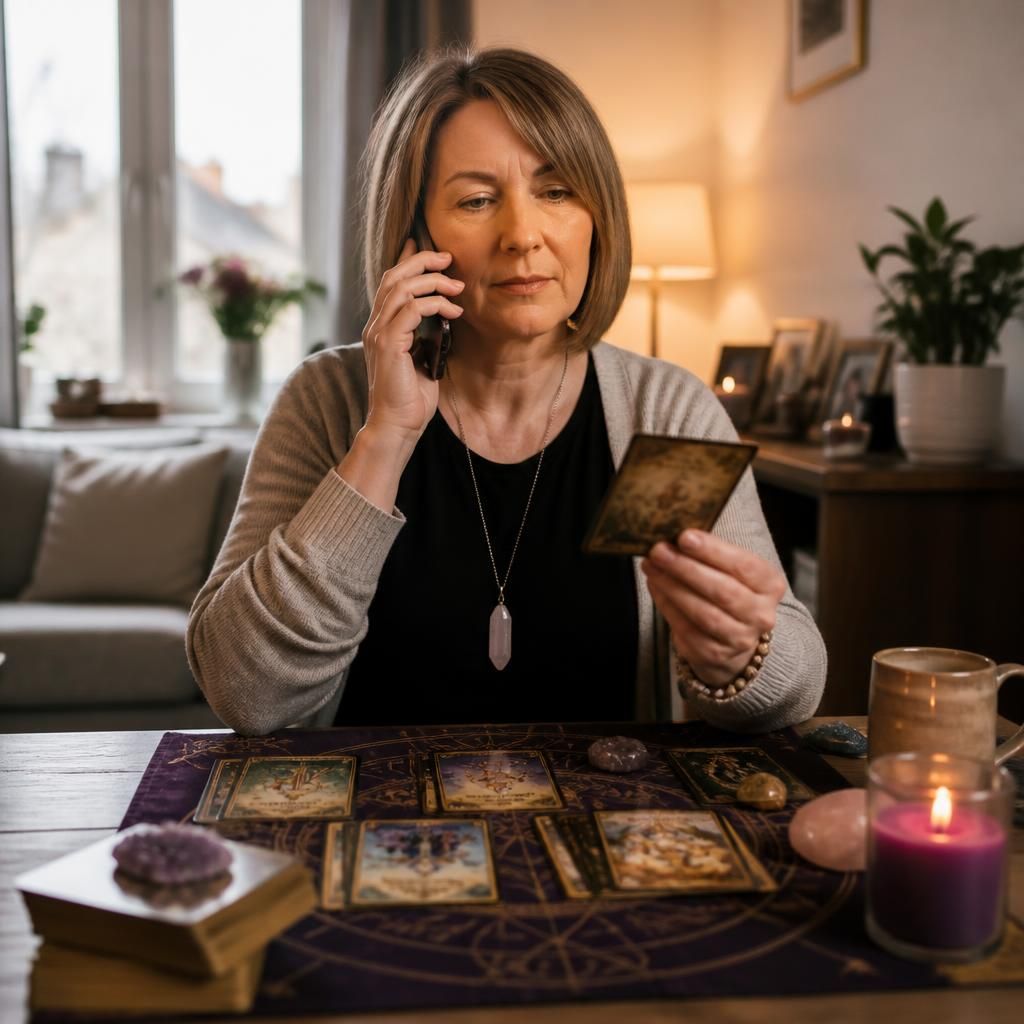
Accuracy also depends on what a particular reading method is intended to provide. Tarot commonly uses symbols and card relationships to explore themes, choices and possible developments, while astrology interprets information associated with a birth chart and current planetary patterns. Clairvoyant readings may present impressions or images, whereas mediumship focuses on perceived communication with someone who has died. These approaches do not produce identical types of statements, so they should not all be judged as though they were precise forecasts.
When assessing a session, ask whether the interpretation remains consistent with the method being used and whether uncertainty is acknowledged. A symbolic message may be useful as a prompt for reflection without being a literal prediction. Likewise, an impression about a relationship or career may suggest a perspective rather than establish what another person will do. Understanding this distinction helps you judge whether the reading offers clear, relevant guidance without treating its underlying interpretation as independently proven.