




What are the key components of a personal horoscope chart that influence the accuracy of my reading?
The key components of a personal horoscope chart are your birth date, exact birth time and birthplace, which establish the positions of the Sun, Moon, planets, zodiac signs and chart houses. The relationships between these placements, known as aspects, add interpretive detail, while accurate birth information is essential for calculating the Ascendant, houses and planetary degrees reliably.
The key components that most influence the usefulness of a personal horoscope chart are the Ascendant and chart angles, the placement and condition of each planet, the houses they occupy, the aspects between them, and the overall patterns formed by the chart. A reliable reading does not treat one placement as a complete answer; it weighs these components together and relates them to the question being explored.
The Ascendant and chart angles
The Ascendant, or rising sign, marks the beginning of the first house and is used to examine outward behaviour, immediate responses and the way a person approaches life. The other angles are the Midheaven, Descendant and Imum Coeli. Together, these points create the chart’s main framework:
- Ascendant: presentation, approach and instinctive reactions.
- Descendant: close partnerships and qualities encountered through other people.
- Midheaven: public direction, reputation and vocational themes.
- Imum Coeli: private life, family foundations and inner security.
Planets close to an angle generally receive particular interpretive weight because their themes can become more visible in the person’s life.
Planets as functions within the chart
Each planet represents a different psychological or life function. The Sun is associated with identity and purposeful expression, while the Moon relates to emotional needs, habits and responses. Mercury concerns thinking and communication; Venus relates to attraction, values and relating; and Mars describes initiative, desire and assertion. Jupiter is linked with expansion and meaning, Saturn with structure and responsibility, and the outer planets with broader generational patterns as well as personal themes when they strongly connect with an angle or personal planet.
The planet itself is only one part of the interpretation. Its sign describes how that function tends to operate, its house shows the area of life in which it is expressed, and its aspects indicate how it interacts with other functions.
Signs and their qualities
A sign adds style and temperament to a planetary placement. The four elements—fire, earth, air and water—can suggest whether expression is more action-oriented, practical, intellectual or emotionally receptive. The three modalities—cardinal, fixed and mutable—indicate tendencies towards initiating, sustaining or adapting.
Rather than counting signs mechanically, an astrologer may look for an overall balance. A chart with strong fixed emphasis, for example, may show persistence and resistance to change, while a chart with substantial mutable emphasis may indicate flexibility but difficulty maintaining a single direction. These are interpretive tendencies, not fixed labels.
Houses and house systems
The houses divide the chart into areas of experience, including identity, resources, communication, home, creativity, work, partnership, shared matters, belief, career, community and retreat. A planet in a house shows where its concerns are most likely to be expressed.
House cusps can vary according to the house system used. Common systems calculate house boundaries differently, so a planet close to a cusp may be assigned to a different house depending on the method. For a careful reading, the astrologer should use one consistent system and explain any placement that is especially sensitive to this choice.
Aspects and their strength
Aspects are angular relationships between planets and significant chart points. Conjunctions combine planetary influences; oppositions highlight polarity; squares can indicate pressure or conflict; and trines and sextiles often describe ease, cooperation or available skills. No aspect is automatically positive or negative: its meaning depends on the planets involved, their signs, houses and the rest of the chart.
Aspect strength is assessed partly through the orb, meaning the distance from the exact angle. Tighter aspects are usually given more weight, particularly when they involve the Sun, Moon, Ascendant or Midheaven. A chart with many aspects may require prioritisation rather than an attempt to interpret every connection equally.
Chart ruler, dignities and retrograde motion
The chart ruler is the planet governing the Ascendant sign. Its sign, house and aspects can provide a useful organising theme for the whole chart. Traditional techniques may also consider essential dignity, which examines whether a planet is especially comfortable or challenged in a particular sign. Retrograde motion is another factor sometimes included in interpretation, especially for personal planets, although its meaning should be considered alongside the complete chart rather than treated as a stand-alone prediction.
Patterns and emphasis
Some charts contain recognisable configurations, such as a grand trine, T-square, stellium or strong concentration in one hemisphere. These patterns can reveal repeated themes, areas of focus or tensions that link several placements. The chart’s dominant element, modality, house emphasis and angular planets may also help an astrologer decide which subjects deserve priority.
Accuracy therefore has two meanings. Astronomical accuracy concerns calculating the chart consistently and placing its points correctly. Interpretive accuracy concerns applying those placements to the reader’s actual question without exaggerating one symbol or presenting possibilities as certainties. A well-grounded personal horoscope reading identifies the strongest chart signatures, explains how they interact, acknowledges ambiguity and separates established chart symbolism from speculation about future events.
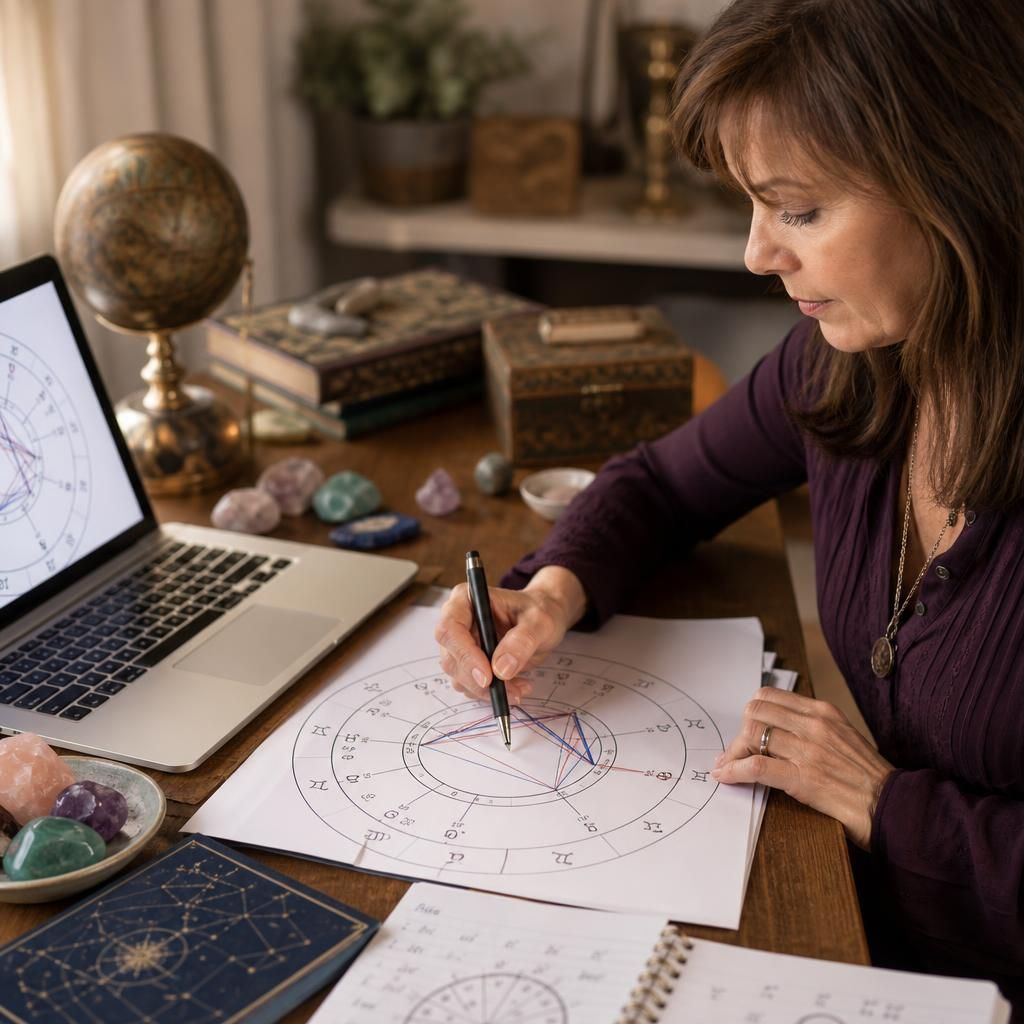
A personal horoscope chart is influenced not only by its interpreted symbols but also by the calculation settings used to create it. The astrologer should check the location’s coordinates, historical time-zone rules and daylight-saving adjustments, as an error in any of these can alter the Ascendant, house cusps and planetary degrees.
It is also important to identify the zodiac framework, such as tropical or sidereal astrology, and the ephemeris used to calculate planetary positions. Different settings can produce different sign or house placements, so a careful reading should state the method used and apply it consistently. This makes the chart easier to verify and helps distinguish a genuine interpretive difference from a technical calculation error.