






What types of insights can astrology provide during a soulmate psychic reading?
Astrology can provide insights into soulmate compatibility by examining birth charts for shared values, communication styles, emotional needs and recurring relationship patterns. It may also offer symbolic guidance about relationship timing and personal growth, but it should be used as a reflective tool rather than a guarantee of a particular outcome.
During a soulmate psychic reading, astrology can add a structured layer of interpretation by examining how two people’s natal charts, planetary relationships and current astrological cycles interact. This may highlight attraction patterns, emotional triggers, areas of ease, likely sources of tension and the personal lessons a connection may bring, without treating a chart as proof that two people are destined to remain together.
Synastry can show how one person’s chart activates the other’s. In a synastry comparison, the planets in each birth chart are assessed against the other person’s planets and chart houses. For example, one person’s Venus making a strong connection with the other’s Mars may be interpreted as an indicator of romantic or physical attraction, while contacts involving Saturn may point towards responsibility, commitment or a sense of restriction. These symbols require context: the same aspect can be constructive in one relationship and difficult in another, depending on the wider chart.
Astrology may also examine the Moon, Mercury, Venus and Mars in greater detail. The Moon is commonly associated with instinctive reactions and emotional comfort; Mercury with communication and thought processes; Venus with affection, attraction and preferences; and Mars with motivation, desire and the way conflict is expressed. Looking at these placements can help a reading explore why two people may feel drawn to one another yet respond differently to closeness, disagreement or reassurance.
Aspects can reveal recurring relationship patterns. An aspect is an angular relationship between two planets. Harmonious aspects may be read as areas where interaction feels more natural, whereas challenging aspects can indicate friction that requires awareness and negotiation. For instance, a difficult Mercury–Neptune contact might be explored in relation to assumptions or unclear messages, while a prominent Saturn aspect might raise questions about boundaries, expectations and perceived obligations. These interpretations describe possibilities for reflection rather than fixed personality judgements.
A reader may use the composite chart to consider the relationship as its own symbolic entity. Rather than comparing two individuals separately, a composite chart combines chart data to produce a representation of the partnership. It may be used to discuss the connection’s apparent tone, its priorities and the way it functions when the two people are together. This can complement synastry: synastry focuses on the interaction between two charts, while a composite chart focuses on the identity or dynamic of the relationship itself.
Astrology can also provide insight into the role of the chart houses. House placements may suggest which areas of life are especially activated by the connection, such as communication, home life, friendship, shared resources or long-term aims. A strong emphasis on one area does not automatically mean that the relationship will succeed or fail; it indicates where the connection may demand attention or have a noticeable influence.
Current planetary movements, known as transits, may be discussed to place relationship experiences in a broader personal context. A transit can symbolically coincide with periods of reassessment, increased responsibility, emotional intensity or a desire for greater independence. In a soulmate reading, this information may help someone consider whether a reaction belongs to the present relationship, a longer-standing personal pattern or a temporary period of change. Accurate transit interpretation depends on reliable birth information and careful consideration of the whole chart.
When birth times are incomplete or uncertain, some astrological details become less dependable, particularly the Ascendant, houses and precise Moon position. A responsible reading should distinguish between information supported by accurate data and interpretations that are more tentative. The reader can ask which birth details were used, which methods informed the interpretation and whether a conclusion is based on a single placement or several consistent indicators.
Useful questions to explore during the astrology portion of a soulmate psychic reading include:
- Which interaction patterns appear most consistently between the two charts?
- How might each person express affection, uncertainty or disagreement?
- What boundaries or communication habits could support a healthier dynamic?
- Which parts of the interpretation relate to the relationship, and which relate to individual personal development?
- What information is uncertain because of missing or inaccurate birth data?
The value of astrology in this setting is therefore interpretative rather than predictive. It can give language to complex feelings, identify themes worth discussing and encourage more considered choices. It should not replace direct communication, practical judgement, professional health or legal advice, or a person’s responsibility to decide what is appropriate in their own relationship.
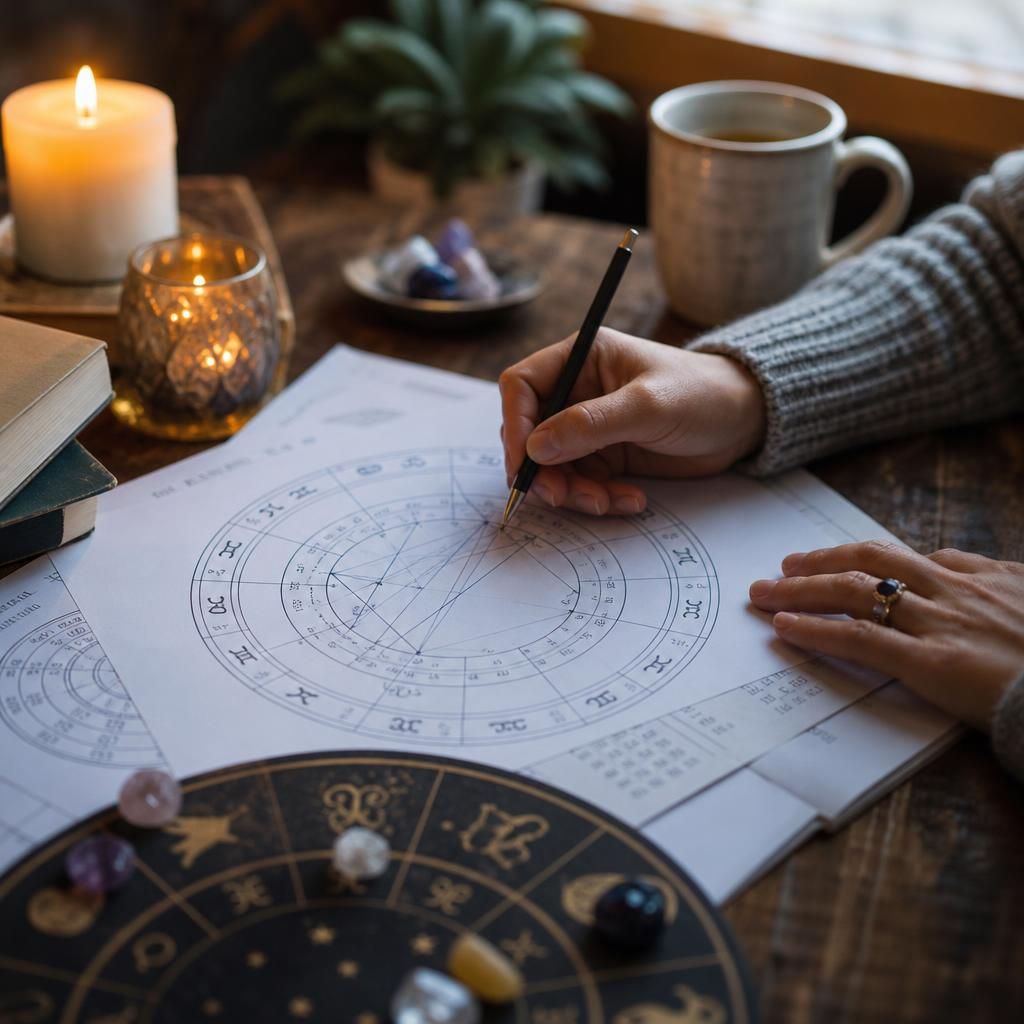
Some astrology-based soulmate readings examine less prominent chart points for insight into why a connection feels familiar, challenging or transformative. The lunar nodes are often interpreted as symbols of ingrained tendencies and areas of development, while Chiron may be used to explore emotional sensitivities that a relationship brings to the surface. The Vertex is sometimes considered when discussing encounters that seem unusually significant, although its use varies between astrologers.
These points are best treated as supplementary themes rather than standalone evidence of a soulmate bond. Their meaning depends on the wider chart, the accuracy of the birth details and the circumstances of the relationship. A useful reading should explain how such symbols relate to observable experiences, rather than presenting specialised placements as definitive proof of a particular connection.