




Are there specific tarot spreads used in psychic-guided readings?
Yes. Psychic-guided readings may use established spreads such as the three-card spread, Celtic Cross, relationship spread or career spread, with the reader selecting or adapting the layout to suit the question and the insight arising during the consultation.
There is no single tarot spread required for a psychic-guided reading. The layout is usually chosen according to the question, the amount of detail needed and the way the reader’s intuitive impressions develop during the consultation. A spread provides structure, while psychic guidance may help the reader decide which themes deserve closer attention.
Each card position has a defined role. For example, a position may represent the current circumstances, an influence from the past, a hidden factor, a likely obstacle, available choices or a practical direction to consider. The meaning of a card therefore depends on both its traditional symbolism and the position it occupies. A reader may also connect cards across the layout, identifying repeated suits, major arcana themes, numbers, symbols or contrasting energies.
Common approaches include the following:
- Short thematic layouts: A small number of cards can examine a focused issue, such as the main influence surrounding a decision, the dynamic within a relationship or the next practical consideration.
- Layered layouts: Several cards may be used to separate circumstances, thoughts, emotions, external influences and possible actions. This can be useful when a question has more than one cause or outcome to consider.
- Choice-based layouts: Separate positions or lines can explore different options, including the likely implications of each path and what the person may need to understand before deciding.
- Timing-focused layouts: Cards can be arranged to examine stages of a situation or developments connected with a period of change. These layouts are better understood as reflective guidance than as fixed dates or guarantees.
- Open or intuitive layouts: The reader may begin with a looser arrangement when the concern is broad. Additional cards can then be drawn to clarify an image, conflict or recurring theme that appears in the first part of the reading.
Psychic guidance can affect how a spread is used. Rather than treating every position as completely isolated, the reader may notice an intuitive impression before turning a card, recognise a connection between apparently unrelated positions or ask a more precise follow-up question. This does not remove the established meanings of the cards; it adds another interpretive layer based on the context presented by the client and the reader’s perception.
The wording of the question also influences the spread. “Will this happen?” may produce a narrower reading than “What factors are influencing this situation, and what can I do?” Open questions generally allow the cards to explore choices, patterns and possible consequences in greater depth. A responsible reading should distinguish between present influences, potential directions and events that remain subject to personal decisions or changing circumstances.
A larger spread is not automatically more informative than a smaller one. More cards can provide additional context, but they can also introduce competing themes or unnecessary detail. For a clearly defined issue, a compact layout may be easier to interpret. A broader arrangement may be appropriate when the reader needs to examine several connected aspects of a complex situation.
Readers may also adapt a spread during the session. A clarifying card can investigate an unclear position, while a second layout may be used when the original question reveals a separate concern. This should be explained clearly so that the client understands which cards address the original issue and which relate to a later line of enquiry.
When assessing a psychic-guided tarot reading, it is useful to ask what the positions represent, whether the layout is fixed or adapted, and how the reader separates symbolic interpretation from intuitive impressions. The value of a spread lies in the clarity it brings to the discussion, not in its name or size. The most suitable arrangement is the one that keeps the question focused and produces guidance that can be considered alongside the client’s own judgement.
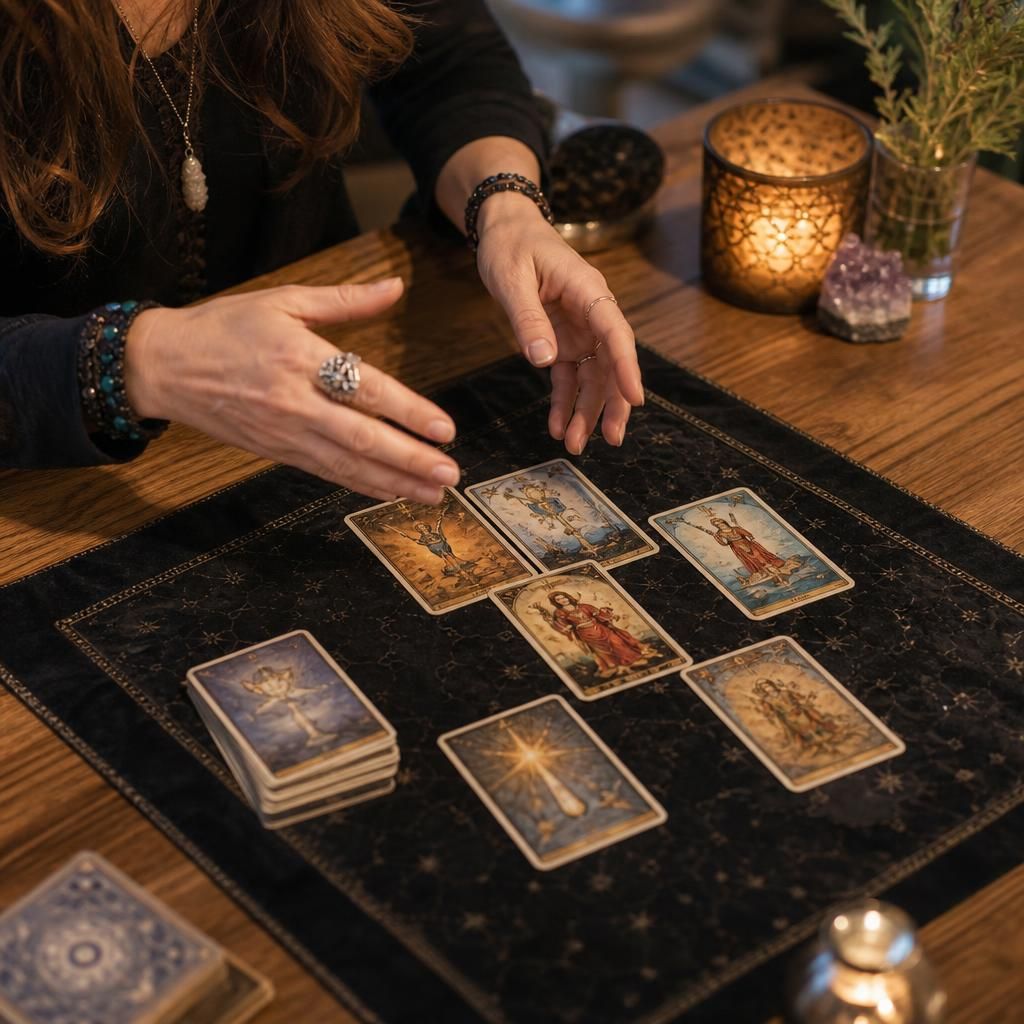
Themed tarot spreads organise a reading around the structure of a particular concern rather than applying a general layout to every question. In a relationship spread, positions might consider each person’s perspective, the shared dynamic, a source of tension and a constructive area for discussion. A career spread may examine the present working situation, relevant skills, external constraints and the considerations surrounding a possible change.
These layouts do not make the topic-specific cards inherently more predictive. Their main purpose is to ensure that relevant aspects of the question are considered in an organised way. During a psychic-guided reading, the reader may give greater attention to a position that corresponds with an intuitive impression, while still relating that impression to the card’s symbolism and the stated focus of the spread.