




How does the process of a cartomancy love reading differ from other divination methods, and what unique benefits can it offer for understanding romantic relationships?
A cartomancy love reading uses a deliberate card spread and the symbolism, position and relationships between cards to explore romantic circumstances, rather than relying primarily on astrological charts, mediumistic communication or clairvoyant impressions. Its distinctive benefit is a structured view of emotions, relationship dynamics, possible influences and available choices, which can help you examine a romantic situation from several connected perspectives.
A cartomancy love reading is a card-based consultation in which a reader interprets a selected layout to examine romantic patterns, choices and possible developments. Its process differs from other divination methods because the interpretation is built from the interaction of several cards within a defined spread, rather than from a birth chart, an intuitive impression or communication with a deceased person. This gives the reading a specific framework for exploring how factors in a relationship may connect.
The process normally begins with a focused question. A broad request such as “What will happen in my love life?” can produce general material, whereas a question about communication, commitment, reconciliation or a recurring conflict gives the reading a clearer direction. The reader may use a spread designed around the issue, with each position representing a particular aspect, such as the current dynamic, an underlying influence, each person’s perspective, a difficulty and a possible course of action.
Cards are then considered both individually and in relation to their positions. A card associated with hesitation, for example, may have a different significance when placed in a position concerning one person’s feelings than when it appears as an influence affecting communication. Repeated suits, contrasting symbols, court cards or a cluster of related themes may add context. The reader brings these elements together rather than treating each card as an isolated answer.
Where the initial layout leaves an issue open, a reader may draw a clarifying card or use an additional spread. This should refine a specific point rather than continually expanding the reading until a preferred answer appears. A sound process also distinguishes the cards’ themes from the reader’s interpretation and from assumptions supplied by the client. That distinction helps keep the consultation focused and makes it easier to assess which parts are observations, possibilities or practical reflections.
Compared with astrology, cartomancy usually works from the question and the selected layout rather than from planetary positions and birth information. Astrology can be used to study longer-term patterns, cycles and compatibility through charts. Cartomancy is generally more direct in examining a particular situation as it is being presented: for example, what may be affecting a conversation, what a person could be overlooking or which choices deserve consideration. Neither method automatically establishes a certain outcome; they use different systems for organising interpretation.
Compared with clairvoyant reading, cartomancy provides an external reference point for the consultation. A clairvoyant approach may centre on impressions, images or sensations received intuitively by the reader. In cartomancy, the cards form a visible sequence that can be discussed position by position. This can make it easier to ask why a particular interpretation has been made and to relate the reading to a defined romantic question.
Compared with mediumship, cartomancy is not primarily a method for attempting communication with someone who has died. A mediumistic reading focuses on perceived contact and messages from a spirit, while a cartomancy love reading focuses on the relationship issue represented by the spread. If a client is seeking bereavement-related communication, that is a different purpose and should not be confused with card interpretation.
Cartomancy may also differ from a purely intuitive consultation because it can show several perspectives within one layout. A relationship spread might separate the client’s expectations from the other person’s apparent position, the effect of past behaviour and the influence of an immediate decision. This does not prove what another person thinks or remove uncertainty, but it can help identify assumptions that need testing through honest conversation and observable behaviour.
Its distinctive benefits for romantic understanding include:
- Defined focus: the question and spread limit the consultation to a particular relationship concern instead of producing an undirected discussion.
- Multiple viewpoints: separate positions can examine feelings, communication, obstacles, external pressures and personal choices without treating them as one issue.
- Recognition of patterns: recurring symbols or related cards may draw attention to habits such as avoidance, unequal effort or difficulty expressing needs.
- Exploration of alternatives: a reading can consider how different responses might affect a situation, supporting reflection on choices rather than presenting one unavoidable future.
- Accessible discussion: the imagery and structure of the cards provide concrete subjects to discuss, which can be useful when a relationship problem feels complicated or emotionally unclear.
- A record for reflection: when the reading is delivered by email, the written interpretation can be revisited and compared with later observations, provided it is treated as guidance rather than proof of a prediction.
The most useful interpretation keeps possibility separate from certainty. Cards cannot verify another person’s private thoughts, guarantee reconciliation or replace direct evidence about behaviour. A responsible reading should therefore encourage clear boundaries, communication and personal judgement. It should also avoid presenting relationship outcomes as fixed or using divination as a substitute for professional support where safety, mental health or other serious concerns are involved.
In practical terms, cartomancy is best understood as a structured reflective method for examining a romantic question. Its value lies in the way the spread organises competing influences and possible responses, while the client remains responsible for decisions and for checking interpretations against real-life communication and conduct.
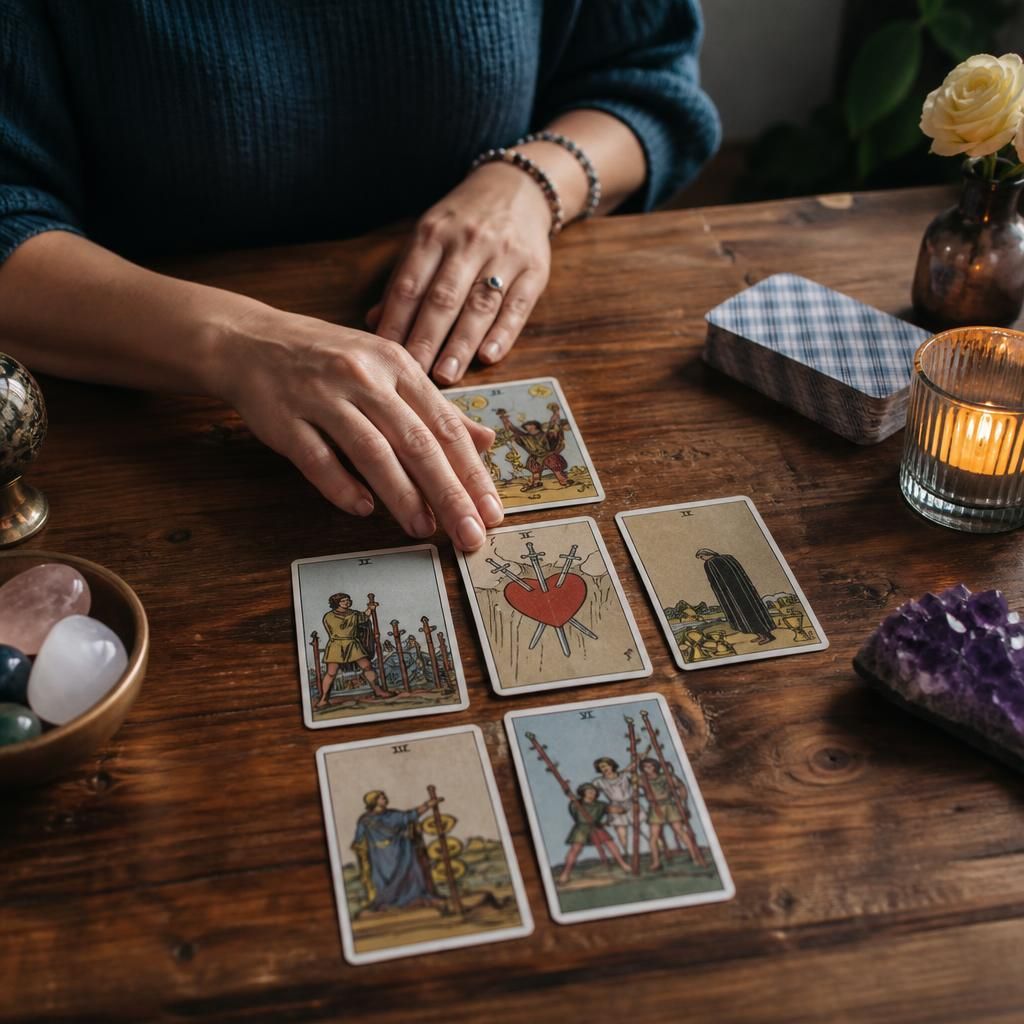
One distinctive feature of a cartomancy love reading is its ability to represent mixed relationship signals without reducing them to a simple yes-or-no answer. Cards with contrasting meanings may indicate that attraction exists alongside uncertainty, or that emotional connection is present while practical circumstances create difficulty. This allows the interpretation to reflect tension within a relationship rather than forcing a single explanation.
That layered symbolism can be particularly useful when romantic experiences feel inconsistent. Instead of treating one encouraging or concerning detail as decisive, the reader can examine how different themes coexist and what each may signify in context. The result is a more nuanced basis for considering whether a concern relates to communication, expectations, emotional readiness or circumstances surrounding the relationship.