


How do psychic card readings specifically address questions about love and relationships?
Psychic card readings address love and relationship questions by interpreting card symbolism, spread positions and intuitive impressions around emotions, communication, compatibility, choices and likely influences. They can help clarify the dynamics of a relationship or the factors shaping a decision, but they should be treated as guidance for reflection rather than a fixed prediction.
Psychic card readings address love and relationship questions by turning a broad concern into several connected areas of enquiry: the people involved, the emotional dynamic, communication, personal expectations, outside influences and the choices available. The cards are interpreted as a reflective framework, helping a reader examine what may be influencing a situation rather than providing an unchangeable verdict about its future.
They clarify the nature of the question. “Will this relationship work?” contains several different concerns. A reading may separate these into questions about mutual expectations, emotional availability, compatibility, unresolved tension and the practical circumstances affecting the relationship. This produces more useful insight than treating a single card as a simple yes-or-no answer. The same approach can be applied to questions about meeting someone new, rebuilding trust, deciding whether to continue a relationship or understanding uncertainty after a separation.
They examine each person’s position. In a relationship reading, cards may be assigned to the client’s feelings, the other person’s apparent stance, the connection between them and the circumstances surrounding the issue. This structure can highlight differences between what someone feels, what they communicates and what they actually does. It can also distinguish a temporary disagreement from a broader mismatch in priorities, commitment or expectations. A careful interpretation should avoid presenting another person’s private thoughts as proven fact; instead, it can identify patterns suggested by the reading and areas that may need direct conversation.
They put emotional patterns into context. Love questions are often shaped by previous experiences, fear of rejection, attachment to a particular outcome or difficulty trusting personal judgement. Cards can prompt consideration of whether a current reaction belongs to the present relationship or is being intensified by an earlier experience. They may also draw attention to repeated behaviours, such as avoiding difficult conversations, accepting unclear commitment or pursuing emotionally unavailable partners. This makes the reading relevant to personal growth as well as to the immediate romantic situation.
They explore communication and conflict. Rather than reducing a disagreement to who is right, a reading can consider how each person expresses needs, responds to pressure and interprets the other’s behaviour. A spread might be used to examine the source of tension, what remains unsaid, how a message could be received and which response is most constructive for the client. The value lies in identifying questions to ask and assumptions to test, not in replacing an honest discussion between the people involved.
They compare possible choices. When a client is deciding whether to initiate contact, set a boundary, ask for commitment or leave a relationship, cards can be read around the likely influences and emotional implications of each option. This does not remove responsibility for the decision. It gives the client a way to compare priorities, risks and personal values. A useful question is often “What should I understand about each path?” rather than “Which outcome is guaranteed?”
Love readings can address different relationship circumstances, including:
- the early stages of attraction and whether interest appears balanced;
- uncertainty about commitment, exclusivity or the direction of a relationship;
- recurring arguments, emotional distance or difficulty expressing needs;
- the effects of family, work, past relationships or other external pressures;
- reconnection after a separation and the conditions needed for trust to be rebuilt;
- deciding how to protect personal boundaries while remaining open to intimacy; and
- preparing emotionally for dating after disappointment or a significant change.
They use the client’s wording and context. The same card can carry a different emphasis depending on the question and its position in a spread. A card associated with change could suggest a developing relationship, a necessary adjustment in an established one or the end of an unhelpful pattern. The surrounding cards, the structure of the spread and the reader’s intuitive interpretation help establish which meaning is relevant. Context is therefore more important than memorising a fixed list of romantic card meanings.
They can identify what is within the client’s control. A reading cannot make another person communicate, commit or return. It can, however, help a client consider their own standards, boundaries, timing and responses. This distinction is particularly important when asking about another person’s intentions or a former partner’s possible actions. The most practical outcome is often a clearer understanding of what the client needs to know, say or decide for themselves.
At Elizabeth Rose Psychics, a love-focused psychic card reading may be used as a personalised conversation about these themes, with the interpretation shaped by the client’s circumstances rather than by a generic prediction. Clients can use the guidance to reflect on their choices and formulate practical questions for their relationships. It should not replace communication, professional relationship support or independent judgement, particularly where there are concerns about safety, coercion or serious emotional distress.
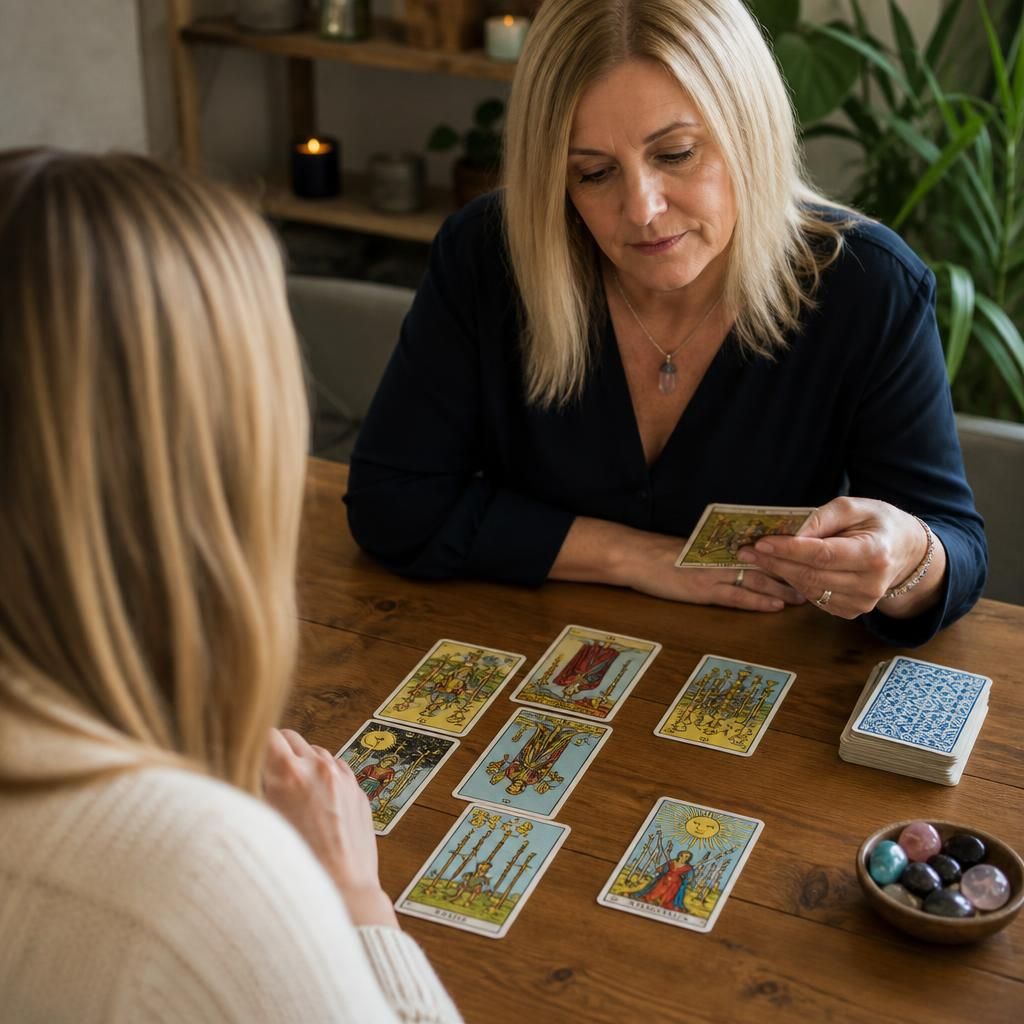
In love readings, a card is not automatically a literal prediction or a direct description of another person. It may represent a behaviour, emotional need, relationship stage or influence affecting the situation. For example, a card associated with independence could point to a need for personal space, a self-protective attitude or an unequal level of dependence, depending on its position and surrounding cards.
This distinction prevents symbolism from being treated too simplistically. A difficult-looking card does not necessarily mean that a relationship will end, just as a traditionally positive card does not guarantee lasting commitment. The reader considers how the card functions within the question: it may describe the client’s expectations, the atmosphere between two people, an obstacle to intimacy or a quality that could support healthier interaction.
Interpreting cards in this way makes a relationship reading more specific without turning it into a fixed forecast. It gives symbolic language to themes that can then be considered alongside observable behaviour, direct communication and the client’s own judgement.