




What role does the tarot reader's experience play in the accuracy and depth of a Tarot & Love Card Reading?
A tarot reader’s experience can add depth to a Tarot & Love Card Reading by helping them interpret card symbolism, relationships between cards and the context of your question with greater nuance. It may support a more coherent, personalised interpretation, but tarot is interpretive rather than a guaranteed measure of future accuracy.
A tarot reader’s experience primarily affects the quality of interpretation rather than guaranteeing a more accurate prediction. An experienced reader is usually better equipped to assess the question, select a suitable approach, notice relevant patterns and explain several possible meanings without presenting speculation as certainty. In a Tarot & Love Card Reading, this can produce a more nuanced discussion of communication, expectations, emotional patterns and potential choices.
Experience improves the reading process
Experienced readers tend to have a structured method. They may begin by clarifying whether you want insight into an existing relationship, a developing connection, a separation or your own approach to dating. This prevents a broad question from being treated as if it had one precise answer. For example, “Will this relationship work?” contains several possible issues, including compatibility, commitment, trust and timing. Separating those concerns gives the cards and the conversation a clearer purpose.
A knowledgeable reader also understands that a card should not be interpreted in isolation. Its position in a spread, relationship to surrounding cards and relevance to the question all affect its meaning. Experience helps the reader weigh these factors instead of applying a fixed definition mechanically. The same card might represent guardedness in one relationship reading, healthy boundaries in another or a need to reconsider assumptions in a third.
Depth comes from context and follow-up
Depth is not simply the number of cards used. It comes from connecting the reading to the issue being examined and asking useful follow-up questions. A skilled reader can distinguish between what the cards may suggest about your feelings, what they may reflect about relationship dynamics and what remains unknown about another person’s private thoughts.
This distinction is particularly important in love readings. Tarot cannot independently verify another person’s intentions or consent, and an experienced practitioner should avoid claiming direct access to someone else’s mind. Instead, the reading may help explore observable behaviour, recurring concerns, possible communication difficulties and the choices available to you. That approach makes the session more practical and less dependent on absolute predictions.
Experience supports balanced interpretation
Readers develop judgement through exposure to different questions, spreads and interpretive traditions. This can help them recognise when a card indicates tension rather than inevitable separation, or when a positive card still requires effort and honest communication. It also helps them explain difficult cards without treating them as proof that a relationship must end.
Good judgement includes acknowledging uncertainty. A responsible reader should separate the following:
- what the cards symbolically suggest;
- what you have directly described about the situation;
- what remains uncertain or depends on another person’s actions; and
- what practical choices you can make.
Keeping these categories distinct reduces the risk of turning an interpretation into an unsupported fact. It also gives you a clearer basis for deciding which insights are useful.
Communication skills affect usefulness
Experience is not limited to knowledge of card meanings. A reader must listen carefully, avoid leading questions and communicate in language that is understandable rather than overly dramatic or vague. They should allow room for you to correct a misunderstanding and should not use fear, pressure or claims of unavoidable outcomes to influence your decisions.
For phone and email readings, clarity is especially important. A phone consultation can allow immediate clarification of a card or question, while an email reading may provide a written interpretation that you can review later. In either format, the value depends on how carefully the reader explains the reasoning behind the interpretation and relates it to the question being explored.
How to assess a reader’s experience
When comparing readers, look for evidence of a clear and ethical approach rather than relying only on claims of being highly experienced. Useful points to consider include:
- Whether the reader explains the interpretive nature of tarot and avoids guarantees.
- Whether they invite a focused question without demanding unnecessary personal information.
- Whether they distinguish symbolism from confirmed information.
- Whether they can discuss difficult cards in a measured way.
- Whether they encourage your own judgement rather than presenting the reading as an instruction.
Experience can therefore increase the accuracy of the reading in a limited, interpretive sense: it may make the response more relevant, internally consistent and attentive to the details you provide. It cannot guarantee that a prediction will occur, determine another person’s behaviour or replace direct communication and practical decision-making. The strongest Tarot & Love Card Reading uses experience to provide context and depth while leaving responsibility for choices with the person receiving the reading.
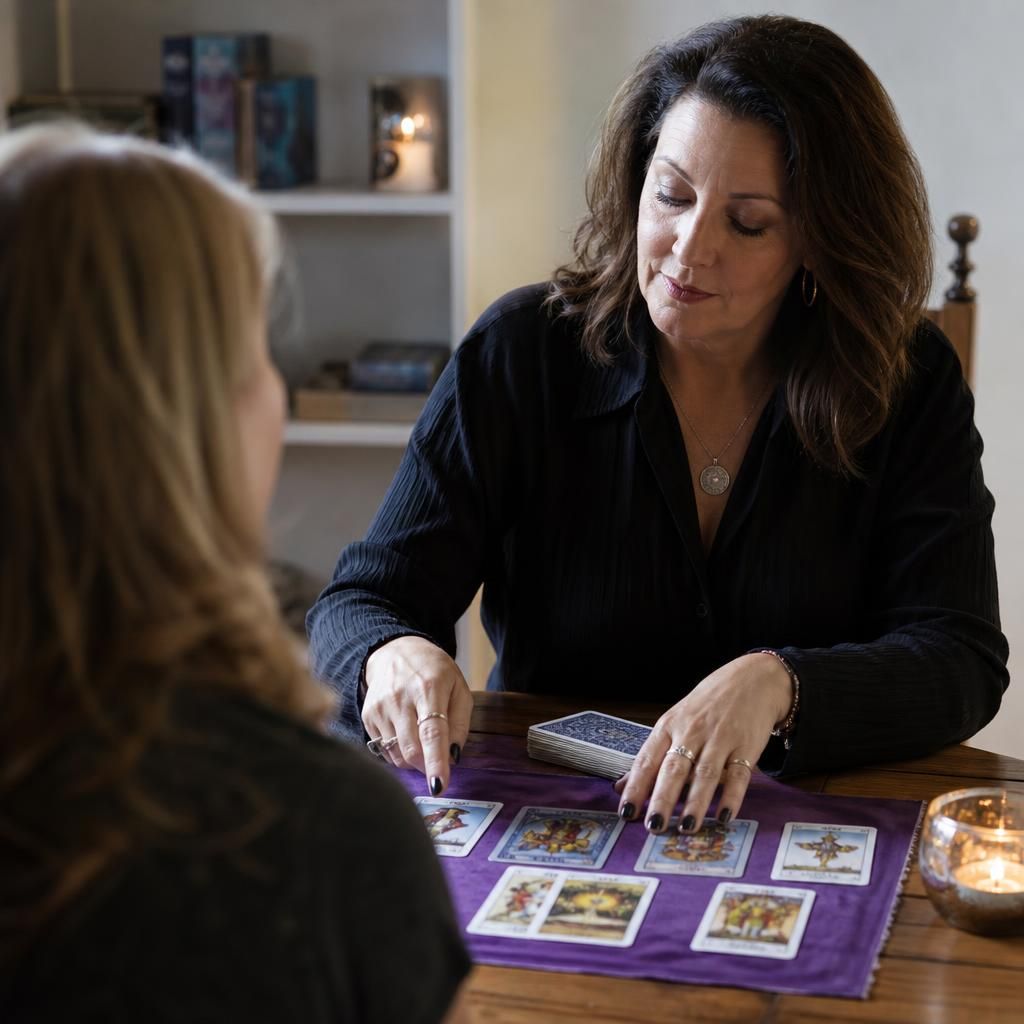
A tarot reader’s experience helps calibrate how specific an interpretation should be. Rather than forcing a definite answer from an ambiguous card, an experienced reader can judge whether the spread supports a broad theme, a possible pattern or a more focused observation. This improves interpretive accuracy by reducing false precision.
For example, a love reading may provide useful insight into recurring communication habits or competing expectations without establishing an exact outcome. A less experienced approach might treat one striking card as decisive, while a more practiced reader considers whether that meaning is supported by the wider spread and the question asked. The result is greater depth without adding unsupported detail.
This calibration also makes the reading easier to use. You can distinguish between an idea worth reflecting on, a pattern that may warrant discussion and a conclusion that cannot be established through tarot alone. Experience therefore contributes not by making every message more definite, but by helping the reader match the strength of the interpretation to what the cards and circumstances reasonably support.
Explore Your Tarot & Love Card Reading Questions
Prepare a focused relationship question and consider an individual Tarot & Love Card Reading with Elizabeth Rose Psychics to explore the themes most relevant to your situation. Choose a phone or email reading format that suits how you prefer to reflect on the interpretation.