


What should I focus on during a Tarot & Love Card Reading to gain the most beneficial insights?
During a Tarot & Love Card Reading, focus on one specific relationship concern at a time, such as communication, emotional patterns or a decision you need to make. Share relevant context and remain open to practical guidance about your choices, boundaries and personal growth rather than seeking a fixed prediction.
The most beneficial focus for a Tarot & Love Card Reading is the part of your romantic situation that you can examine honestly and act upon. Rather than treating the cards as a verdict on another person’s behaviour or feelings, use the reading to clarify your own priorities, recognise recurring dynamics and consider the choices available to you.
Begin with a clear intention. Before the reading, decide what you want to understand. Your intention might be to assess whether a relationship reflects your values, understand why you feel uncertain, prepare for an important conversation or identify what you need from a future partnership. A clear intention gives the reading a useful direction without restricting the interpretation to one expected answer.
Focus on patterns rather than isolated events. A single message, disagreement or change in mood may be difficult to interpret on its own. Tarot can be more useful when you consider the wider pattern: how trust is built, how each person responds to uncertainty, whether effort is mutual and whether your expectations are compatible. Looking at these broader themes can provide more depth than asking the cards to explain one moment in isolation.
Separate facts, assumptions and fears. Make a mental distinction between what you know, what you suspect and what you are worried might happen. This prevents anxiety from becoming the only lens through which the cards are read. You can acknowledge concerns without presenting them as established facts. If the reading produces an interpretation that differs from your initial assumption, consider it as a perspective to examine rather than evidence that either your fear or your preferred outcome must be true.
Keep your own agency at the centre. Questions framed around your responses, standards and decisions generally offer more practical value than questions seeking control over another person. This does not mean ignoring the other person’s actions; it means assessing how those actions affect your choices. Consider whether the relationship supports your stated needs, which limits are important to you and what information would help you make a considered decision.
Define the time frame you are considering. “The future” can mean the next conversation, the development of a new connection or a major long-term commitment. Identifying the relevant period helps prevent an interpretation about short-term circumstances being mistaken for a permanent conclusion. A time frame should be treated as a context for reflection, not a guarantee that events will follow a fixed schedule.
Pay attention to the relationship between cards. Individual card meanings are only one part of a reading. The position of a card, its relationship to surrounding cards and repeated symbols can alter the emphasis. Notice where the spread shows tension, support, hesitation or a need for further information. If cards appear to conflict, ask how the different messages might describe competing influences rather than selecting the interpretation that is most reassuring.
It is also useful to focus on what would help you evaluate an interpretation. During the reading, consider:
- Which part of the message relates to information you already recognise?
- Which part challenges an assumption you may have made?
- What observable behaviour or conversation could help you reflect on the interpretation?
- What would remain important to you regardless of the reading’s outcome?
These questions help you distinguish a meaningful insight from a vague statement that could apply to almost any relationship. They also keep the reading connected to real circumstances rather than allowing symbolism to replace judgement.
Leave room for follow-up clarification. If a card or combination seems unclear, ask for its relevance to the specific position in the spread. Clarification is especially important when a reading touches on commitment, separation, reconciliation or a new romantic opportunity. The aim is not to force a definite answer, but to understand the range of possible meanings and the assumptions behind them.
Finally, record the main themes and review them after the reading rather than making an immediate decision based solely on one interpretation. A Tarot & Love Card Reading can support reflection, but it cannot replace direct communication, personal judgement or attention to behaviour over time. The strongest focus is therefore a balanced one: understand the symbolic message, compare it with the facts of your situation and decide what aligns with your values and wellbeing.
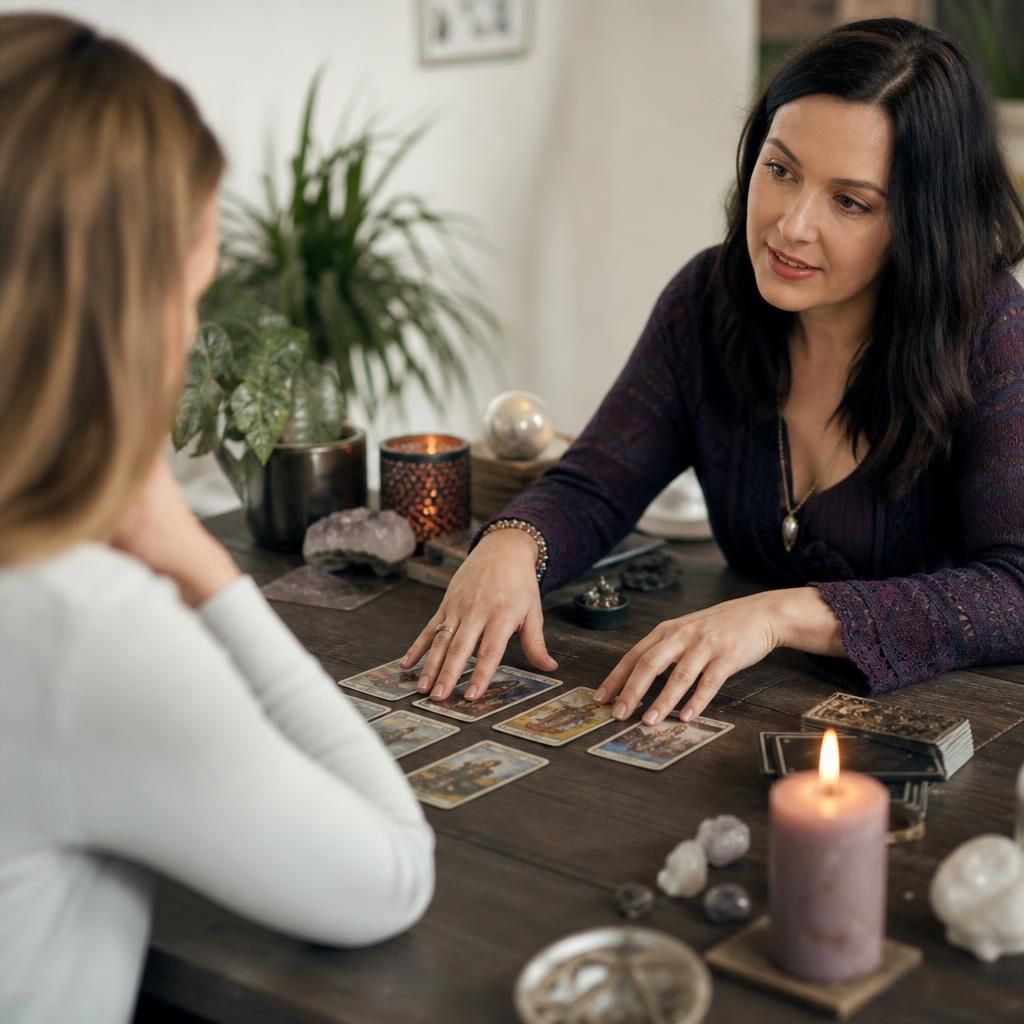
A useful focus for a Tarot & Love Card Reading is the wording of your question. Open, exploratory questions usually provide more context than questions that demand a simple yes-or-no prediction, because they allow the cards to examine influences, options and possible responses.
For example, replace “Will this person commit to me?” with “What is influencing the direction of this relationship, and what should I understand about commitment?” Instead of asking “Will we get back together?”, ask “What factors are affecting reconciliation, and what would I need to consider before pursuing it?” These formulations do not assume a particular outcome and can reveal practical considerations that a binary answer may conceal.
Keep the wording specific enough to relate to your circumstances, but open enough to allow an interpretation that differs from your expectations. If a question contains several issues, separate them into distinct prompts so that each card position has a clear purpose. This makes it easier to assess whether the reading has addressed your actual concern rather than simply confirming the answer you hoped to receive.