



What level of detail is included in a synastry reading report?
A synastry reading report typically examines how two birth charts interact, including planetary aspects, sign relationships and house overlays. It may then interpret these patterns in relation to compatibility, communication, emotional needs, relationship challenges and opportunities for personal growth.
A synastry reading report can range from a concise overview of the main chart connections to a detailed, section-by-section analysis of two natal charts. Its depth usually depends on the reading format, the astrologer’s method and the amount of interpretation provided alongside the chart calculations. A detailed report explains which connections are most influential, how they are prioritised and what they may mean for the relationship in practical terms.
Personal chart information
The report normally begins by identifying the birth details used for each chart, such as the date, place and recorded time of birth. Accurate information is particularly important when the interpretation involves chart angles or house placement. If a birth time is uncertain, the report may need to distinguish between findings that are more dependable and those that could change with a revised time.
Technical chart analysis
A more comprehensive report may include an aspect table or a written explanation of the angular relationships between planets and other significant points. This can show:
- which planets are connected;
- the type of aspect formed, such as a conjunction, trine, square, opposition or sextile;
- whether the connection is close or relatively wide;
- which person’s planet is involved and how the interaction is interpreted;
- whether repeated patterns appear across several parts of the comparison.
The closeness of an aspect, often described using its orb, can affect how prominently it is treated. Reports may also give greater weight to aspects involving the Sun, Moon, personal planets, chart angles or other points selected by the astrologer. This prevents a long list of minor connections from obscuring the patterns considered most relevant.
Interpretation of important themes
Rather than treating every connection as equally significant, a detailed report usually groups the findings into themes. It may explain how the charts relate to attraction, trust, boundaries, conflict styles, shared priorities and the way each person responds to closeness or independence. These interpretations should describe tendencies and possible dynamics, not present a relationship outcome as certain.
The report may also distinguish between supportive and demanding patterns. Supportive features can indicate areas where understanding comes more naturally, while challenging features may highlight subjects that require patience, clear communication or negotiated boundaries. A useful interpretation explains both sides: a difficult connection is not automatically a sign that a relationship cannot work, and an easy connection does not remove the need for honest communication.
Relative importance and synthesis
The most valuable part of a report is often the synthesis at the end of the analysis. Individual aspects can appear contradictory when read in isolation. For example, one pattern may suggest ease and familiarity while another points to different expectations or pressures. A well-organised report brings these observations together, explains which patterns appear dominant and separates recurring themes from isolated details.
This concluding section may identify the relationship’s main areas of ease, potential friction and development. It should avoid reducing the reading to a simple score or verdict, because astrology does not measure a relationship in the same way as a scientific compatibility test. Instead, the report offers an interpretive framework for considering how two people may interact and where greater awareness could be useful.
Additional details that may be included
Depending on the scope of the report, the astrologer may examine chart angles, lunar nodes, Chiron, selected asteroids, retrograde planets or links involving house rulers. These additions can provide more nuance, but they are not always necessary for a clear reading. Including every available point does not automatically make a report more accurate or more useful.
Some reports also separate observations into sections for each person, explaining how one individual may experience the other’s placements. Others organise the material by topic, such as attraction, emotional responses or long-term stability. Neither structure is inherently better; clarity depends on whether the explanation shows how the different findings fit together.
What a detailed report does not provide
A synastry report is not a guarantee of permanence, a substitute for relationship counselling or a factual prediction of another person’s behaviour. It cannot establish someone’s intentions independently of their words and actions. Its purpose is to offer symbolic interpretation and prompts for reflection, allowing readers to consider recurring patterns with a more structured perspective.
Before requesting a report, it is sensible to check whether it is written, spoken or provided in a combined format; which chart factors are covered; whether follow-up questions are included; and how uncertain birth times are handled. These details make it easier to judge the level of depth offered and whether it matches the kind of insight being sought.
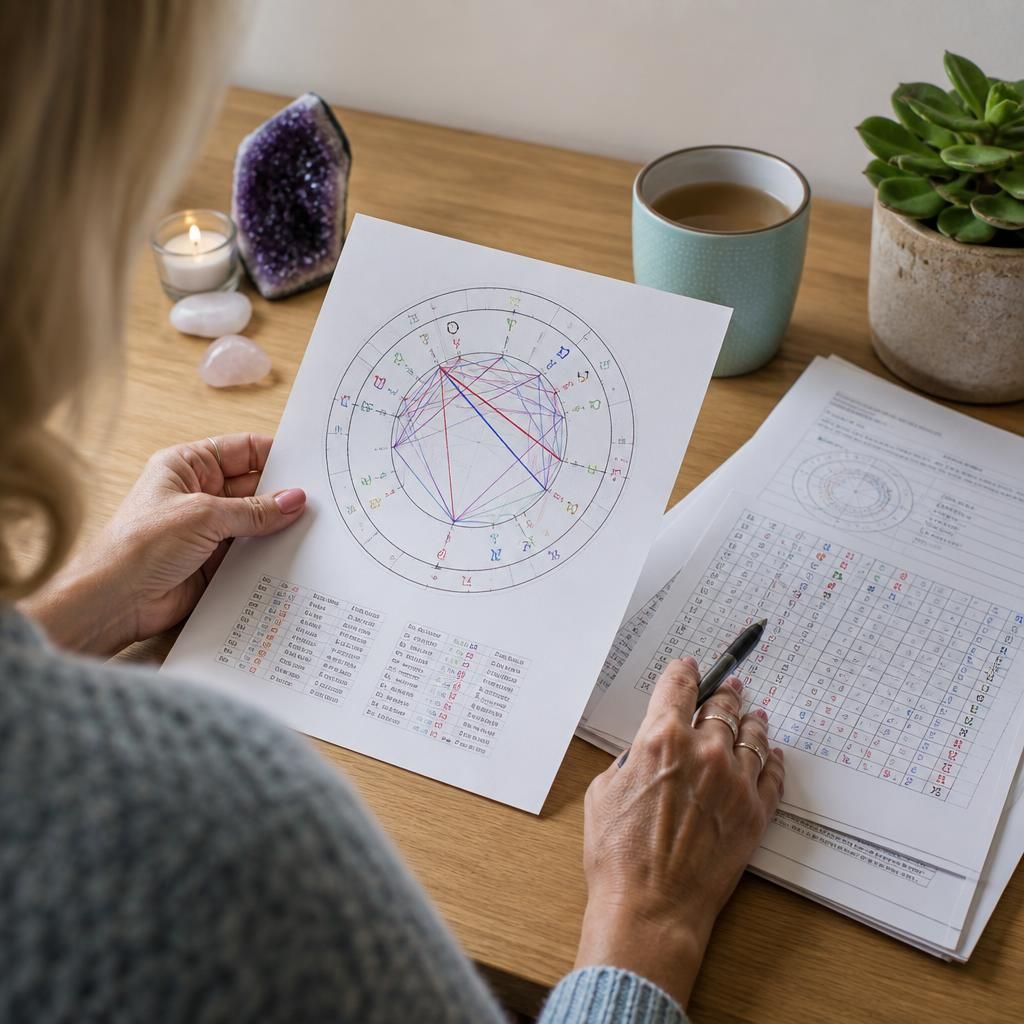
Part of a synastry reading report’s detail may lie in how clearly its technical material is presented. Alongside the written interpretation, it may include a chart wheel, aspect grid, symbols for planets and signs, and a short legend explaining the notation. Some reports also add a glossary for terms such as orb, retrograde and house cusp, helping the reader follow the analysis without translating every item separately.
- A chart wheel shows where each person’s planets fall in relation to the other chart.
- An aspect grid provides a visual reference for the connections discussed in the text.
- Labels or annotations can identify the placements and aspects considered most relevant.
- A contents page or clearly separated sections can make a lengthy report easier to navigate.
These features improve usability, but a larger chart image or longer technical appendix does not automatically mean the report contains deeper insight. The important distinction is whether the supporting material helps the reader understand the interpretation rather than simply adding more symbols or data.
Explore Your Synastry Reading Report Options
If you have reviewed the typical contents of a synastry report, consider requesting a reading tailored to the two birth charts and the relationship questions you want to explore. Elizabeth Rose Psychics provides personalised synastry guidance by phone and email.