





How do clairvoyant psychic vision readings differ from other types of psychic consultations?
Clairvoyant psychic vision readings are based primarily on intuitive visual impressions received by the reader, whereas tarot consultations interpret card symbolism, mediumship focuses on communication with spirits, and astrology examines birth charts and planetary influences. The main difference is the source and method used to explore a question, although some consultations may combine approaches.
Clairvoyant psychic vision readings differ from other psychic consultations mainly in how information is received, explored and communicated. They tend to centre on the reader’s visual impressions and the meaning those impressions may have for the client, while other approaches rely on a different structure, such as a spread of cards, a birth chart or a purported connection with a deceased person.
The consultation is often more open-ended. A clairvoyant reading does not necessarily require a fixed system or a predetermined sequence of symbols. The discussion may develop from the impressions that arise during the session and from the details the client chooses to share. This can make the conversation feel exploratory, particularly when the client has a broad concern rather than one narrowly defined question.
By contrast, tarot consultations usually have a visible framework: the selected cards, their positions and the relationship between them provide the material for interpretation. Astrology consultations are commonly organised around chart details and particular planetary patterns. Mediumship has a different purpose again, with the discussion generally centred on messages or signs associated with someone who has died. These distinctions affect not only the information offered, but also the way the client participates in the session.
The form of the information can also vary. Clairvoyant impressions may be described as scenes, colours, places, people, objects or brief visual symbols. Their meaning is not always literal. A picture of a doorway, for example, might be discussed as a possible symbol of a decision, transition or opportunity rather than treated as a prediction that a particular physical door will appear. The reader and client may consider the impression alongside the question, circumstances and emotions involved.
Other consultations may give the client a more established interpretive vocabulary. A tarot card has recognised associations, although its meaning changes according to its position and context. An astrological chart offers a technical structure for discussing tendencies, cycles and areas of emphasis. In mediumship, the perceived relevance of a message may depend on whether the client recognises a person, memory or detail. Clairvoyant work is therefore often less about applying a standard reference system and more about examining the significance of individual impressions.
The handling of time is another possible difference. A clairvoyant reading may explore the present situation, likely developments and the choices influencing an outcome. It should not be understood as establishing an unavoidable future. Personal decisions, changing circumstances and incomplete information can all affect how a situation develops. A responsible consultation presents impressions as material for reflection rather than as a substitute for judgement.
Different methods may frame time in other ways. Astrology can be used to discuss broader periods or recurring patterns associated with planetary movements, while tarot may examine the circumstances surrounding a particular question or decision. Mediumship is not primarily a forecasting method, as its central focus is usually communication and meaning connected with the deceased. These are differences in emphasis, not a ranking of one method above another.
The client’s question influences which approach is most useful. A clairvoyant session may suit someone who wants to explore an evolving situation without reducing it to a single yes-or-no answer. It may also be appropriate where the client wishes to discuss visual impressions, personal symbolism or the wider context around a concern. Someone looking for a structured examination of relationship dynamics, timing or personal patterns may instead prefer a method whose format is designed around those themes.
- For an open personal concern: clairvoyant work can provide a conversational way to examine impressions and possible meanings.
- For a structured decision: tarot may offer a defined spread through which different influences or options can be considered.
- For recurring patterns and longer cycles: astrology can provide a chart-based framework for discussion.
- For questions connected with someone who has died: mediumship is the consultation type normally associated with that purpose.
These categories are not absolute. A reader may combine clairvoyance with tarot, astrology or mediumship, provided the basis of each part of the consultation is explained clearly. A blended session can offer several perspectives, but it may also make it harder to tell which method supports a particular observation. Asking the reader to distinguish direct impressions from card interpretation, chart analysis or personal reflection can make the conversation easier to understand.
The quality of a reading should be judged by clarity and professional boundaries, not by dramatic detail. Useful questions include: What does the reader mean by an impression? Is it being offered as a possibility or a certainty? Can the client ask for clarification? Does the reader acknowledge uncertainty? A trustworthy consultation should not pressure someone into accepting a statement, making an urgent decision or paying for additional services to prevent an alleged negative outcome.
Elizabeth Rose Psychics provides consultations focused on clairvoyance, mediumship, tarot and astrology by phone and email. The appropriate choice depends on the question, the type of interpretation the client prefers and whether a single method or a clearly explained combination is wanted. Whatever the approach, a psychic consultation is best used as a reflective source of guidance rather than as professional medical, legal or financial advice.
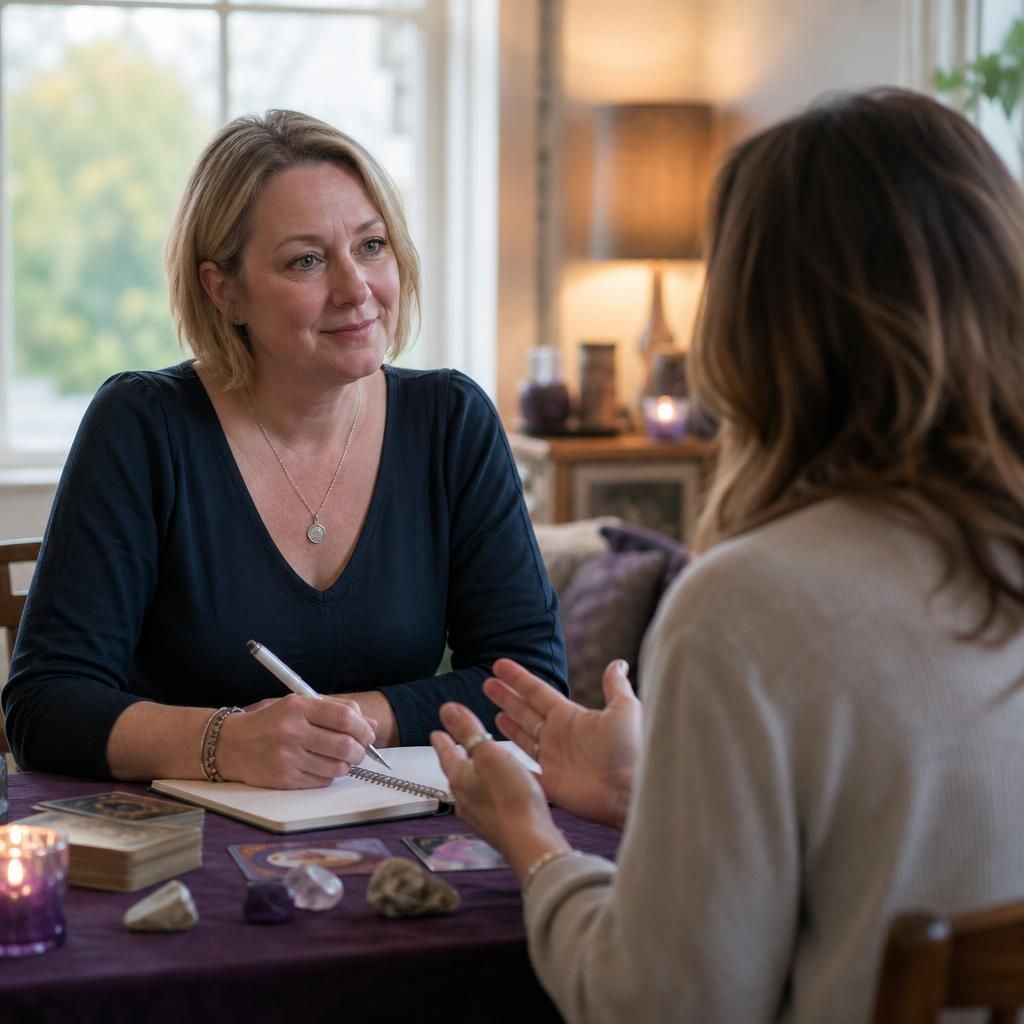
One practical difference is whether the consultation produces a fixed reference that can be reviewed afterwards. A clairvoyant vision reading may centre on impressions described during the conversation, so the useful record is often the client’s notes about the images, interpretations and questions discussed.
Tarot consultations can usually be revisited through the cards drawn and their positions in the spread. Astrology provides a chart that can be examined alongside the reader’s interpretation, while mediumship may be remembered through the specific messages or details shared. These records do not prove that an interpretation is accurate, but they can make the method used and the reasoning behind it easier to distinguish.
For that reason, it is sensible to ask a clairvoyant reader to separate the initial visual impression from any suggested meaning. Recording the wording, noting what was uncertain and reflecting on the discussion later can help prevent a symbolic image from being treated as a definite fact.