


How do moon phases influence emotions in astrology love readings?
In astrology love readings, moon phases are interpreted as symbolic indicators of changing emotional needs, relationship focus and patterns of closeness or reflection. By comparing the current lunar phase with the birth charts of those involved, a reading may explore when feelings are more expressive, private, responsive or ready for emotional reassessment.
In astrology love readings, moon phases provide a symbolic framework for understanding shifts in emotional attention, intimacy and relationship behaviour. They are not generally treated as fixed causes of events or as guarantees about what a partner will do. Instead, the phase can add timing and context to the birth-chart factors already associated with feelings, attachment and communication.
The lunar cycle is commonly read as a process of emotional development:
- New Moon: A period associated with beginnings, intention-setting and inward consideration. In a relationship reading, it may draw attention to what someone wants to establish or change emotionally.
- Waxing Crescent: This phase is linked with gradual development. It can symbolise tentative openness, growing interest or the need to allow trust to build rather than demanding immediate certainty.
- First Quarter: The first quarter is often interpreted as a point of decision and effort. Relationship concerns may become more apparent, encouraging direct choices about boundaries, priorities or shared responsibilities.
- Waxing Gibbous: This phase is associated with refinement. A reading may use it to examine expectations, recurring reactions and the adjustments needed before a relationship reaches greater clarity.
- Full Moon: The full moon represents visibility and culmination in symbolic astrology. Feelings that have been developing may seem more difficult to ignore, making it a useful phase for examining emotional honesty, attraction or unresolved tension.
- Waning Gibbous: This phase often relates to reflection and integration. It can highlight what a person has learnt from a recent emotional experience and which conclusions may need to be discussed with a partner.
- Last Quarter: The last quarter is commonly connected with reassessment and release. In love readings, it may focus attention on habits, assumptions or commitments that no longer support a healthy dynamic.
- Waning Crescent: This closing phase is associated with rest, completion and preparation for a new cycle. It may be used to consider forgiveness, emotional recovery or the value of pausing before making another decision.
Astrologers also consider the sign occupied by the Moon. A lunar phase in a fire sign may be interpreted through initiative and direct expression, whereas a phase in an earth sign may place more emphasis on security and practical reliability. Air signs can bring communication and perspective to the foreground, while water signs are traditionally associated with sensitivity, attachment and emotional absorption. These are broad symbolic tendencies, not descriptions that apply identically to everyone.
The Moon’s relationship to the natal chart adds further detail. For example, a phase forming a notable aspect to a person’s natal Moon may be read as especially relevant to their established emotional responses. Contact with Venus can shift the focus towards affection, pleasure and relationship values; contact with Mars may raise questions about desire, irritation or conflict; and contact with Saturn can invite examination of responsibility, distance or durability. The interpretation depends on the planet, aspect, sign and house involved rather than on the phase alone.
In a partnership reading, the same lunar phase may affect two people differently. One person’s chart may make the period symbolically relevant to emotional security, while the other person’s chart may connect it with communication or personal independence. This is why a sound interpretation avoids assigning a single mood to both partners. It examines how each person may process closeness, uncertainty and change, then considers how those patterns interact.
Moon phases can also help organise the timing of relationship questions without claiming to predict a definite outcome. A reader might compare the symbolism of a recent full moon with a period of heightened disagreement, or use a waning phase to explore what should be reviewed after an important conversation. The purpose is to identify themes and possible responses, not to replace direct communication or factual knowledge about the relationship.
When interpreting lunar symbolism, it is useful to distinguish emotional awareness from emotional action. A phase may suggest that feelings deserve attention, but it does not determine whether someone will apologise, commit, withdraw or end a relationship. Those choices are influenced by personality, circumstances, communication skills and consent. Astrological interpretation is therefore most constructive when it generates practical questions such as:
- What feeling has become more noticeable, and what may have triggered it?
- Is the current reaction connected to the present situation or to an older pattern?
- What does each partner need in order to feel heard and respected?
- Which expectation should be clarified rather than assumed?
- Would reflection, discussion or a clear boundary be the most appropriate next step?
Moon phases are best understood as one layer of an astrology love reading. The natal Moon, Venus, Mars, the seventh house and significant aspects generally provide the relationship framework, while the current lunar cycle can show which emotional themes are receiving attention. Used in this way, lunar symbolism can support self-observation and more considered relationship decisions without presenting astrology as a substitute for honest conversation, professional health advice or independent judgement.
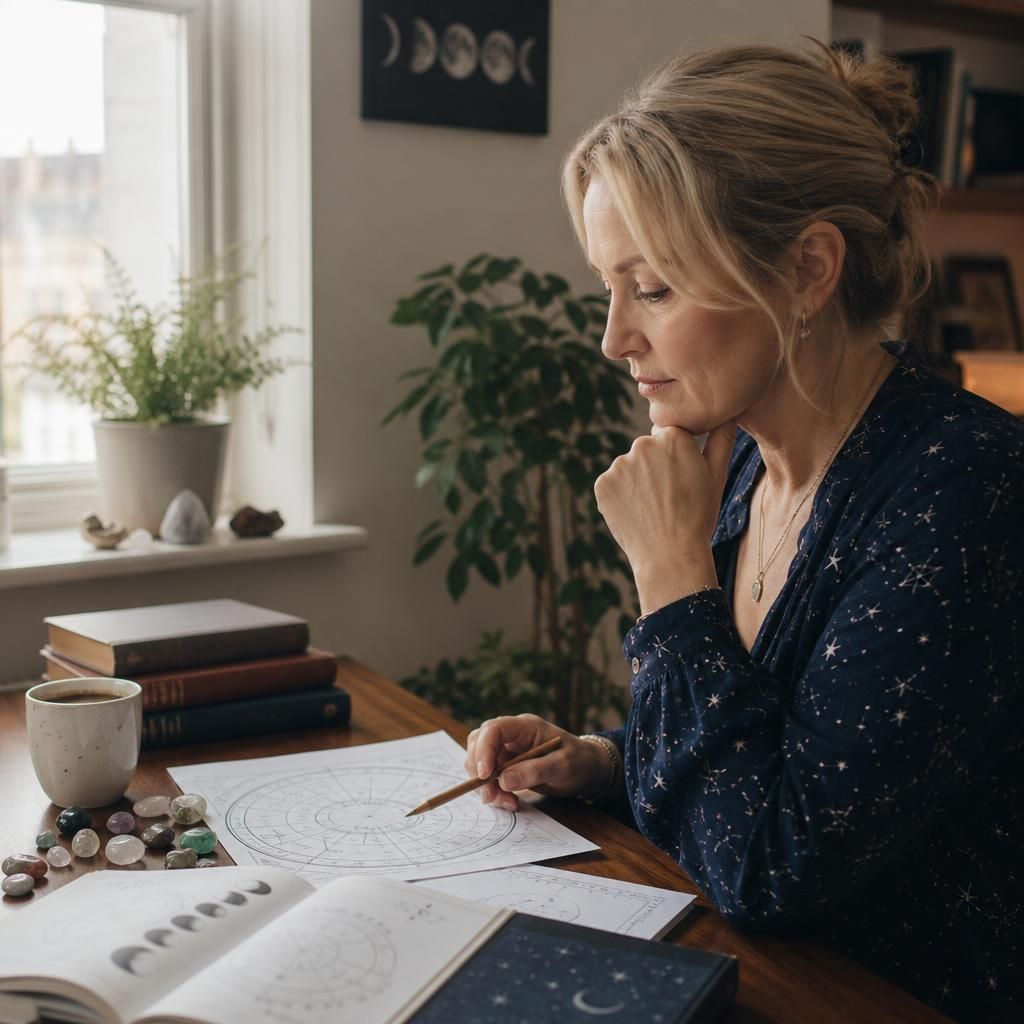
In astrology, a moon phase describes the Moon’s changing relationship with the Sun, represented by the amount of lunar light visible from Earth. In an astrology love reading, this astronomical cycle is interpreted symbolically rather than as a direct cause of a particular mood or relationship event.
The visible shape of the Moon should not be treated as a measure of emotional intensity. A bright full moon does not automatically indicate stronger love, and a dark new moon does not mean that affection is absent. The phase instead supplies a symbolic backdrop for examining how feelings are being expressed, contained or reconsidered within the wider chart.
- Illumination: how much of a feeling or relationship issue is becoming apparent.
- Growth or decline: whether attention is gathering around a matter or gradually moving away from it.
- Cycle: whether the situation is being approached as a beginning, continuation or point of completion.
This distinction helps keep lunar symbolism proportionate. The phase can frame a question about emotional awareness, but the meaning of that question comes from the individual charts and the circumstances being discussed.