







What are the benefits of understanding my astrological chart?
Understanding your astrological chart can help you identify recurring patterns in your personality, motivations, relationships and decision-making. It provides a structured framework for reflecting on personal strengths, challenges and life priorities, supporting more informed choices rather than predicting fixed outcomes.
Understanding your astrological chart gives you a structured symbolic map of the sky at the time and place of your birth. Its main benefit is that it brings together planetary placements, signs, houses and aspects, allowing these features to be interpreted as a connected system rather than as isolated horoscope statements.
It can help you understand the different parts of an astrological interpretation. A planet represents a particular function, a sign describes how that function may be expressed, and a house indicates the area of life associated with it. Aspects show how planetary influences relate to one another. Learning this structure makes a reading easier to follow and helps you distinguish between a broad sun-sign description and a more individualised natal chart analysis.
A chart can provide useful language for personal reflection. Astrological terms may help you describe tensions such as wanting independence while also seeking reassurance, or valuing stability while feeling drawn towards change. This does not prove that a particular trait or experience is caused by a planetary position. Rather, the chart can act as a framework for considering questions you may not have expressed clearly before.
It can clarify the relative emphasis within a chart. A reading may consider whether certain elements, qualities, planets or houses are especially prominent. This broader view prevents one placement from being treated as a complete description of a person. For example, a placement commonly associated with direct expression may be moderated by other chart factors connected with caution, sensitivity or practicality.
It can support more nuanced relationship reflection. Comparing relevant parts of two charts, sometimes called synastry, may highlight differences in communication styles, emotional needs and approaches to commitment. The value lies in identifying subjects for discussion and mutual understanding, not in treating planetary comparisons as proof that a relationship will succeed or fail.
It can help you use timing techniques more carefully. Transits and other forecasting methods compare current planetary movements with the natal chart. Understanding the underlying chart gives this information a stable reference point. Timing should be treated as an opportunity to consider themes and prepare questions, rather than as a guarantee that a specific event will occur.
It can make consultations more focused. When you know the basic structure of your chart, you can ask more precise questions about a particular placement, house, aspect or period of change. You can also record interpretations over time and compare them with your own observations, instead of relying on a general statement without context.
- For personal development: use the chart to identify areas worth examining, such as boundaries, communication or confidence.
- For relationships: use it to frame conversations about differing needs and habits, without assigning blame to a sign or planet.
- For work and direction: use relevant chart themes to explore preferences and working conditions, while weighing them against skills, experience and practical circumstances.
- For future planning: use timing interpretations as prompts for reflection, not as substitutes for evidence-based decisions or professional advice.
Astrology is an interpretive and metaphysical practice, not a scientifically established method for diagnosing health conditions, proving personality traits or predicting fixed events. A chart is therefore most constructive when treated as a reflective tool. It should complement, rather than replace, medical, financial, legal or mental-health guidance where those forms of expertise are needed.
An astrology reading can explain how the chart’s components are usually interpreted and how they may interact in your particular chart. Elizabeth Rose Psychics provides astrology readings by phone and email for people who want personalised guidance while exploring these symbolic themes.
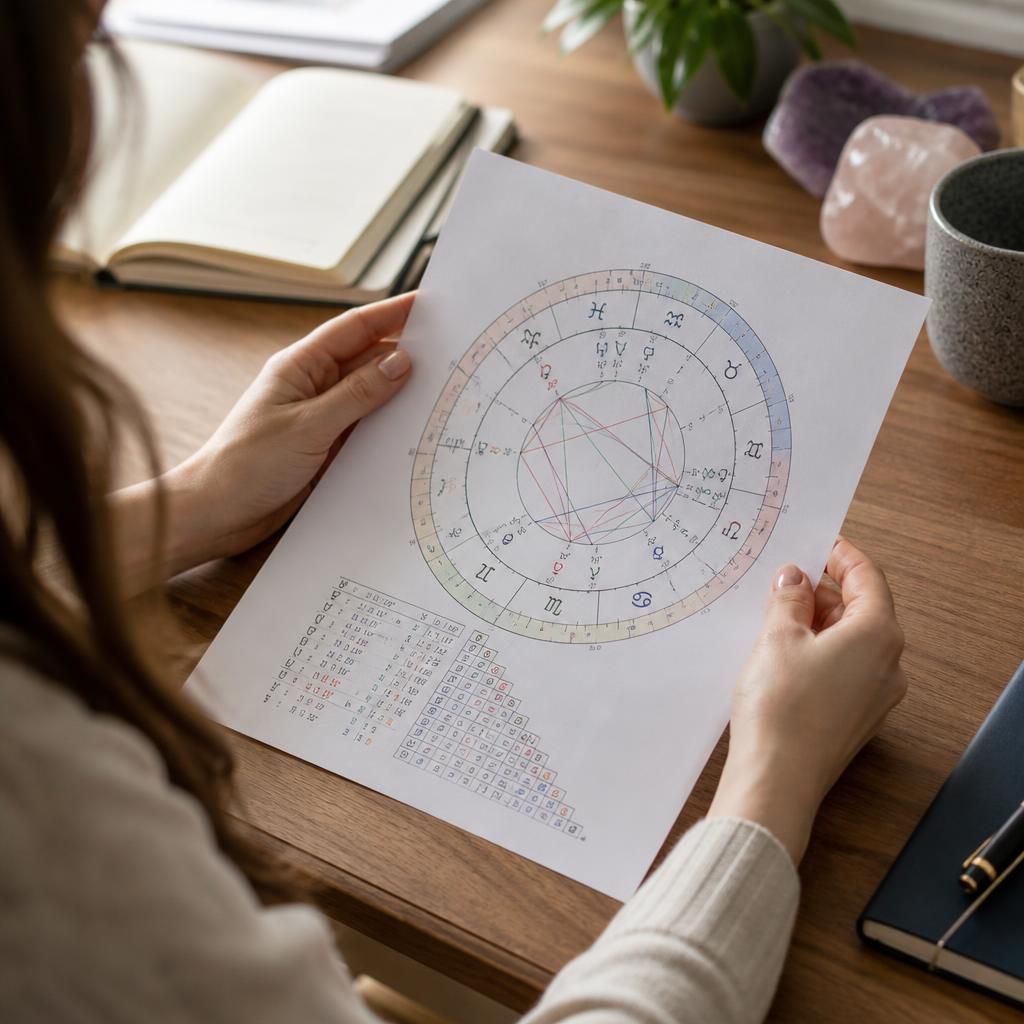
Understanding your astrological chart also helps you assess how reliable and specific an interpretation can be. A natal chart is calculated from your birth date, location and, where available, exact birth time. The birth time is particularly important because the ascendant and house cusps can change, so an uncertain time may limit the precision of those parts of the reading.
Knowing this allows you to separate firmly established chart details from interpretations that depend on incomplete information. It also helps you ask whether a reading is based on the full chart or only on a single sign or placement. This context makes astrological guidance easier to evaluate and prevents broad statements from being treated as a complete account of your circumstances.